RATO MID FREQUENCY
Social Death Beyond Blackness
When I go to the Eastern Cape, there were two elders I would always make a point to visit, even if my journey was overshadowed by the grim obligations of a funeral. Leaving without sitting with them never felt right, as if the trip would be incomplete without their wisdom. With them, I didn’t just converse; I entered a world where words carried histories, and Xhosa vocabulary, rich, arcane, and unspoken in the cities, was resurrected with each syllable.
I write this now in the aftermath of the old man’s passing earlier this year. His absence is heavy, leaving only the old woman still standing against time, though diminished by its relentless erosion. Not so long ago, she and I had a conversation that continues to echo in my mind.
I asked why she hadn’t been at the preparations for a ceremony at my home. Her reply was both simple and devastating:
“People as old as me are only called when needed; otherwise, we don’t really exist.”
Her words carried the weight of a life confined by a social order that discards when it no longer consumes. I pushed her to explain further. She said that at a certain age, it’s as though you’ve already died. Society demands your disappearance not literally but functionally. You are a relic, a shadow of what once was, a placeholder in a world that no longer finds utility in your being.
Her description struck me as a chilling articulation of social death, a condition that exists at the edges of life, where existence becomes spectral. The elder becomes an apparition in the communal psyche, animated only when summoned for tradition or necessity, otherwise left to dissolve into irrelevance.
Her testimony reminded me that social death is not confined to the lexicon of the enslaved and colonized, though it finds its most grotesque embodiment there. It is the condition of those rendered surplus to the needs of a world obsessed with utility, production, and the performance of vitality. It is a mode of disappearance, where one remains alive yet is rendered inanimate by the gaze of the living world.
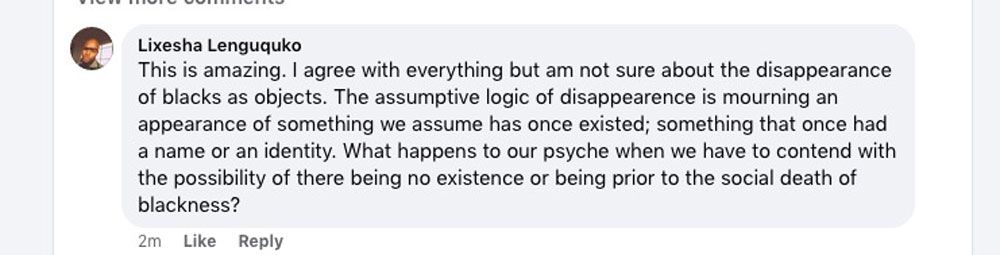
In Afro-pessimism, social death is central to understanding Blackness as a position of ontological non-being. The enslaved did not merely lose freedom; they were ejected from the human order, denied kinship, and subjected to a violence so profound that it reduced them to fungible objects. The elder’s lament reminded me that this fungibility is not confined to the plantation or its afterlives but seeps into the structures of modernity in ways both subtle and overt.
Elders confined to the periphery of social life. Prisoners interred within carceral tombs. Patients battling terminal illnesses, their identities replaced by medical charts and diagnoses. These are manifestations of a world structured to extinguish those who no longer serve its purposes. The gaze of society looks past them, and in that gaze, they cease to exist.
The elder’s words, “we don’t really exist,” are a haunting reminder of how death begins long before the body succumbs. It is a process, a slow unraveling of one’s place in the world. Social death is not merely exclusion; it is the active erasure of being, the severing of the ties that anchor a person to the world. It is the realization that life, for many, is conditional, granted only as long as it is needed, desired, or seen as useful.
This conversation lingers in my mind as a confrontation with the cruel mechanisms of a society that celebrates life while discarding the living. It forces me to ask: how do we reckon with a world that devours, consumes, and discards? How do we confront the fact that so many live among us as ghosts, waiting for a death that has already begun?