OSCAR HEMER
16 October 2025
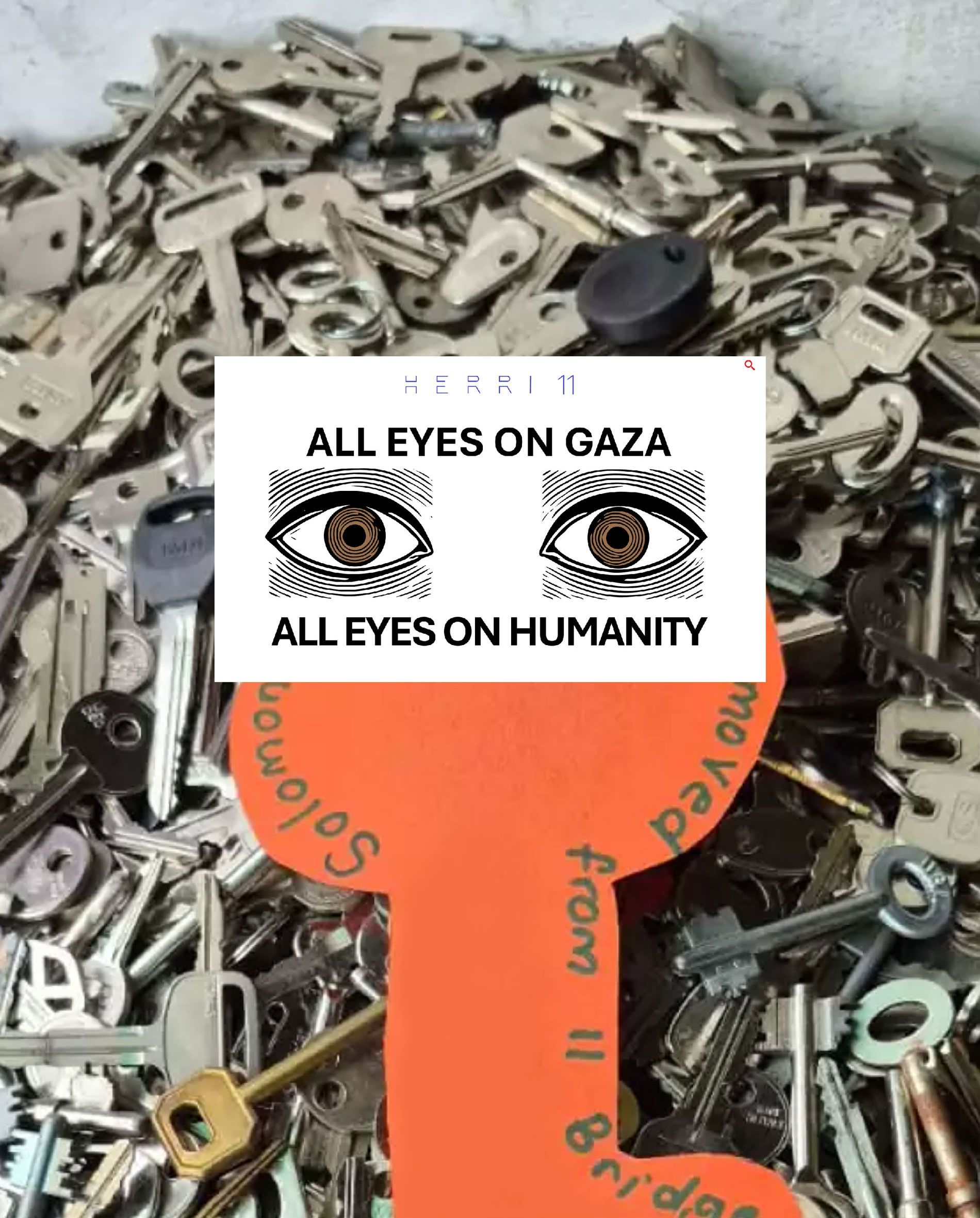
Does anyone think that holding another demonstration or signing another petition will forestall the destruction of Gaza City as planned for September 2025? Writer Imraan Coovadia asks the rhetorical question in the latest issue of the outstanding South African multimedia magazine herri (#11), which is entirely devoted to Gaza. Afterwards, he continues, the architects, financiers and guardians of Gaza’s “death-world” (Achille Mbembe’s term) will still be in place and we will have to live with them in some way – and with ourselves, although we didn’t manage to pause the killing for a single day.
Living with former perpetrators and accomplices is an almost universal human experience, not only in Germany, Spain, Cambodia, South Africa and other countries that have more and less profoundly come to terms with their traumatic past. But being forced to live with states and regimes that committed genocide and got away with it is something else, although not new. Turkey was never punished for the systematic murder of one and a half million Armenians, Assyrians, Syrians and Chaldeans, but it is difficult to hold Erdogan or any other living Turk responsible for what happened more than a hundred years ago. However, a parallel can be drawn between Putin’s Russia’s forced adoptions of Ukrainian children and the Holodomor, Stalin’s orchestrated mass famine. Whether Putin will ever be held accountable remains to be seen. Russia is in any case subject to significant sanctions.
Israel’s crimes against humanity in Gaza and the West Bank are not only taking place in real time but are being broadcast live while the world watches – or looks away. Netanyahu’s murderous regime can count on the full support of the US, regardless of who is in the White House. A divided EU cannot even agree to “put pressure” on its ally to let in emergency aid after the bombings

South Africa, on the other hand, has acted decisively by bringing the Netanyahu regime before the war crimes tribunal in The Hague. There are several reasons why South Africa feels special ties to Palestine. The most important is its own experience of apartheid and a struggle against a military and political supremacy that for a long time seemed hopeless.
South Africans with experience of their own country’s dramatic – certainly not unproblematic – transformation not only have the authority to speak out about Gaza; they feel a duty to do so. Among the more than eighty contributors to this unusually well-fed special issue are scarred anti-apartheid fighters like Pastor Allan Boesak, internationally renowned artists like Candice Breitz and Tracey Rose, and a host of younger writers, artists, academics and activists.
Steven Robins, author of Letters of Stone: From Nazi Germany to South Africa, describes how an abstracted and context-free “anti-Semitism” has become a pretext for stifling academic freedom not only in the United States and Europe but also in South Africa. herri’s curator the multi-artist Aryan Kaganof, views the violence in Gaza through a lens that combines the “Afro-pessimism” thesis of structural powerlessness and neglect with the less defeatist analysis represented by thinkers like Anna Tsing.
What has come to be called “decay studies” also looks at what happens after the destruction. Decay is not just a process of rotting, but also transformation in which new ecologies arise.
According to Tsing, hope for the future sprouts in the ruins of global capitalism. Although it is difficult and even offensive to try to discern hope in the traditional sense in today’s Gaza, Kaganof nevertheless sees something hopeful in Gaza’s refusal to disappear. To insist on the obstinacy of life, even when stripped of futurity; to remain, even in fragments, is a kind of counter-spell. A refusal to be unspoken.
Not all analyses are equally nuanced, but the collective expressive power of herri’s manifestation is enormous. It comes from solidarity – an almost forgotten concept – and precisely the feeling of necessity.
Comparing the apartheid states of South Africa and Israel was only a few years ago considered just as offensive as the grotesque comparison with Nazi Germany. From a South African perspective, the parallel is obvious, and thus also how the outside world should act.
Allan Boesak calls for a boycott and isolation of Israel in the same way as South Africa was boycotted and isolated forty years ago.
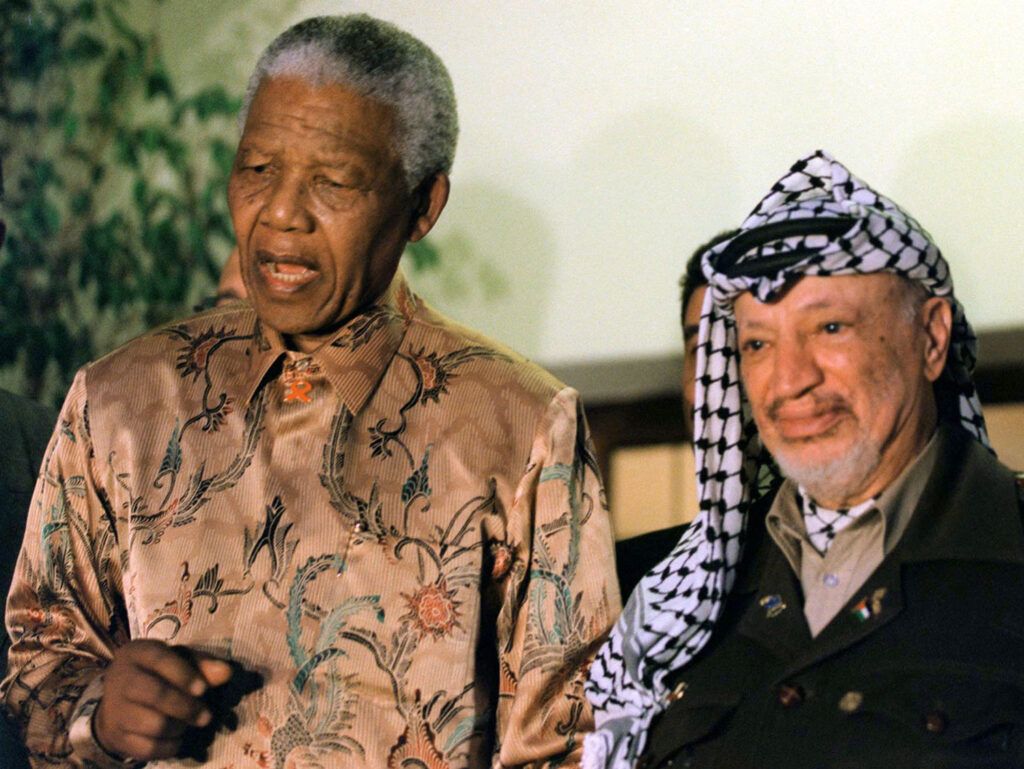
What he seems to forget, however, is that the Western world was divided even then. Remember that Margaret Thatcher called Nelson Mandela a “terrorist”. Nor were the sanctions the cause of the apartheid regime’s fall, but the end of the Cold War and the collapse of the Soviet Union. South Africa’s peaceful transition to democracy could probably only have occurred during the historical parenthesis of the nineties.