MZOXOLO VIMBA
The weight of the sack: Hessian, history and new meaning in Tshepo Sizwe Phokojoe’s “The Gods Must be Crazy” exhibition.
Tshepo Sizwe Phokojoe’s “The Gods Must Be Crazy” is a homecoming. A necessary meeting with memory, to understand what time has unravelled. But what do we do when time unravels the truth and the truth is impossible to bear? Tshepo Phokojoe seeks to understand the history of South African townships, through the Khoi-Sans and their Gunaib and the Tsu-gaib mythology. He is searching for new ways of understanding what it means to have to exist in spaces where violence is the only language, where the mere act of breathing is nothing but a struggle.
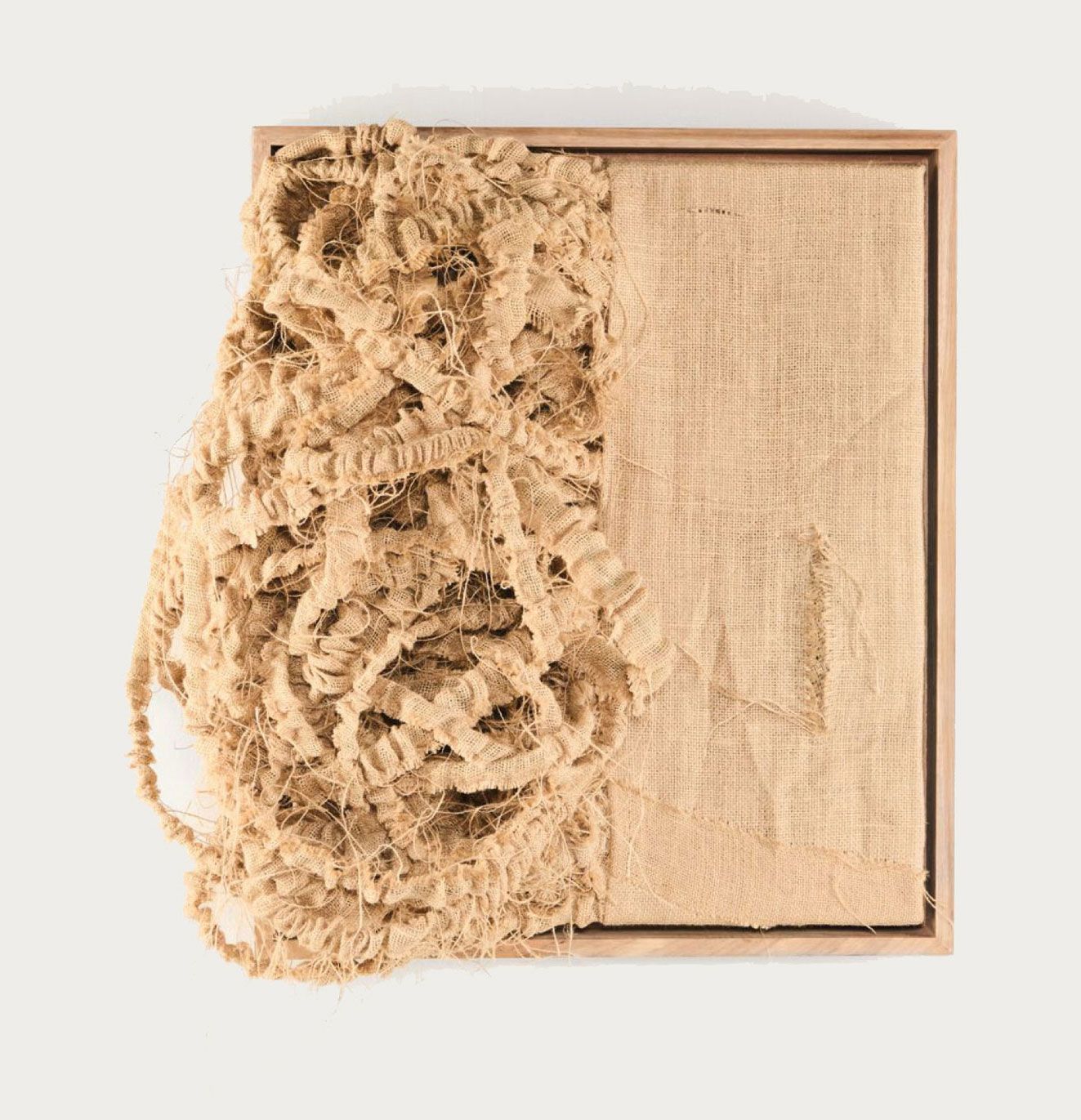
The exhibition is curated in a way that appreciates that the creation of the present is based on history. It wants to bear testimony to the fact that the future or newness draws from the old/past. It almost aligns with the Sankofa metaphor: to look at the past to make sense of what our tomorrow might look like. But there is a certain skepticism that the exhibition brings forth. It boldly suggests that we cannot fully trust history; it is sometimes unreliable. Look at how it is interpreted differently based on different contexts, and look at how it is vulnerable to erasure and manipulation. The project forces us to look at history not as fact but as what we decide to make of it.
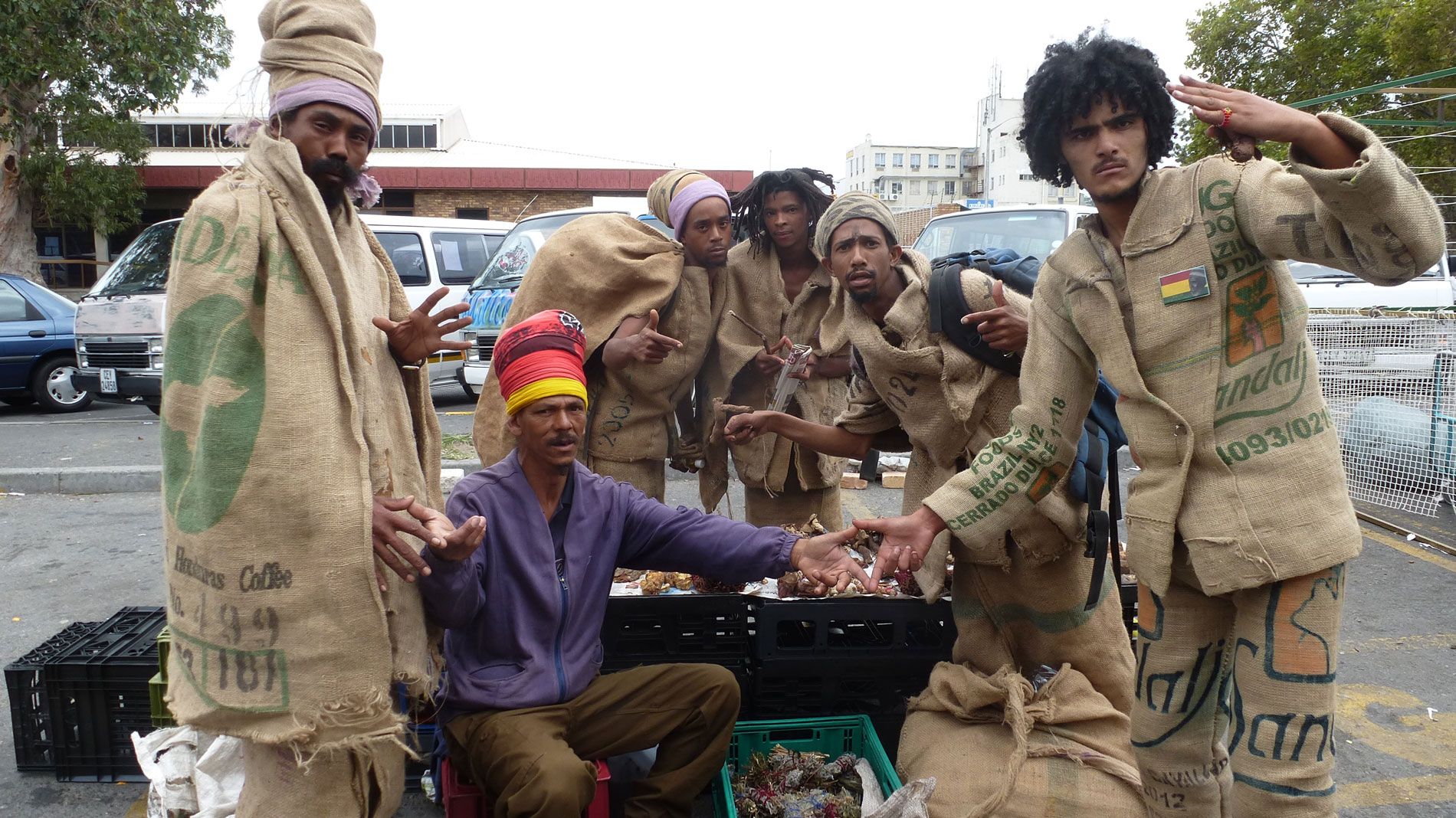
The exhibition takes a closer look at the Sakmanne: herbalists, who usually live in mountains and insist on living based on ancient principles similar to those of the Khoi and the San. The Sakmanne also exist in different geographies, and their names vary depending on where they are. The commonality is their way of life, a way that insists on harmony, peace and respect for nature in a world that thrives on cruelty, exploitation and ruin. The Sakman is a man in protest, a man that insists that in this decaying world there are still traces of life. The name “sakman” is mostly used in Cape Town, they shamelessly occupy the streets, walking barefoot, wearing hessian jute sacks and selling herbs of different kinds.
The sakmanne are devotees of nature, only taking from nature what nature can reproduce and giving back to it to ensure it continues to provide for future generations. Perhaps this explains why they wear hessian/jute sacks. The hessian cloth is biodegradable, it decomposes and serves as manure for the soil.
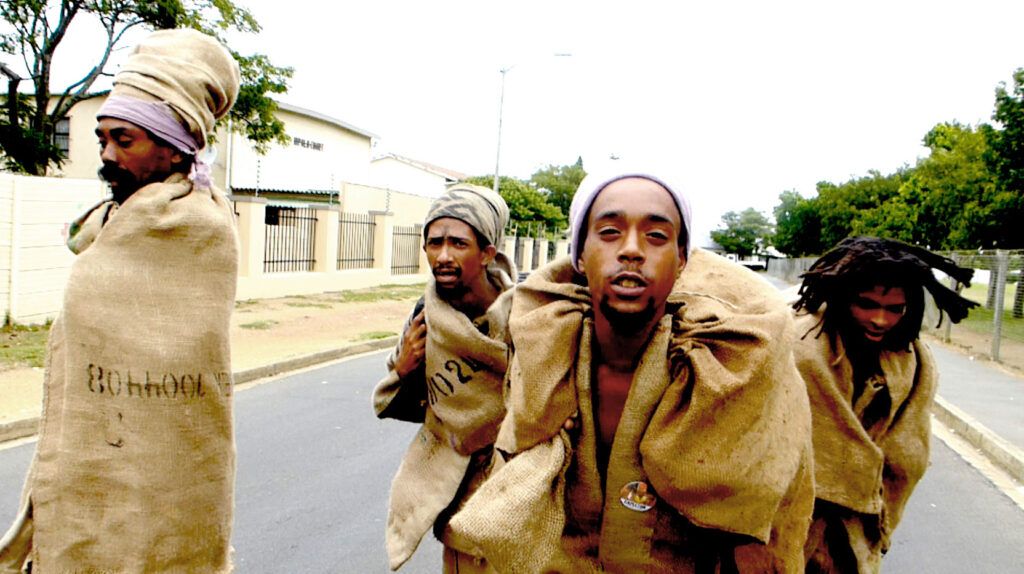
Phokojoe uses the hessian material as his entry to a conversation about home and belonging. The material provides a lexicon through which he can articulate what these things mean to him. Phokojoe has an interesting relationship with the material. He states that his first encounter with the material was at his home in Soweto, where people used the material to build their houses. Of course those who built their houses using this material were the poorest among the poor. Seeing this material and those who depended on it rattled Phokojoe; his curiosity around the ways in which this material can and ought to be used was aroused.
The recorded history of this material being used in the township dates back to 1944. In that year, James Sofasonke Mpanza “led a group of sub-tenants from Orlando east, Newclare and Pimville onto land that was owned by the city between the Orlando community hall and the railway line”. Initially occupied by 250 homes, the camp which was later called Masakeng (Place of shacks), ended up having between 6000-8000 shacks.
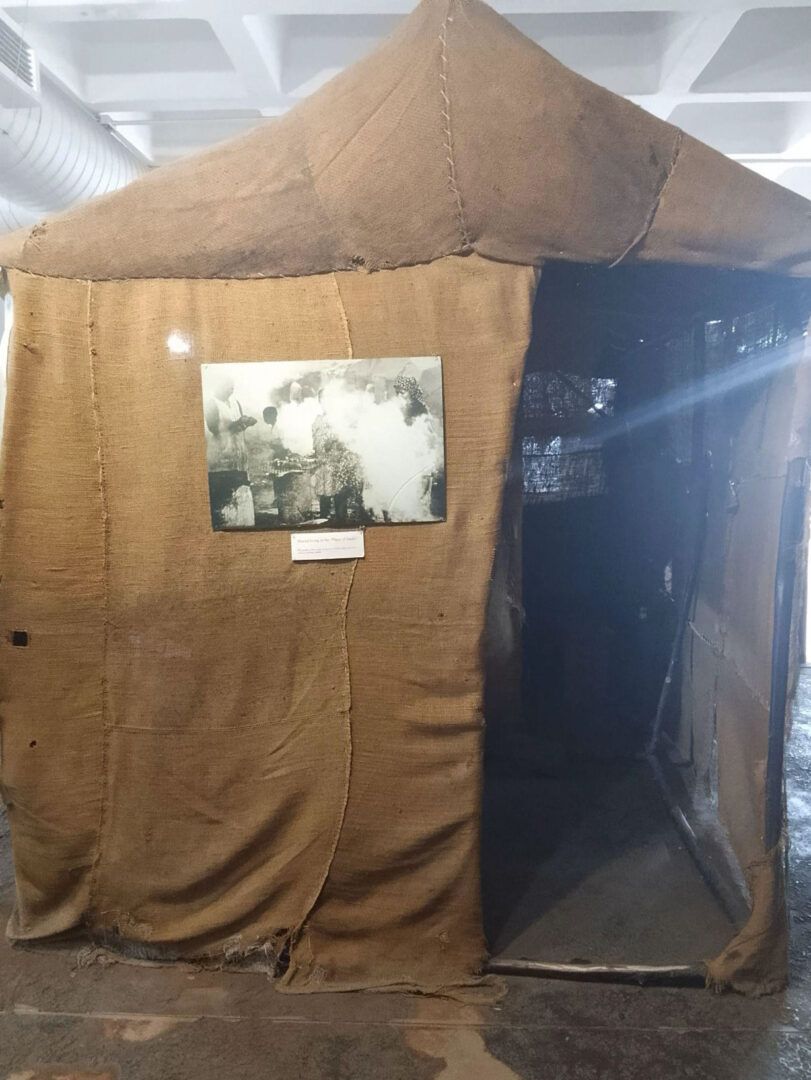
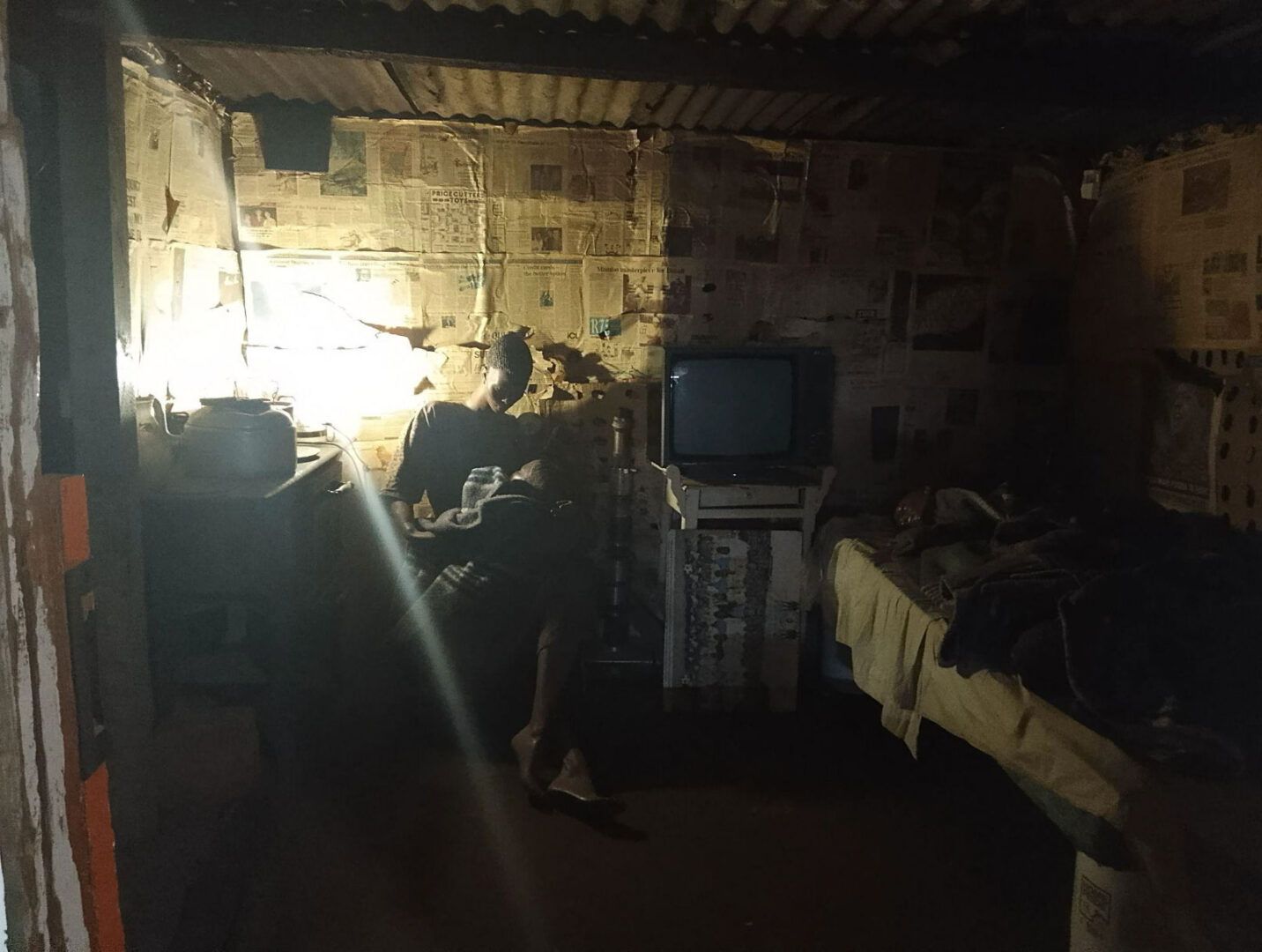
1 Replica of the Masakeng shacks as seen at Museum Africa, in Newtown, Johannesburg.
2 Inside look into the masakeng shacks. Replica as seen at Museum Africa in Newtown, Johannesburg.
This history is not only limited to Soweto. There is evidence of people using this material to build houses in other parts of South Africa. In Seshego Limpopo, there is a village called Masakeneng (also meaning place of shacks in Sepedi), widely known as the birthplace of EFF leader Julius Malema. Its inhabitants were forcefully removed from the then New Petersburg area to make way for white people. They then settled in what is now Masakaneng and used the hessian sacks to build their homes.[1]citizen
The hessian/jute sack is associated with poverty and by extension black people. In South African slang uMasaka, also meaning Sakman is used to describe a person who doesn’t have much and generally struggles to cover their basic needs. In one interview, Phokojoe has sarcastically described himself as uMasaka. One who is not usually afforded much respect because his wretchedness is apparent. What does it mean for him to know this as a black person from the hood? This knowing allows us to think about what it means for Phokojoe to shamelessly insist on this material that is so heavy with shame.
Phokojoe is not the first to use this material to create artwork. Nkhensani Rhihlamvu, with whom Phokojoe served briefly as a studio assistant has also explored the ways in which the material can be given a voice. Phokojoe is, whether aware of it or not, in conversation with the artist. Other artists who have also used the material are Nkosinathi Thomas Ngulube who has become an important intercessor for Phokojoe.[2]thomartsgallery Ngulube has gone a step further than just making artworks with the materials. It is written that, “In brief, during a sympathetic event, living in a derelict building, the artist used the hessian material with his family, in winter at the birth of their 5th child, as part of their blankets to add warmth”.[3]arteye
Based on the fact that the jute sack has been used by the sakmanne as clothing, and by displaced black people to build their homes in certain townships, it is possible to deduce that Phokojoe uses the material as a tool of protest. He takes what is considered useless and associated with poverty and insists on putting it in galleries – spaces that are generally associated with class and affluence – to recount his memories, thoughts and experiences as a South African living in a black body. He repurposes the material by giving it new meaning and a higher status, and like the sakmanne; he uses it as a symbol of piety, interacting with it as more than just material but something spiritual.

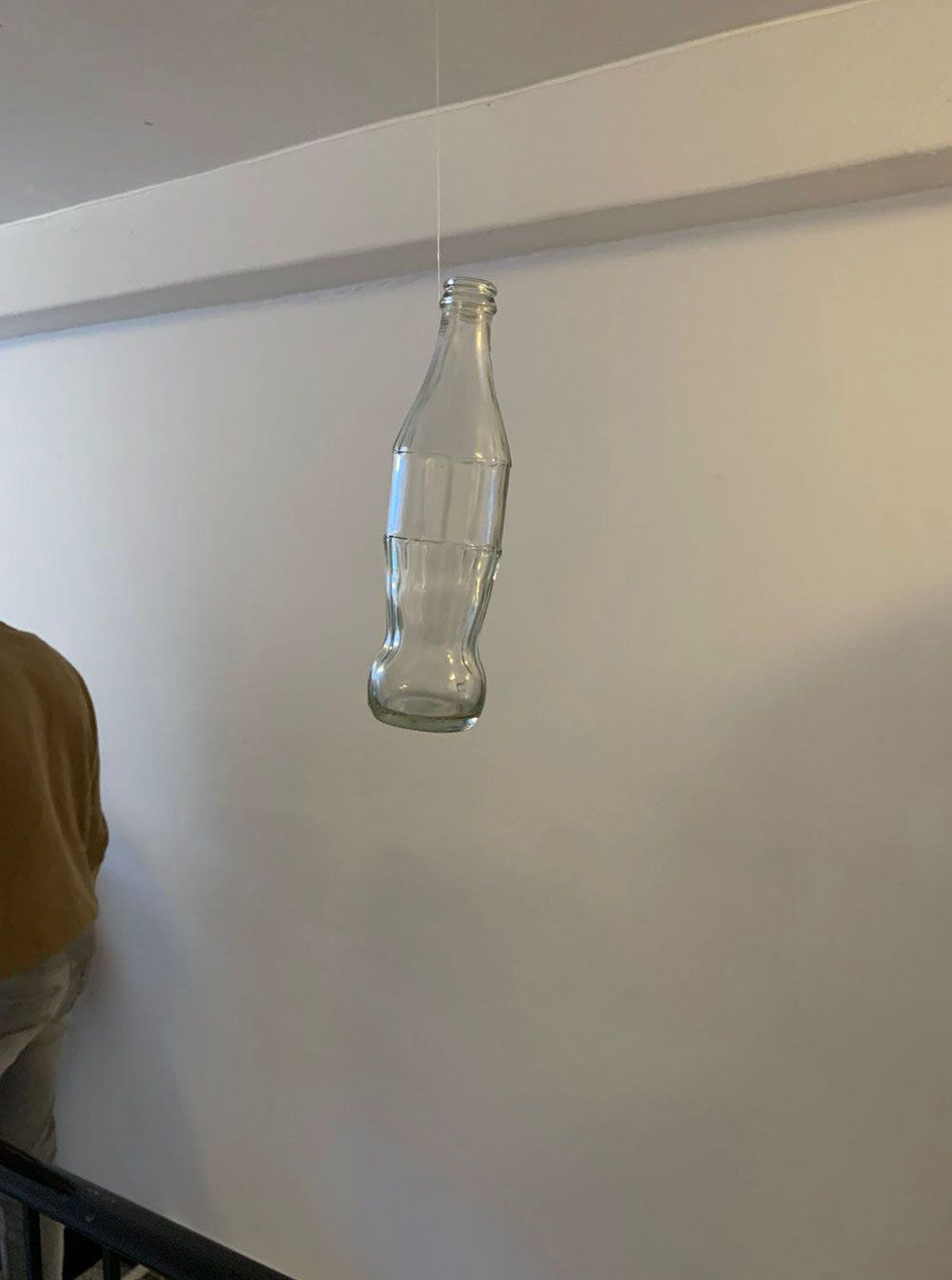
The title “The Gods must be crazy”[4]wikipedia. is borrowed from a 1980 film in which the emergence of a Coca Cola bottle that has fallen from the sky brings about confusion in a Kalahari desert community. The exhibition investigates the collision between two worlds, the old and the new, confusion and clarity, pain and the important work of repairing. As seen in the exhibition, the existence of the coca cola bottle hangs quietly in the entrance of the exhibition to invite us all to smile or laugh and remind us of the movie, but most importantly to think about healing and the harmony in the balance between old and new.
Phokojoe’s process is deliberately slow. Upon the emergence of an idea, he doesn’t quickly rush to the studio, instead, he lets the idea sink in, builds it in his head before he makes it. For this particular exhibition, Phokojoe insisted on going to Cape Town to make the work. This meant he wanted proximity to the Sakman community, to let them inform the work. This is not done as research in the anthropological sense, but this is something older, more felt than learnt. The work couldn’t be done in Johannesburg, where he works and lives. It required presence, asking questions and listening.
“Most of the work must be in the thinking before the doing,” Phokojoe always insists. This is a phrase most of those around him have heard many times. When deadlines approach and his friends who mean well remind him, he quickly refers to this line like a mantra. Always trusting that the mental work, mapping and accumulating meaning, helps build the foundation of “important work”.
What we get to see physically is what has already been built in the mind.
Hessian remains his chosen material, but this time it speaks in two voices. The usual brown hessian appears with the weight of tradition, speaking to ancestry, labour, history and survival; all themes Phokojoe has grappled with since his emergence in the scene after winning the Blessing Ngobeni Art Prize. This time he introduces the red, first appearing as a brazen-faced guest appearing around the brown with its vibrancy, insisting on being seen and being alive. The introduction of red also marks time between where hurt ends and healing starts. Phokojoe layers the work as a journey of what was endured and what might become.
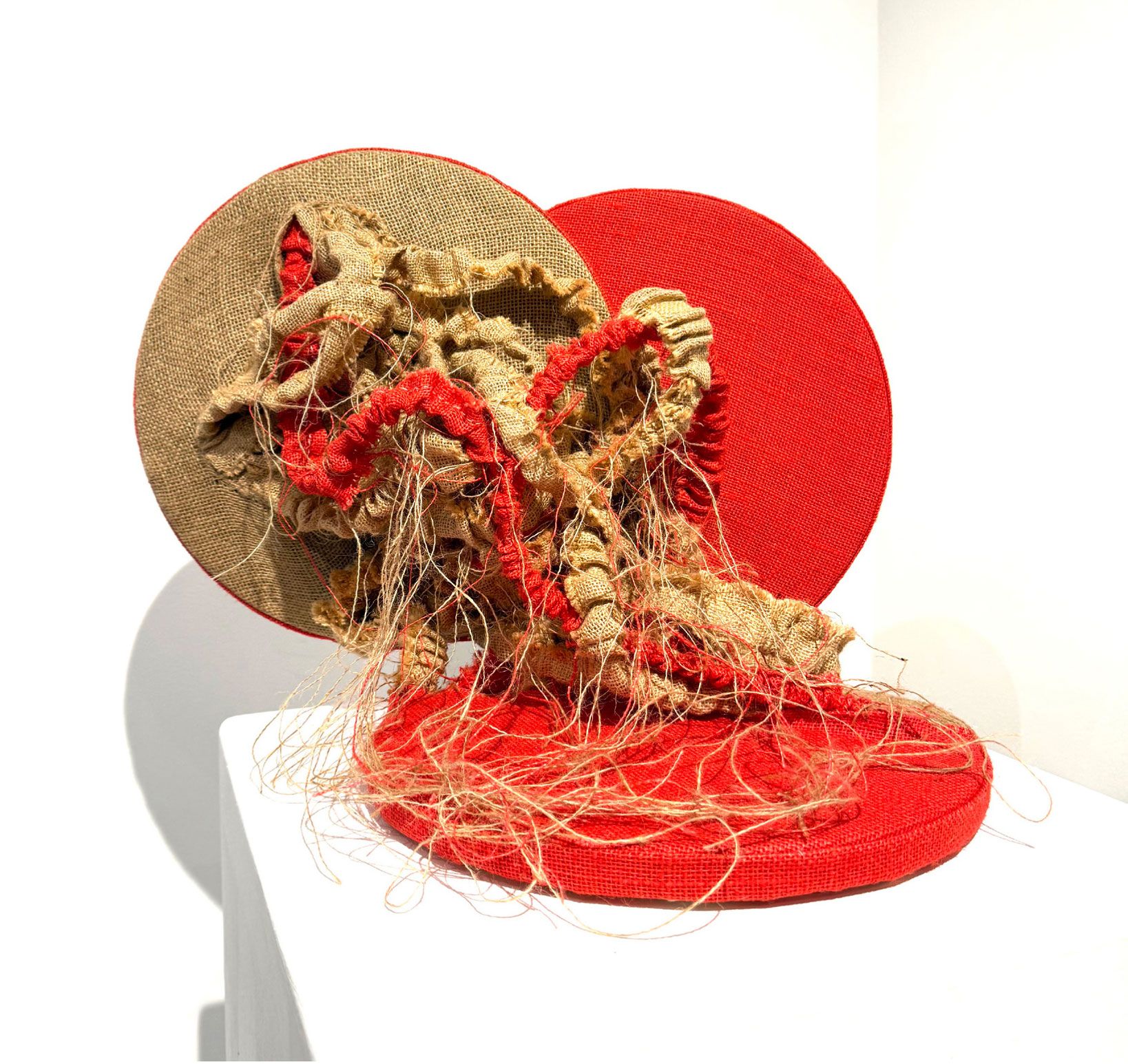
The act of stitching remains central to his process, using both found and new material Phokojoe continues to combine these materials to make something whole again. His patience in the repetitive nature of stitching is not an act of replacing what is old with the new. It is an intentional seeking, the patience to sit and create a safe haven, a home, because stitching is also therapy for himself. In his own words he says “when I’m stitching everything else ceases to exist”.
The exhibition draws from the Khoikhoi myth of Guinab and Tsui-Goab. The struggle between the God of drought and the God of rain. Though these Gods exist in opposition, in his hands they become more about rhythm. Intersecting at a place of being dry and then replenished, breaking down and rebuilding. The brown hessian represents the severity of the hard times we all endure, and the red brings Tsu-Goaib’s rain but not in floods, slowly, like mercy allowing new growth.
Together they show that healing is the willingness to move through pain and not the absence of it.
Remember the Coca-Cola bottle hanging at the entrance of the exhibition? Besides smiling, the bottle invites us to think. Think back to the movie, how the existence of the bottle caused conflict in the kalahari community? How does modernity and power meddle into our traditions, vocabularies and intimate spaces? The bottle just hangs at the entrance of the exhibition, it is not tampered with, it simply is, but it is there to remind us that nothing is perfect, pure or static. Not this exhibition, not home and not harmony. Everything is patchwork, it’s always in process.
The work sits in the gallery like a journal. And like an academic journal, it is not simple. Phokojoe refuses to simplify, if anything he’s been heard saying, “I’d rather you see my work as ugly”, suggesting that beauty might be too easy. That life is about living within contradictions, in the present and the past, in pain and in healing while moving forward by learning to live with your struggles.

The exhibition was made possible with the help of studio sunday best, who have now served as midwives to Phokojoe’s vision for a third time. The relationship is more than just sponsorship but kinship seen in the commitment of Studio Sunday Best to help artists realize their visions. Studio Sunday Best creates infrastructure where there are gaps by offering curatorial development and production support to ensure ideas of artists don’t just remain ideas but get developed and executed as public offerings.
The crazy Gods in Phokojoe’s world, perhaps understand that being whole doesn’t mean being perfect but just like stitching, it’s through every mistake, step by step, thread after thread and patch after patch. “The Gods Must be Crazy” doesn’t suggest that the new erases the old but grows from it. In a world that moves fast, forgets and separates quickly, we ought to learn to live and work with what’s old and torn to map out something we might call new.
| 1. | ↑ | citizen |
| 2. | ↑ | thomartsgallery |
| 3. | ↑ | arteye |
| 4. | ↑ | wikipedia. |