MENZI MASEKO
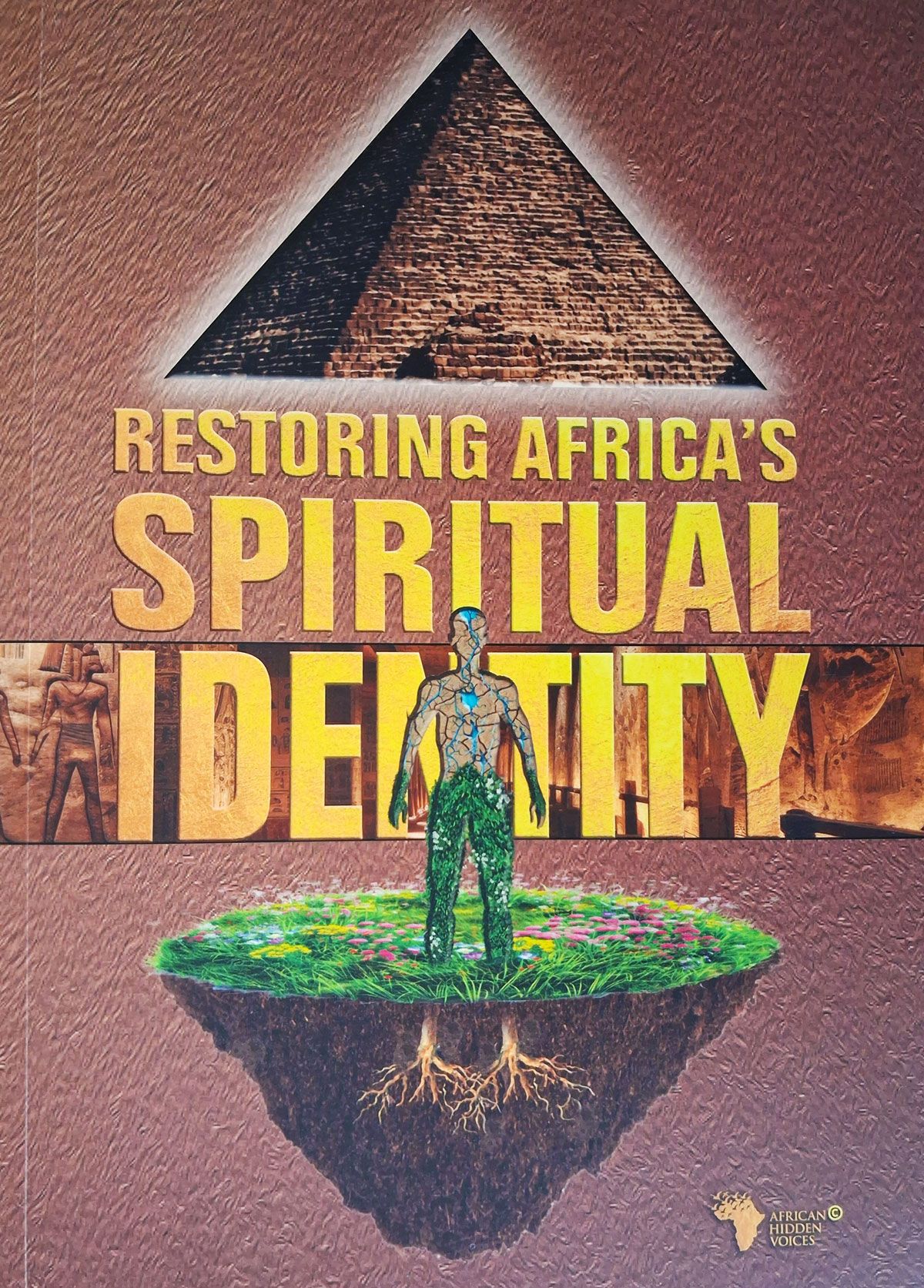
Acknowledging Spiritual Power Beyond Belief - A Review of Restoring Africa’s Spiritual Identity by African Hidden Voices (AHV)
Of God-Kings and Reluctant Messiahs
“Ancient Africans understood that the spiritual mind was the key to accessing higher knowledge, connecting with ancestors, and navigating both the spiritual and material worlds. However, the colonisation of Africa and the imposition of foreign religious beliefs have suppressed the spiritual mind, disconnecting many Africans from their spiritual heritage.”
– p. 84 (African Hidden Voices)
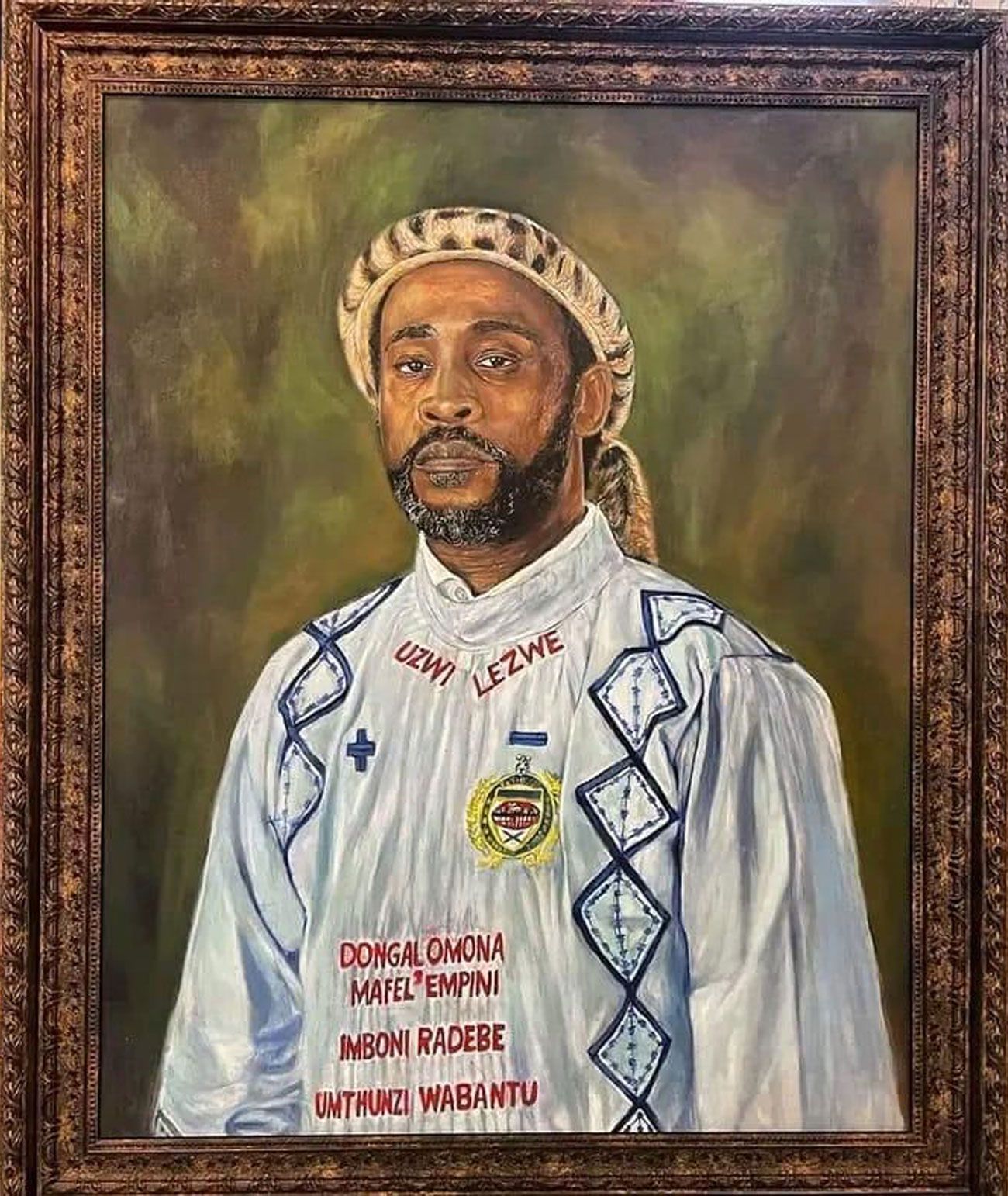
This passage under the subtitle, Restoring the Balance and Advancing the Spiritual Mind, captures the essence of this book. The timely offering by Isambulo Publications is inspired by the Spiritual as well as commonplace revelations of Inkosi yoMoya Imboni Dr. uZwi Lezwe Radebe, whom it is safe to state that the acronym PSCB meaning Physical Spiritual Central Being (p. 68) refers to him. Before we delve deeper into the text, let us look at the man in the middle of this awakening of spirituality. Who is Imboni Dr. uZwi Lezwe Radebe?
Born November 8, 1977, Samuel Mbiza is the revered founder of the Revelations Spiritual Home (TRSH), a man of mysterious circumstances. According to the book, Inkosi Yomoya Imboni Dr. uZwi-Lezwe Radebe is part of an age-old pattern of Seers, and historical ‘religious leaders’ who are “chosen by the spiritual dimension to lead and guide nations. They are incarnate deities on earth, endowed with divine wisdom to navigate both the upward and downward spiritual dimensions.” (p.149). The text provides a lot of information regarding the roles and responsibilities of the PSCB in society and among the followers but very little is given in terms of biographical or personal details, save that Radebe experienced ‘spiritual phenomena’ at the early age of 4.
All we know from available research is that Imboni Radebe was born in the Western Cape township of Gugulethu and has evolved from having profound paranormal experiences (seeing strange lights and hearing voices) as a youth to becoming a herbalist and an expert in indigenous knowledge systems. He holds a doctorate in theology from an unspecified Bible college in the United States of America. Radebe has confirmed that the visions he encountered as a child were both frightening as well as profoundly empowering, and he now sees them as preparation for the work he presently does in the African Indigenous Spirituality space.
He spent several years as a deacon and preacher with the controversial Universal Church of the Kingdom of God (UCKG), an evangelical pentecostal/Charismatic church which had spread like wildfire throughout every Southern African town and city, he had joined this church at an early age of 16 and quickly became one of its most popular young preachers. Samuel Radebe nee Mbiza (civil name), transformed himself into the spiritual guide and entrepreneur who is now Imboni, the spiritual leader of the The Revelation Spiritual Home ( TRSH). This profound transmutation from religion to spirituality happened during 2006 when he had an epiphany or a spiritual revelation at the Vaal River.
He is said to have seen a golden lampstand with seven coloured candles with some large strangely shaped heads. This was interpreted as a sign for him to establish a spiritual institution. After a 2008 pilgrimage to the River Ncome (Blood River) in KwaZulu he entered into a ‘covenant with his spiritual guide’ which served as a vow for him to restore African Indigenous Spirituality.
By 2009 the TRSH was officially established, and had been named “The Revelation Church of God” and relocated from Plein Street in Johannesburg, to the former Great Synagogue in downtown Johannesburg. By June 2012, Radebe claimed to have received a revelation that confirmed that his followers should enter a covenant with him and his uMfihlakalo or uMabizwa Asabele – the One Who Answers When Called, (TRSH’s name for the Divine or Supreme Creator).
In the year 2014, TRSH acquired a mountain in the Free State where it is reported that this would be a permanent resting place for the Covenant which they had entered during a revelation at eSibonakalisweni eThekwini/Durban. After several other profound revelations, The Revelations Church of God transformed its name to The Revelation Spiritual Home in the year 2020. One of Imboni Radebe’s key contributions to the revival of African Indigenous Spirituality is his launch of the African Association for Indigenous Spirituality (AAFIS) in the year 2023. Notably, a musical theatre production was performed in his honour in Durban during the year 2024 titled Spirit King. One can appreciate this significant work when considering that the TRSH has branches across several countries including Lesotho, Eswatini, Botswana, Malawi, Mozambique as well as overseas in Ireland and the USA. No small feat in this age permeated by so many gurus and spiritual movements.
From reading the preface and then the contents page of this African Hidden Voices publication, one gets the impression that this is a decolonial project to promote Self-Actualisation, Afrikan Centredness, highlighting the historical and present-day significance of Seers (Izimboni) as well as institution building within the Indigenous Knowledge Systems (IKS) space. The book was first published in South Africa in 2024. While it deals with a lot of interconnected subjects, the key themes highlight the dichotomy between religion and spirituality.
The Revelations Spiritual Home is a formidable institution that has taken up this lofty task with resolute attention to details. As custodians of African Indigenous Spirituality, The Revelation Spiritual Home fills a void that keeps on emerging in the Afrikan spirituality space, where identity politics permeates even within the wellness space or industry. South Africa has never lacked any spiritual leaders, miracle workers or izinyanga (those born with the gift to heal family constellations as well as individuals), but the establishment of an institution that purports to serve the aspirations of a whole continent is very rare.
As a member of several Afrocentric institutions myself, having helped to establish the Institute of Afrikology, Ikhambi Natural Healing and the Africa Centre for Intangible Phenomena Studies to name a few, I can attest that this is a very difficult space, but Radebe and his Hidden Voices team have been able to capture the imagination of the people in a profound way.
The only parallel institutions that we may compare TRSH to would be the Kemetic ( Ancient Egyptian) spirituality based Great Empire of Kemet of Mkhulu Nsingiza as well as Dr. VVO Mkhize’s Umsamo Institute. While these are not exactly pivoting around the leader as a divinely ordained ‘chosen one’, they offer their followers knowledge that is helpful for daily, cosmic and ritualised connection with their higher powers. Here follows a structured breakdown of what one can expect from this publication.
Part 1 is titled Africa Had No Religion, a popular or even populist statement that is thrown about euphemistically among the so called ‘conscious community’ members. The authors spend just over thirty pages elucidating the nuances of polytheism and monotheism, spiritual hierarchy (a theme that is really pervasive throughout the book, and it will be abundantly clear why), and then ten pages are used to clarify the difference between knowing and believing.
Part 2, titled Identity is a “Comprehensive Examination” of what Conversion into European derived religious modalities did to the psychology and behavioural dynamics of African people in general. Part 3 deals with ‘Spiritual Balance’ and is by far the most loaded chapter in the book. This third chapter deals with everything from Positive and Negative Energy, The Duality of Spirit and the Human Body, The Spiritual Mind and the Physical Mind as well as the variances between ‘Good and Bad Spirituality.’
After reading this chapter I was reminded of the following lines from an Introduction to Fydor Dostoevsky’s The Brothers Karamazov:
Leading scientists tell us that religious ‘truth’ has been founded on falsehood and forced upon whole nations, misleading people in huge numbers and causing conflict and violence.
This is exactly the point that this entire text meticulously explains. But since this is a book about a renaissance of knowledge and deeper inquiry into Afrikan wisdom, a good scientist always asks, why? Why is there such mystery around religion and why is there a need for mediums or chosen ones in the spiritual journey?
Perhaps the answers are already available, possibly because of the structures that many people have long accepted as fundamental parts of reality. There is no sphere of human activity that has not been tainted by religion, which according to the authors, is a completely foreign concept in the whole Afrikan continent.
Chapter 4 focuses on what is termed The Dark Ages of Africa: The Suppression of African Indigenous Spirituality. This is truly the entire focus of the book, repeated across the rest of the chapters with varying degrees of reasoning and examples. While the African Hidden Voices team does the utmost to emphasise that Radebe is the principal PSCB throughout the book, this chapter also briefly introduces other more or less well-known African Spiritualists (Seers/ Izimboni) from the Afrikan Continent.
While its significant to note that their mission to restore African identity was suppressed in various ways by the insidious, often-psychic violence of Western or Colonial religions, it is also important to note that they all emerged out of the Judeo-Christian milieu.
In other words, the seers were often considered Afrocentric prophets existing within colonial environments. The chapter concludes with an interesting and well referenced polemic about the ‘Characteristics of Religion and African Traditional Religion’ as well as a Comprehensive Exploration of African Indigenous Religion.
Part 4, 5 and Chapters 4 all the way to 8 deal with a behavioural anthropological study and setting of a proper context for Spiritual Institutions, and some recommended corrections for the Pan Africanist agenda in the Quest for Africa’s Unity as well as some conclusive remarks regarding the restoration of Africa’s Spiritual Identity. Chapter 4 locates the implications of Eurocentric and Arab derived religions on Afrikan society:
African women, who had often played central roles in spiritual practices as healers and mediums, were particularly targeted by Christian missionaries. This gendered attack on African spirituality further weakened the spiritual fabric of Africa, as the balance between masculine and feminine energies – central to AIS – was disrupted. p.93
This is a highly significant point to raise as there have been many attempts to centre the divine feminine in the historiography of faith-based developments in Africa, but women tend to be treated as an afterthought, not as central figures playing key roles in these developments.
Highlights
The church and the Global System. The key hypothesis is summarised in the Preface (VI) with the following words,
Religion played a central role in the development of the Global System, impacting various domains such as the judiciary, politics and economics. This system, rooted in the principles of the church institution, represents a foundational framework of contemporary global power structures.
The theory is cogent and compelling enough when one observes the so-called Western civilization’s well connected and orchestrated institution of authority.
The 21st century upsurge in esoteric knowledge revival paradoxically complicates this notion. Even once die-hard scientists are questioning their current scientific materialist paradigms. This simply means that the so-called Global System is already suffering an internal crisis.
It is not science alone that is being rattled by this open-minded spiritual seeking generation, but the areas of sociology and politics as well. One statement or revelation by Inkosi Yomoya Imboni Dr. uZwi-Lezwe Radebe (2025, ASC) that stood out in this publication is this profound one:
Pan-Africanism, like African Initiated Churches, falls short in addressing the true essence of Africa’s authentic Spiritual Identity. Both movements attempt to restore Africa’s dignity and autonomy yet lack the spiritual resources necessary to achieve this. (p.177)
I found this statement substantial as it reminded me of the works of Ayi Kwei Armah (2000 Seasons, The Healers etc) as well as the 1975 book by Sibusiso Mandlenkosi Emmanuel Bengu aptly titled: Chasing Gods Not Our Own which emerged from his doctoral thesis titled “African cultural identity and international relations.”
The disruption of Afrikan spiritual sovereignty is a reality and there have not been many institutionalised and structured responses to this scourge until the establishment of Great Empire of Kemet and its Afrikan Calendar regime and Imboni Radebe’s emergence as an Afrika centred spiritual leader. According to the African Hidden Voices, everything has been impacted by religion, from the legal/judiciary to the varied but neo-liberal educational institutions.
One can agree with the book’s ‘physical spiritual central being’ (PSCB) to the extent that this is a fair description of the Western church’s hegemony, until the end of the 20th century where secularism had spread. Imboni encourages a conscious departure from current religiosity and or belief, while still emphasising a hierarchical structure that must recognise him as the supreme spiritual authority. This made me contemplate whether there really is any fundamental ‘shift’ from religion into personal spiritual power, or do PSCB’s represent another form of authority that simply replaces the pastor/ preacher/prophet with another guru?
The 21st century appears to be embracing not just secular approaches but we are in the midst of the knowledge economy, this is not a revelation but a logical evolution from industrialisation to information technologies towards quantum field theories all the way to the scientifically predicted singularity.
The paradox is that while data, information and knowledge is increasing, wisdom also seems to be dissipating. While I appreciate the notion that the Revelation Spiritual Home acts as the renaissance of the Ancient Kemetic (Egyptian) Mystery Schools, what really makes Restoring Africa’s Spiritual Identity book special among the various other publications and platforms presenting similar information?
Perhaps it is the way in which they illustrate how ‘Spiritual Hierarchy’ works. This point is thoroughly emphasised in cyclic repetition throughout the text, yet one never gets a sense that it is an actual revelation of something not previously known. Page 16 states, “These PSCBs are not simply elevated because of human desire or capability, but because they are ‘chosen’ by the Deities who incarnate in them to represent the Creator on Earth.” I personally could not see the difference between this description and any of the Seers or Gurus from Asia.
Another factor is the revelation of The Creator as uMfihlakalo (Mystery) through the person of Imboni Radebe and symbolised by the number 0 (p.17) signifying completeness and a genderless whole. This is an interesting point because Masculine and Feminine Energies in African Indigenous Spirituality (AIS) are discussed thoroughly, with an eye-opening emphasis on the Upward and Downward Theory (pages 23-24).
Among the great services that this book presents to the readers is the attention given to a number of other PSCB’s or Izimboni from the African continent, especially the female ones, such as Imboni Mantsopa Makhetha from Maseru, Imboni Kimpa Vita from the Kongo and Imboni Alice Lenshina of Zambia, who are hardly ever written about in mainstream media.
Their biographies and struggles are a positive highlight of the book and they also act as a way to confirm Inkosi yoMoya as a legitimate continuation of a particular spiritual tradition.
Critical Analysis and Evaluation
Several questions could be raised regarding African Hidden Voices as a school of knowledge about African Ancestral Spirituality or thought versus Revelation as part of the typical religious belief system that is purportedly not religious. Imboni uZwi-Lezwe Radebe urges readers to unlearn the beliefs and religious habits we have inherited from Eurocentric and other peoples, embracing with intelligent and open minds the age-tested ways of our ancestors. How then does asking Africans to reactivate their spiritual minds appear to also require devotion to the physical spiritual central being?
We are not given sufficient evidence in the book to support the claim that Africans have depended on chosen avatars in matters of ritual or spiritual discernment. Are Radebe’s spiritual visions or revelations sufficient anecdotes to go by for heavily religionized Africans to abandon what they have been indoctrinated with? Perhaps not, yet the revelations do serve as a way towards questioning the status quo and finding value in what is indigenous. Is there a hidden patriarchal archetype that is being perpetuated in the text? The hierarchical diagram presented as the Upward and Downward Theory which depicts a duality of spiritual order between physical and spiritual realms appears to suggest this, but the reader may view it as simply a natural fact.
As stated in Chapter 1.2 dealing with the Spiritual Hierarchy, “This structure preserves balance and ensures that those chosen to lead, do so with the highest spiritual backing and knowledge.” (p.16). Yet, this spiritual backing and knowledge is implicit and not backed by any innovative ideas, just a repetition of what the Great Empire of Kemet, a Joshua Maponga or any decolonised man or woman on the streets might say. 21st century Spiritual literacy requires a more scientific approach with empirical evidence, not hierarchies filled with mysticism.
The aforementioned hierarchy is depicted this way:
The Creator – Isithunywa who works with other izithunywa assigned different roles within the institution – The Spiritual Guider (Physical spiritual central being) – Other roles which are informed by the Spiritual Guider who is informed by Isithunywa.
Secondly, the Nguni/IsiZulu word Imfihlo means secret while Imfihlakalo means mystery, where do the two meet and how does the hierarchical system maintain secrets while presenting as a means towards Spiritual liberation? It was difficult to navigate the blurred lines between spiritual authority of the leader and the self-determination or self-realisation of the adherents.
Referring to UMdali/UMenzi (The Creator) as UMfihlakalo does not automatically make it a mystery, but leaves room for further religious manipulation by omission of details. While the Kemetic and Vedic traditions have offered several examples of a scientific and rigorous illustration of divinities and supernatural realms as cosmic phenomena, the Hidden Voices presents us with a prophet-like figure whose personal visions are termed revelations and while important for the decolonial project, leave much scope for elucidation.
It leaves one wondering whether there is such a thing as spiritual life without some form of hierarchy, mostly with a messianic figure or God-King at the top? Is it by personal design or perhaps just human nature that there must be followers and leaders, monarchs and subjects? Adherents to African Spiritual Institutions are expected to remain subjects to Izithunywa ( messengers) rather than becoming agents who develop their own personal capacity for divinity. As a designated Spirit King, Imboni uZwi-Lezwe has every right to lead those who are convinced by his revelations, and the book will serve as a conscious guide for those who may explore this journey with TRSH as well as those who prefer to view this unfolding movement from the outside looking in.
It was refreshing to see Traditional Health Practitioners described as those who serve benevolent madlozi (idlozi elihle) and carry some form of spiritual authority. The placement of Amadlozi below Isithunywa will surely raise some eyebrows and cause some controversy, but the authors make up for such judgments by including a very detailed reference page where key sources are cited. The reference page will surely serve as one of the most beneficial aspects of the book as it assists the reader to do some much-needed personal research.
Amadlozi (Ancestors) which are a common key feature of Afrikan Spirituality are first described as malevolent spirits, but later depicted as ‘working spirits’ which can be both benevolent and harmful are only briefly discussed in the book. Idlozi is regularly reduced to either good or bad spirits within the lower rungs of the downward/upward theoretical framework. (p.89).
This is all reminiscent of the Hermetic adage of ‘as above so below’, only that in these types of institutions, the below (material) is not equal to the above (the spiritual). One is viewed as inferior to the other, but this is exactly how gurus and spiritual leaders are able to create a hallowed space that separates them from their followers. Perhaps the less connected among us desire messiahs or avatars, while others view it as utter nonsense.
Afrikans on the Southern parts have Umsamo, an elevated space within the kraal as well as indlu kaGogo (The Grandmothers House), the inner Umsamo where supplication is made through (umphahlo) or ukuthemeleza (to speak affirmatively) to any situation facing the home, yet since the advent of Abrahamic religions, it appears that African Indigenous Spirituality requires these new forms of spiritual guides as a way to restore not just identity but to organised communities around the idea and rituals of renewal.
An attempt at clarifying the necessity of Spiritual Institutions is made in chapter 6. It is best to quote an illustrative passage from there:
Mystery schools were integral to the spiritual landscape of the ancient civilisations, functioning as centres of the cultivation and preservation of sacred knowledge. (p.168)
This historical fact is curtailed by the repeated mention of the Atlantean myth, which makes one wonder whether Imboni Radebe’s AIS movement is inspired by the New Age traditions which have emerged very strongly lately with their talk of an Aquarian Age. These are Platonic or Hellenistic ideas that crept into Kemetic or Ancient Egyptian spirituality after conquest by the Greco-Roman empires. This is a part of the book that should have been left out as it brings further suspicion to the matter of whether Radebe is a New Age guru in the tradition of the Oshos, the Sadhgurus or the plethora of other mystical spiritual leaders who mix truth and fiction to boost their own status. Indigenous knowledge systems and Nature provide everything.
According to Mesopotamian beliefs, the Tigris has its model in the star Anunit and the Euphrates in the star of the Swallow. A Sumerian text tells of the “place of the creation of the gods,” where “the divinity of the flocks and grain” is to be found. For the Ural-Altaic peoples the mountains, in the same way, have an ideal prototype in the sky. In Egypt, places and names were named after the celestial fields: first the celestial fields were known, then they were identified in terrestrial geography.
Mircea Eliade, The Myth of The Eternal Return – Cosmos and History (1945/ 1989)
The Revelation Spiritual Home portrays itself as part of the restored ancient mystery school tradition. An author called Renee (2019) is quoted throughout chapter 6, but I strongly suggest that this conflation of Afrikan Spirituality with New Age ideas be removed from further publications as it adds an unnecessarily complex dimension to an otherwise formidable institution. This New Ageist rhetoric is a contradiction to the stated vision of African Hidden Voices, “TRSH emphasizes the importance of re-establishing our roots in AIS, reminding Africans that there is strength in returning to practices and beliefs that are inherent to the continent.”
This should be the true foundation of the reclamation agenda that the TRSH and its ambitious leader Imboni Dr. uZwi -Lezwe Radebe is pursuing. All other attempts at reconciling with either Far Eastern philosophies or Western mythological tropes such as the Atlantis hypothesis, will serve to only curtail the great strides being made. Spiritual empowerment and liberation can only come from within and TRSH, African Hidden Voices and their bold leader have dedicated themselves to fulfilling this journey and more visionaries will follow to either compliment or complicate their mission.
Conclusion
It is worth noting that TRSH has captured the active spiritual imagination of many Sangomas as well, especially those who profess to carry the gifts and challenging aspects of Isithunywa (Spiritual Messengers). This is precisely because Imboni uZwi-Lezwe Radebe has positioned himself as a key representative of the Upward aspect of the spiritual hierarchy, presented as the realm of Izithunywa. The rituals that form a pivotal part of the Revelation Spiritual Home’s weekly gatherings are another aspect that has drawn so many followers, as they concentrate on the removal of impurities, negative energy, evoking abundance, protection of homes and persons from hostile or malevolent spirits in addition to a socio-politically conscious community dimension. African people’s Spirituality has always involved ritual practices that involve water, the wilderness, natural elements and other articles including lights and repetition of mantras, this movement fills that gap by also offering a spiritual leader who ticks every box, from being a business person or entrepreneur to being a divinely ordained guide who happens to be a King of kings. It is safe to say that many will find a home in the arms of Imboni, but I doubt that any Rastafari or Christians will be coming, as they already are possessed by their own Kings of kings.