MAKHOSAZANA XABA
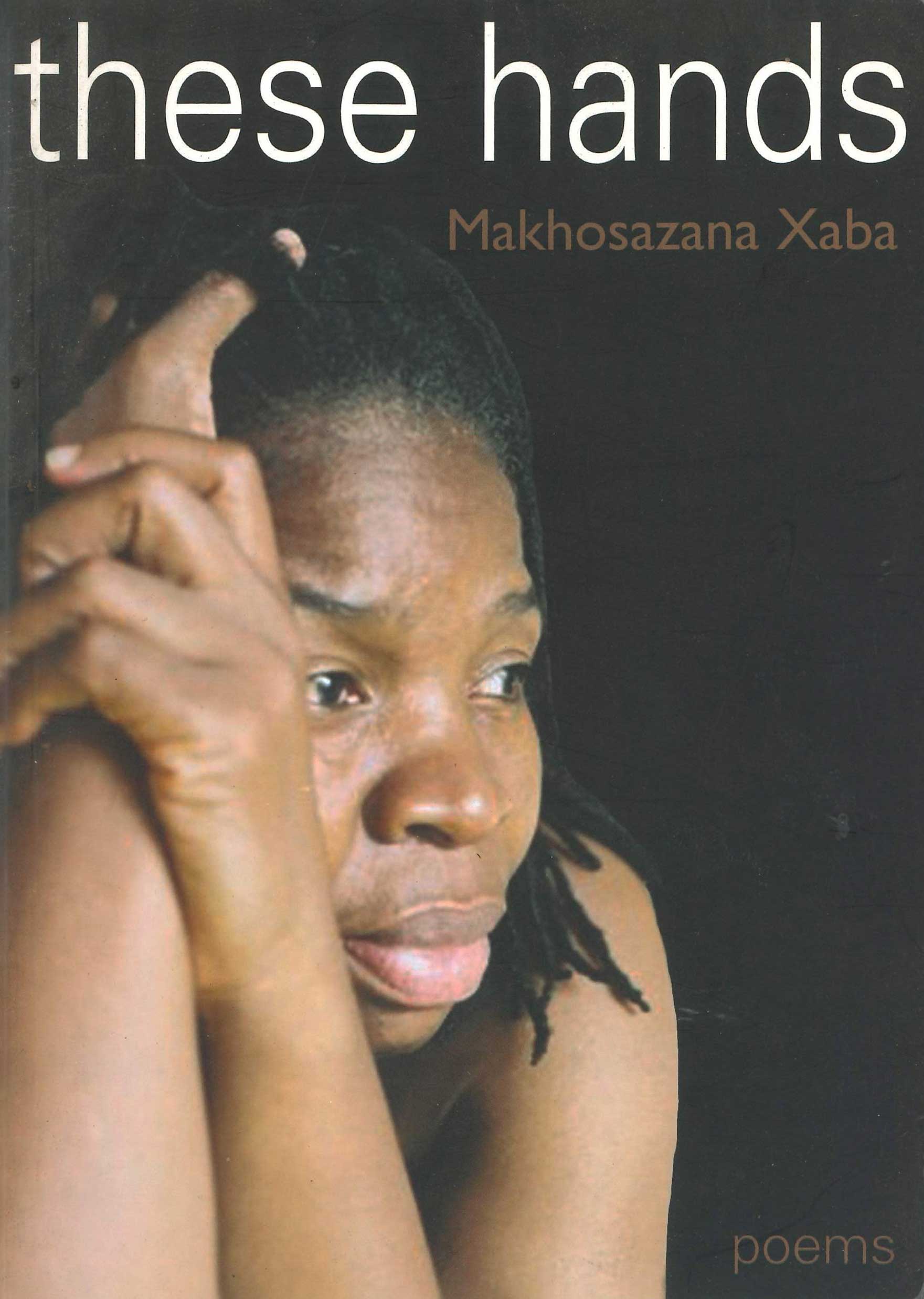
Poems from These Hands
These hands

These hands know
putrid puss
from oozing wounds.

They know
the musty feel
of varying forms
of faecal formations.

They know
the warmth
of gushing blood
from gaping bodily spaces.

They know
of mucus, sliding
out of varying orifices.

These hands remember
the metallic feel
of numerous guns,
when the telling click
was heard.

They recall
the rumbling palm embrace
over grenades,
ready for the release
of mortal destruction.

These hands will never forget
the prickling touch
of barbed wire
on border fences.

These hands
can still feel
the roughness
of unknown tree leaves
that served as toilet paper
in bushes far away
These hands have felt pulsating hearts
over extended abdomens,
they know the depth of vaginas
the opening mouths of wombs,
they know the grasp
of minute, minute-old clenched fists.

These hands
have squeezed
life's juice from
painful pounding breasts.

These hands
have mode love,
producing vibrations
from receiving lovers.

These hands
have pressed buttons,
knobs and switches,
they have turned screws
and wound clocks,
steered wheels
and dug holes,
held instruments,
implements and ligaments,
moulded monuments,
created crafts,
healed hearts.

These hands
now caress the keyboard,
fondle pens
that massage papers,
weaning fear,
weaving words,
wishing with every finger print
that this relationship
will last forever.
Malume

In his message, "Fare thee well, comrade Zinjiva",
Raks called you a soldier-poet of note.
We called you Malume,
you told me stories about the early days of the ANC,
stories of the heated debates within the ANC,
stories of umkatashiya within Mkhonto weSizwe.
Malume, the storyteller,
uMalume I never had at home.

Raks called you a diplomat par excellence.
To me you were Malume.
You told me stories about foreign countries.
The breathing, talking, laughing pictures
of lives in those countries now hang in my mind's eyes,
your voice on ornamental frame around each one.

Raks called you father-husband, all rolled in one.
To me you were Malume.
We cooked and ate together.
We made rules about how to use the toilet,
when to flush and when to not
as water rations and nocturnal noise were an issue.

Molume, we waited for you on those nights
when a serious story hit the news
we knew when you came home
there would be more stories to listen to.
For any news item of the day
could turn into a long story in the evening.
Malume, weaver of words,
we sat in your bedroom
catching droplets of wisdom from your lips.

Raks called you an activist, a philosopher.
To me you were Malume
who would come home drunk on some days
order us to hide your other bottles
until you are sober and ready to partake again.
We sat at our kitchen bench many a day,
discussing our meagre finances,
which mphando item to sell next
so we could afford another meal.

I heard via Raks' e-mail of your death,
a month and more after your burial.
How can a diplomat par excellence die
without this even becoming news?
In frustration I asked around
only to confirm your passing had not hit the hot news list.
I thought back to the months when I last visited
you at your Judith's Paarl home.
I thought back to the Lusaka that is now our history.
I awoke to the fact that I carry into the future
the verbal tapestry you crafted.
I carry your voice into tomorrow.
Malume you spiced my life.
Brakpan 2002

They knew not her name,
they knew not from whence she came
She worked for them
in their very home.

A domestic worker,
in the backyard
the familiar servants' quarters.
When she dared walk in the garden
two pitbulls ripped her apart
A member of the public
killed the two dogs out of rage.
The dog owners,
home owners, white employers,
knew not her name,
from whence she came
who worked for four months in their home.

She was just a
domestic worker, black,
in a backyard in Brakpan.
Now she lies in a mortuary.
Her dogbite-riddled body can't be claimed.
Her employers assert unashamedly that
the dogs bit her because, they too, did not know her,
because she had never walked in the garden.

She was merely a body,
a black body,
in a backyard in Brakpan
in the year 2002.
The Silence of a Lifetime

At seven she was raped
by her uncle
in the middle of the night
under a dining table
in the lounge-cum-dining room
of their four-roomed home
where eleven of them lived
in the township.
Everyone else was asleep
on every available floor space.
She muffled her cries
as his penis suffocated her.
He kept whispering to her,
"Don't ever tell anyone".

At fifteen she was gang-raped
by four classmates
in broad day light
on a desk in their classroom
at their school
where a thousand of them studied.
Everyone else was in their little comer
on the grounds of the school premises.
She cried out loud.
Each boy muffled her cries with a punch.
Numbed with pain, she kept hearing them:
"Stop thinking you're so smart".

At eighteen she was date-raed
by her first boyfriend
just before ten at night
on a concrete pavement
behind the movie theatre
in a city
where millions of city dwellers breathe and stroll
Everyone else was on their own important mission
on the streets, in the corners of the city.
She cried silently
as she wondered madly
what had suddenly gone wrong
with her very first boyfriend,
as he kept saying:
“Prove that you love me”.


At twenty-six she was raped in marriage
by her husband
at six o'clock in the morning
on their matrimonial bed
while their child was feeding on her breast
in their home
where no one would question why.
Everyone else was minding their business,
whatever it is at this time of the day.
She swallowed to muffle the anger
as her baby swallowed the breast milk.
She heard him say, at one point:
“You are my wife, aren't you?"

At forty-five she was raped
by two of her colleagues
on a sunny weekend afternoon
in her own flat,
in her own lounge,
where anyone who walked in there
did so at her invitation.
The work had been done,
the report written,
when her colleagues took her by surprise.
Everyone else was rninding their own business
as they do every weekend afternoon.
Her cries went nowhere.
Her colleagues had turned the music system on full blast.
As they took turns, they each muttered:
"So who's the boss now?
This boardroom is much better
than the one at work, hey, Sweetie?”

At sixty she was raped
by the neighbour she knew so well
one wet Sunday morning
on the path from church,
amongst the mielie fields
where everyone walked by
every single day of the year
in this small community,
in this tiny village
where the villagers lived in peaceful harmony.
Every villager was minding their own business,
whatever it is they did on a rainy Sunday morning.
She could not even cry
for the shock of what was happening was numbing.
She kept telling herself she was dreaming
though she knew she was hearing right
when he kept saying:
"When last did you get it, old woman?
Enjoy it.
No one else wants an old rag like you."
I was born in Greytown, KwaZulu-Natal. I came during the winter school holidays in 1957 when my parents visited my grand aunt. They lived in Pietermaritzburg. Two years later they moved to Ndaleni, Richmond where I was to spend 21 more years. My childhood identity was shaped within the environment provided by this semi-rural area once a Methodist mission station. The primary school built in 1936 was my initiation to formal education.
I first encountered poetry at home. As children we were no allowed to simply say “Ngiyabonga” when we were accepting a gift or had any reason to be grateful to my parents. To my father we had to say Ngiyabonga Daddy, Xaba, Nankosi, Shwabada, Malobusohlanga, Nombobozinde, Nonxasiyakhothala, wen’owahlephula isinkwa sebandla, wen’owethemba ukuphana kunokuncishana, Mazalakubusa! We had to then turn to mama and say Ngiyabonga Mama, Mbatha, Ndabezitha, wena kaSontshikazi, gumbi lamagwala, amaMbatha awangakanani ngoba nasentendeni yesandla ayahlala!
Izithakazelo, that’s poetry .
Izithakazelo are no just about tracing family lineage, they are about specific historical events of individuals or groups. No family or clan is without a story and no story is devoid of its history. My father always insisted on knowing izithakazelo of whoever graced our gate. I acquired the habit and fell in love with the practice. My mother just seemed to know most of izithakazelo as if she had in some previous life studied them My parents came from Northern Natal where it was common practice to acknowledge someone through the use of their izithakazelo My father also introduced me to Shakespearian poetry that, like the songs, he performed whenever he felt like.
Primary school introduced the likes of “Muskiete jag” and “The daffodils” which I recited with the alacrity of a child but I was more at home with “Izibongo zenkosi uShaka” and its ilk. By the time I got to secondary school I was hating more and more the Afrikaans and English poems as they were having less and less relevance to my life. I longed for more Zulu poems that we were learning less and less about.
I was in my early twenties when I first read the words “I write what I like”, the title of a book by Steve Bantu Biko. I thought then, what profundity in just five words, of fifteen letters. What made that statement potent for me was the political context of the seventies. Only a brave and free-thinking black person could say such. I had always wanted to be a writer but what did I really know to want to be a writer? What could I write about? What did I have the right to write about? What was I permitted to write about? Who would be interested in what I write and why? Would I ever know enough to write well? Could I make a living from writing? I would never be able to write in English? Who would wont to read my isiZulu?
The insight I got frorn that statement was that in fact I could just write what I like and that is fine because I am me. This was as liberating an assertion as the one: “I’m black and I’m proud.” I did not start writing immediately though. But this statement has lived with me until this day.
In my mid-twenties I slowly discovered other kinds of poetry, novels, essays, stories – banned literature. I was in a network of friends who shared what we could lay our hands on which sadly was a very few and far between selection. I remember so well a comrade sharing an audiotope of Gill Scot Heron’s poem:
“I Said I wasn’t gonna write no more poems like this,
but the dogs are in the streets.
I said I wasn’t gonna write no more poems like this,
but the mother fucken dogs are in the streets.”
Through this poem I could imagine what the poet was feeling and thinking so far away in the USA because indeed, the dogs were in our own streets. That was a poem that was a precursor to my understanding and assimilation of protest poetry. I found it so liberating just listening to the tape. It gave me personal power and confidence that the struggle will be won, one day.
In exile I discovered even more liberation poetry. It spoke a language I understood and embraced. An example of such a poem is “Red Song” by Keorapetse Kgositsile that begins thus:
“Need I remind
Anyone again that
Armed struggle
Is an act of love”
I never had to read the whole poem – I still don’t – just these lines, sufficient for me. I would repeat them to myself, smile and then repeat them and smile. It says it all. That said, even during that period I still did not not fully rediscover poetry as a genre. I found some of it inaccessible as it seemed to me that it was written with the express aim to obfuscate.
Interestingly though, I never thought I could write poetry until the year 2000 when members of my writing group began to give me extremely positive feedback. Before this time I had written extensively, published in numerous local and international journals on various topics on women’s health. An insatiable hunger for creative writing was always with me and I finally gave it a proper breathing space within my writing group.
Since 2000 I have been writing more and more poetry. I experience poetry as a liberator. With it I free myself. Sometimes the feeling is as physical as a reduced load off my shoulders. I have now bought more poetry books than I thought existed. I now read poetry for leisure, entertainment, my education and a desire to discover. I am learning and deliberately pushing through obscure poems – those that lend themselves to this – for the fun of it.
I belong to a writing group of wise women. We meet once a month for three hours in one another’s homes. Our process is simple, you bring a piece of writing it could be poetry or prose or anything you wish to get feedback on. Someone also reads your writing so that you can hear what it sounds like and the group gives you feedback on it. I find this an extremely safe and nurturing space that has allowed me to gain confidence about my writing over the years. In fact, I doubt I would have ever thought my poetry is worth sharing beyond the secure boundaries of our group had they not suggested that I start publishing it. The positive feedback from them encouraged me to write more and more poetry, something I never thought I had in me. There is immense power in hearing your work being read, it helped me become even more critical of my own writing.
My poems come from lived experience: relationships with friends, family and colleagues, conversations, observations, news, thoughts, dreams, and a range of strong emotions. Most of them come to me as voices when I am alone, often waiting in restaurants (I love eating out, I hate cooking), in queues, on benches, while driving, being driven, while flying or simply flying with my brain cells. I write them on serviettes, tissues, tickets, receipts, white spaces of newspapers, note books, back pages of books and diaries. Once I have written a poem I often forget about it. One of my plans is to get more systematic to carry a notebook all the time and to type poems as soon after they have been written as possible, file them properly and keep an accurate record.