LEFIFI TLADI
Two Letters to Kemang Wa Lehulere
1
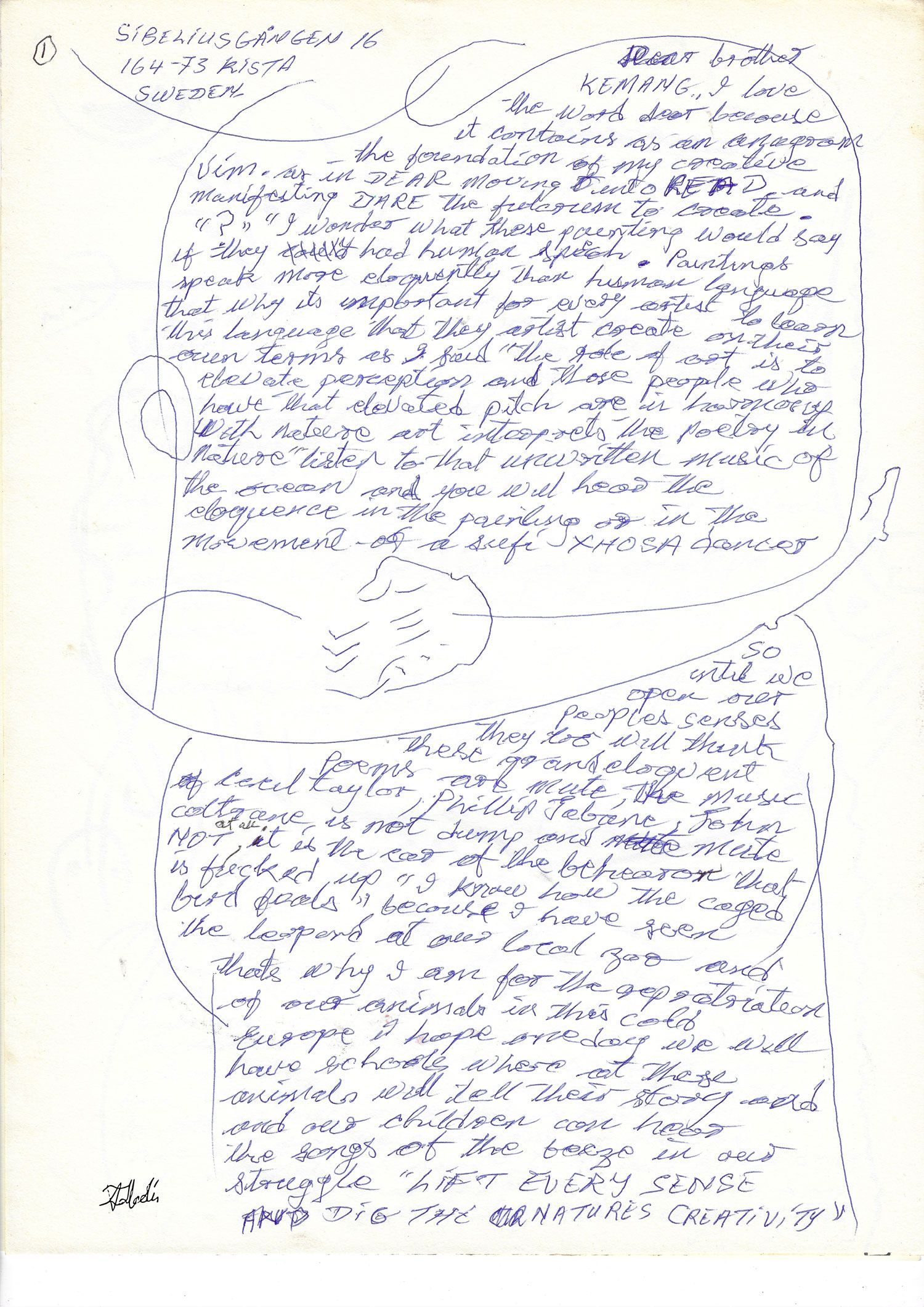
Dear brother KEMANG, I love the word dear because it contains as an anagram the foundation of my creative vim. As in DEAR moving into READ and manifesting DARE the fulcrum to create. “?” I wonder what these paintings would say if they had human speech. Paintings peak more eloquently than human language that’s why its important for every artist to learn this language that they artist create on their own terms as I feel the role of art is to elevate perception and those people who have that elevated pitch are in harmony with nature art interprets the poetry in nature listen to that unwritten music of the ocean and you will hear the eloquence in the painting or in the movement of a scefi (???????) XHOSA dancer.
So until we open our peoples senses they too will think GQ (???) and eloquent poems are mute, the music of Cecil Taylor, Phillip Tabane, John Coltrane is not jump and mute not at all, it is the ear of the behearer that is fucked up. “I know how the caged bird feels” because I have seen the leopard at our local zoo and that’s why I am for the repatriation of our animals in this cold Europe I hope one day we will have schools where all these animals will tell their story and our children can hear the songs of the beaze (????) in our struggle “LIFT EVERY SENSE AND DIG THE NATURE’S CREATIVITY”
2
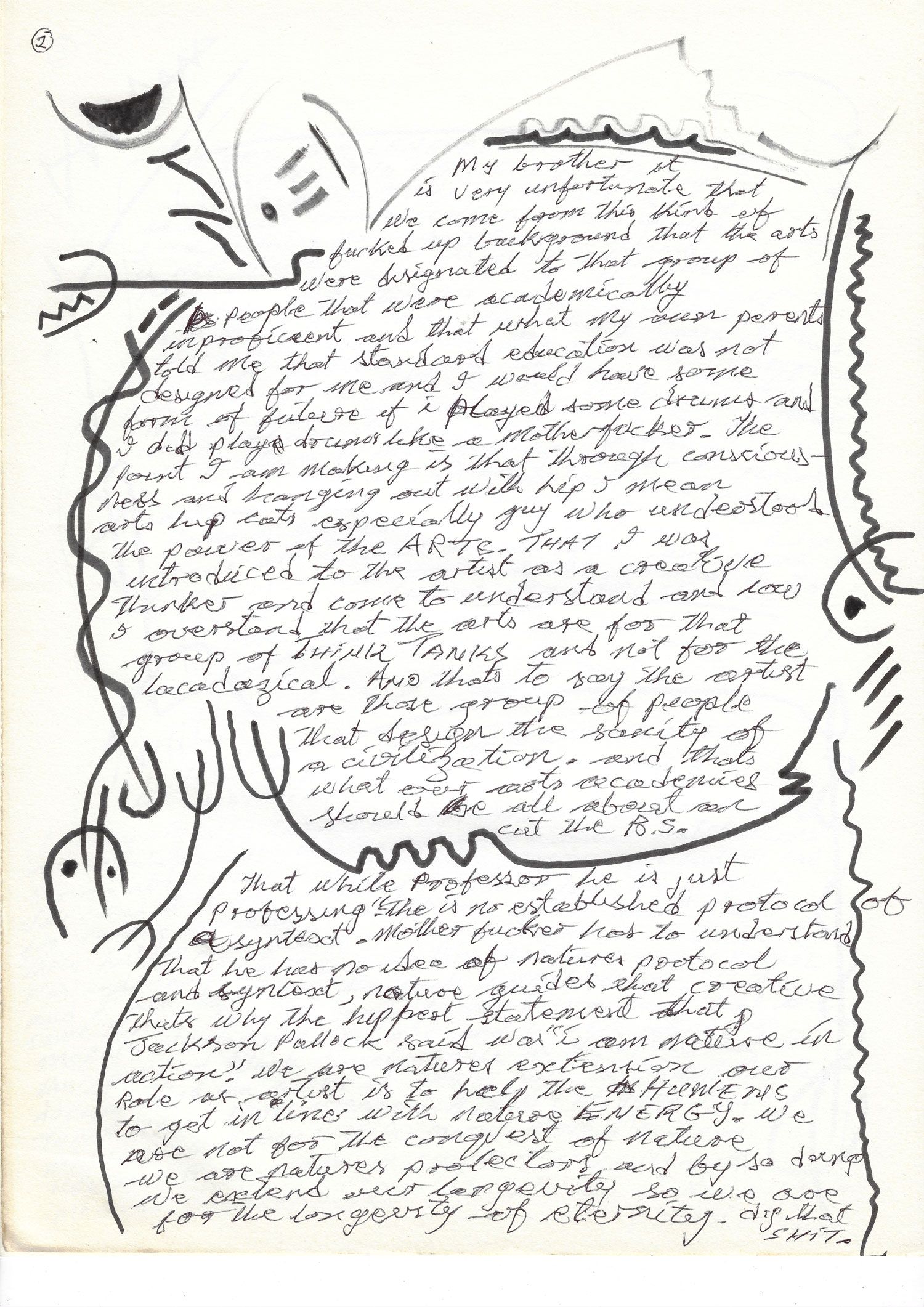
My brother it is very unfortunate that we come from this kind of fucked up background that the arts were designated to that group of people that were academically inproficient and that what my own parents told me that standard education was not designed for me and I would have some form of future if I played some drums and I did play drums like a motherfucker. The point I am making is that through consciousness and hanging out with hip I mean arts hip cats especially guys who understood the power of the ARTS, that I was introduced to the artist as a creative thinker and came to understand and how I overstood that the arts are for that group of THINK TANKS and not for the lackadaizical. And that to say the artists are those group of people that design the sanity of a civilization, and that’s what our arts academics should be all about and cut the B.S.
That white professor he is just professing there is no established protocol syntext not to understand that he has no sense of nature’s protocol and syntext, nature guides that creative, that’s why the hippest statement that Jackson Pollock said was “I am nature in action”. We are nature’s extension our role as artists is to help the HUMANS to get in line with nature’s ENERGY. We are not for the conquest of nature we are nature’s protector’s, and by so doing we extend our longevity so we are for longevity of eternity. Dig that SHIT.
3
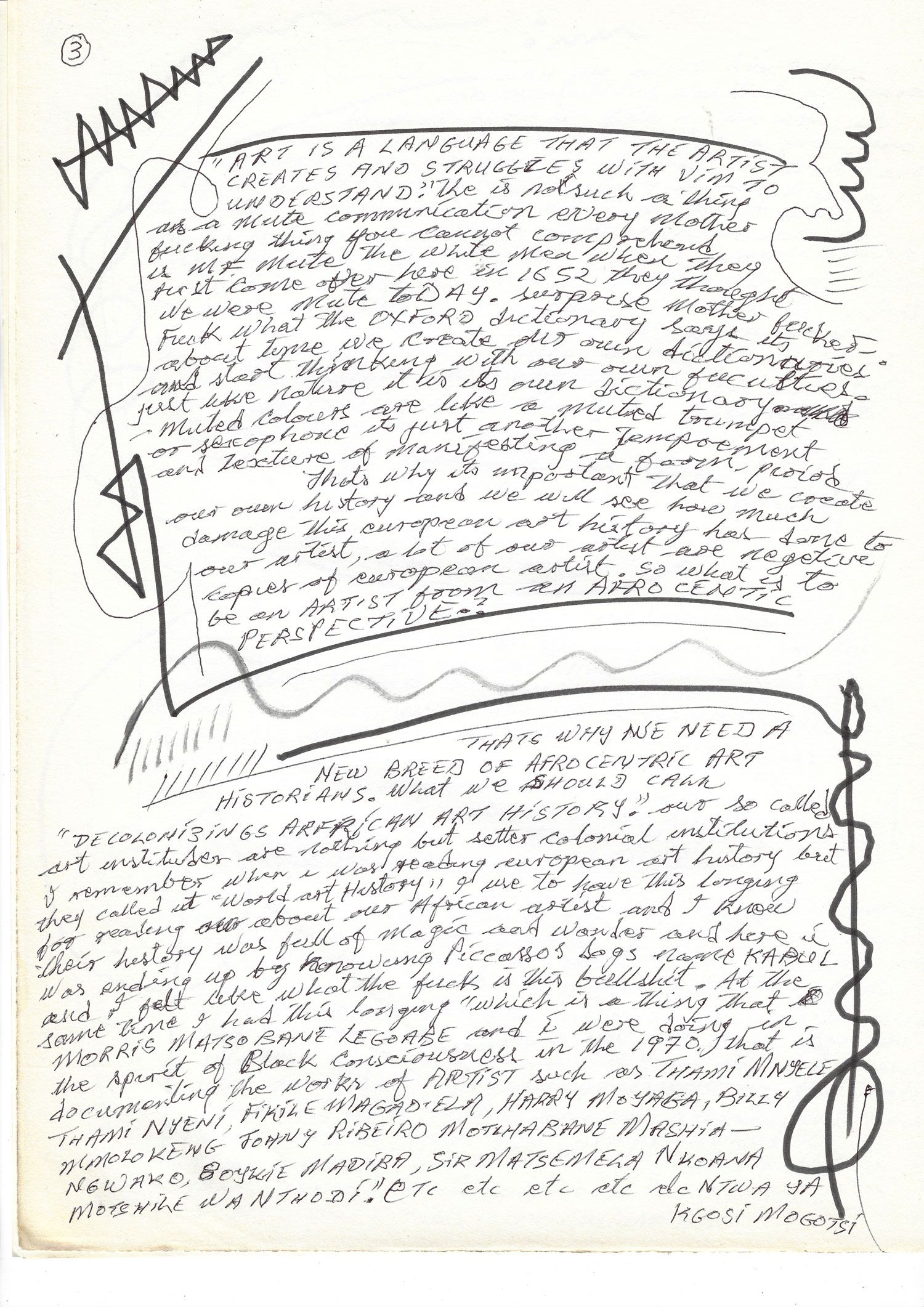
“ART IS A LANGUAGE THAT THE ARTIST CREATES AND STRUGGLES WITH VIM TO UNDERSTAND”: There is not such a thing as a mute communication every mother fucking thing you cannot comprehend is M.F. mute the white men when they first came over here in 1652 they thought we were mute to DAY. surprise mother fucker Fuck what the OXFORD dictionary says it’s about time we create our own dictionaries and start thinking with our own faculties just like nature it is its own dictionary. Muted colours are like a muted trumpet or saxophone it’s just another temperament and texture of manifesting a form, period.
That’s why its important that we create our own history and we will see how much damage this European art history has done to our artists, a lot of our artists are negative copies of European artists. So what is it to be an artist from an AFROCENTRIC PERSPECTIVE?
THAT’S WHY WE NEED A NEW BREED OF AFROCENTRIC ART HISTORIANS. What we should call “DECOLONISING AFRICAN ART HISTORY”. Our so-called art institutions are nothing but settler colonial institutions. I remember when I was reading European art history but they called it “World art History” I used to have this longing for reading about our African artists and I know their history was full of magic and wonder and here it was ending up by knowing Picasso’s dog name KABUL and I felt like what the fuck is this bullshit? At the same time I had this longing which is a thing that MORRIS MATSOBANE LEGOABE and I were doing in the spirit of Black Consciousness in the 1970s and that is documenting the works of ARTISTS such as THAMI MNYELE, THAMI NYENI, FIKILE MAGADLELA, HARRY MOYABA, BILLY MMOLOKENG, JOHNNY RIBEIRO, MOTLHABANE MASHIANGWAKO, MOYKIE MADIBA, SIR MATSEMELA NKOANA, MOTSHILE WANTODI. Etc. etc. etc etc de NTWA YA KGOSI MOGOTSI
4
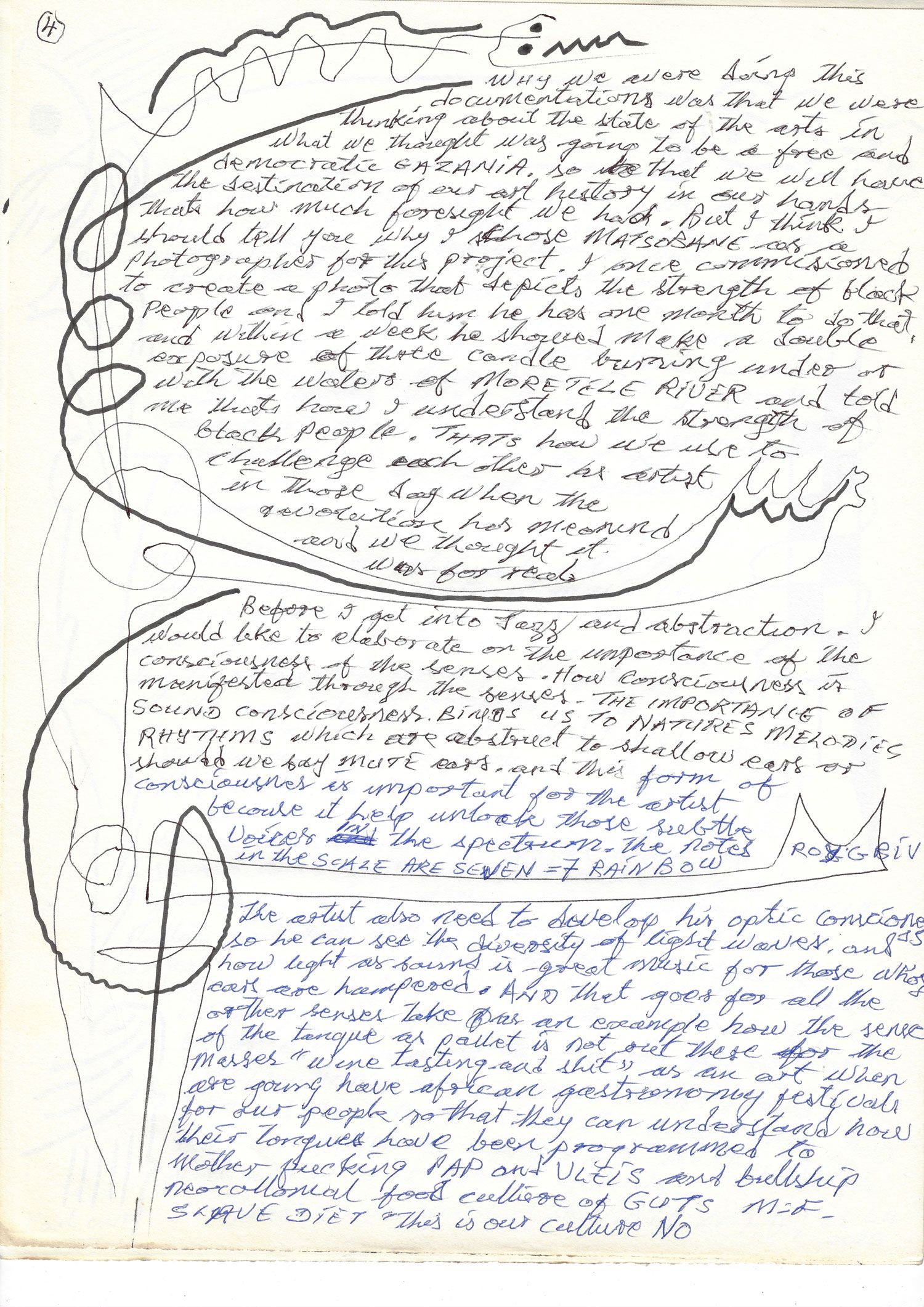
Why we were doing this documentations was that we were thinking about the state of the arts in what we thought was going to be a free and democratic AZANIA. So that we did have the destination of our art history in our hands, that’s how much foresight we had. But I think I should tell you why I chose MATSOBANE as a photographer for this project. I once commissioned to create a photo that depicts the strength of black people and I told him he has one month to do that, and within a week he should make a double exposure of three candles burning under or with the waters of MORETELE RIVER and told me that’s how I understand the strength of black people. That’s how we used to challenge each other as artists in those days when the revolution had meaning and we thought it was for real.
Before I get into jazz and abstraction. I would like to elaborate on the importance of the consciousness of the senses. How consciousness is manifested through the senses. THE IMPORTANCE OF SOUND CONSCIOUSNESS BINDS US TO NATURE’S MELODIES RHYTHMS which are abstract to shallow ears or should we say mute ears, and this form of consciousness is important for the artist because it helps unlock those subtle voices in the spectrum. The notes in the scale are seven = 7 RAINBOW ROYGBIV
The artist also needs to develop his optic consciousness so he can see the diversity of light waves and how light as sound is great music for those whose ears are hampered. AND that goes for all the other senses take an example how the sense of the tongue as pallet is not out there for the masses “wine tasting and shit” as an art when are going have African gastronomy festivals for our people so that they can understand how their tongues have been programmed to mother fucking PAP and VLEIS and bullshit neo-colonial food culture of GUTS. M.F. SLAVE DIET. This is our culture NO.
5
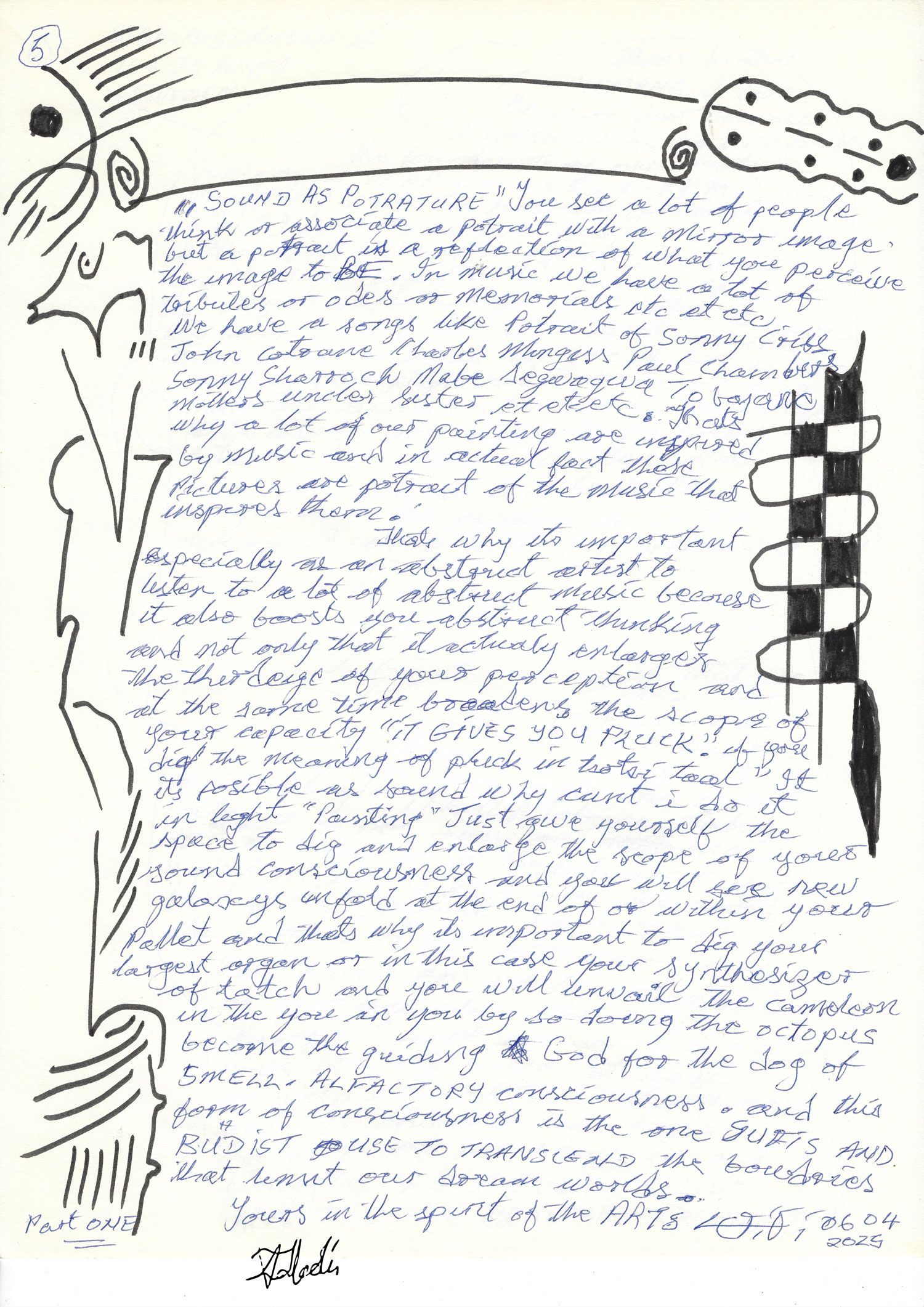
SOUND AS PORTRAITURE. You see a lot of people think or associate a portrait with a mirror image but a portrait is a reflection of what you perceive the image to BE. In music we have a lot of tributes or odes or memorials etc etc etc. We have a songs like Portrait of Sonny Criss John Coltrane Charles Mingus Paul Chambers Sonny Sharrock Mabe Segwagwa Tobejane mothers under sister etc etc etc. That’s why a lot of our paintings are inspired by music and in actual fact those pictures are portraits of the music that inspires them.
That’s why it is important especially as an abstract artist to listen to a lot of abstract music because it also boosts your abstract thinking and not only that, it actually enlarges the third eye of your perception and at the same time broadens the scope of your capacity “IT GIVES YOU PLUCK” if you dig the meaning of pluck in tsotsi taal. It is possible as sound, why can’t I do it in light “Painting”? Just give yourself the space to dig and enlarge the scope of your sound consciousness and you will see new galaxies unfold at the end or within your pallet and that’s why it’s important to dig your largest organ or in this case your synthesizer of touch and you will unveil the chameleon in the you in you by so doing the octopus become the guiding God for the dog of SMELL. OLFACTORY consciousness, and this form of consciousness is the one SUFIs and BUDDHISTs USE TO TRANSCEND the boundaries that limit our dream worlds.
Yours in the spirit of the ARTS. LEFIFI 06042025
1
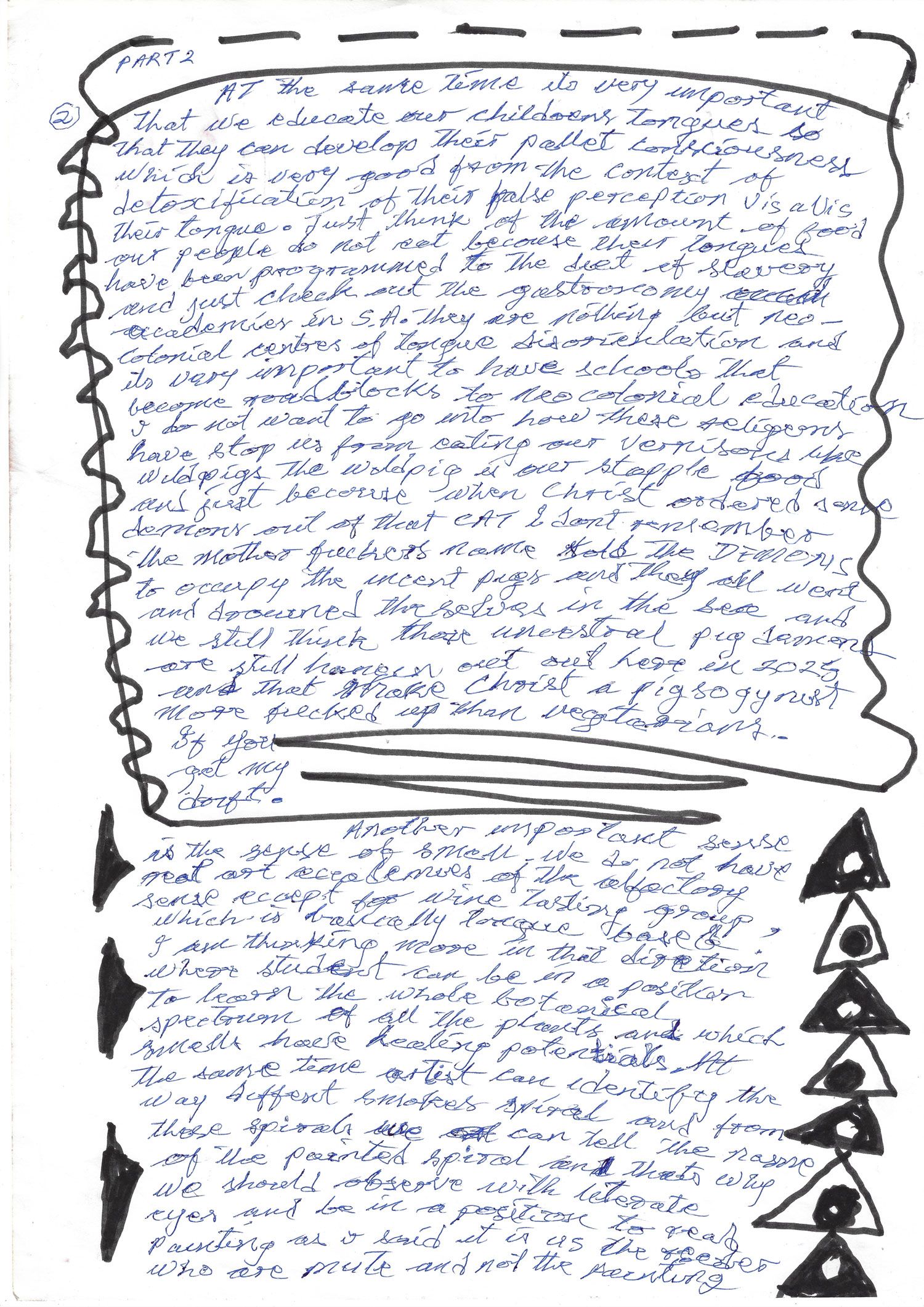
At the same time it’s very important that we educate our children’s tongues so that they can develop their pallet consciousness which is very good from the context of detoxification of their false perception vis a vis their tongue. Just think of the amount of food our people do not eat because their tongues have been rpgrammed to the diet of slavery and just check out the gastronomy academies in S.A. They are nothing but neo-colonial centres of tongue disorientation and its very important to have schools that become roadblocks to neocolonial education. I do not want to go into how these religions have stopped us from eating our vernisones (????) like wildpigs the wild pig is our staple food and just because when Christ ordered some demon out of that cat I don’t remember the motherfucker’s name told the demons to occupy the innocent pigs and they all went and drowned themselves in the sea and we still think those ancestral pig jamsen (?????) are still hanging out here in 2025 and that makes Christ a pigsogynist more fucked up than vegetarians if you get my drift.
Another important sense is the sense of smell. We do not have real art receptiness (????) of the olfactory sense except for wine tasting group which is basically tongue based. I am thinking more in that direction where student can be in a position to learn the whole botanical spectrum of all the plants and which smells have healing potentials. At the same time artists can identify the way different smokes spiral and from these spirals we can tell the name of the painted spiral and that’s why we should observe with literate eyes and be in a position to read painting as I said it is us the reader who are mute and not the painting.
2
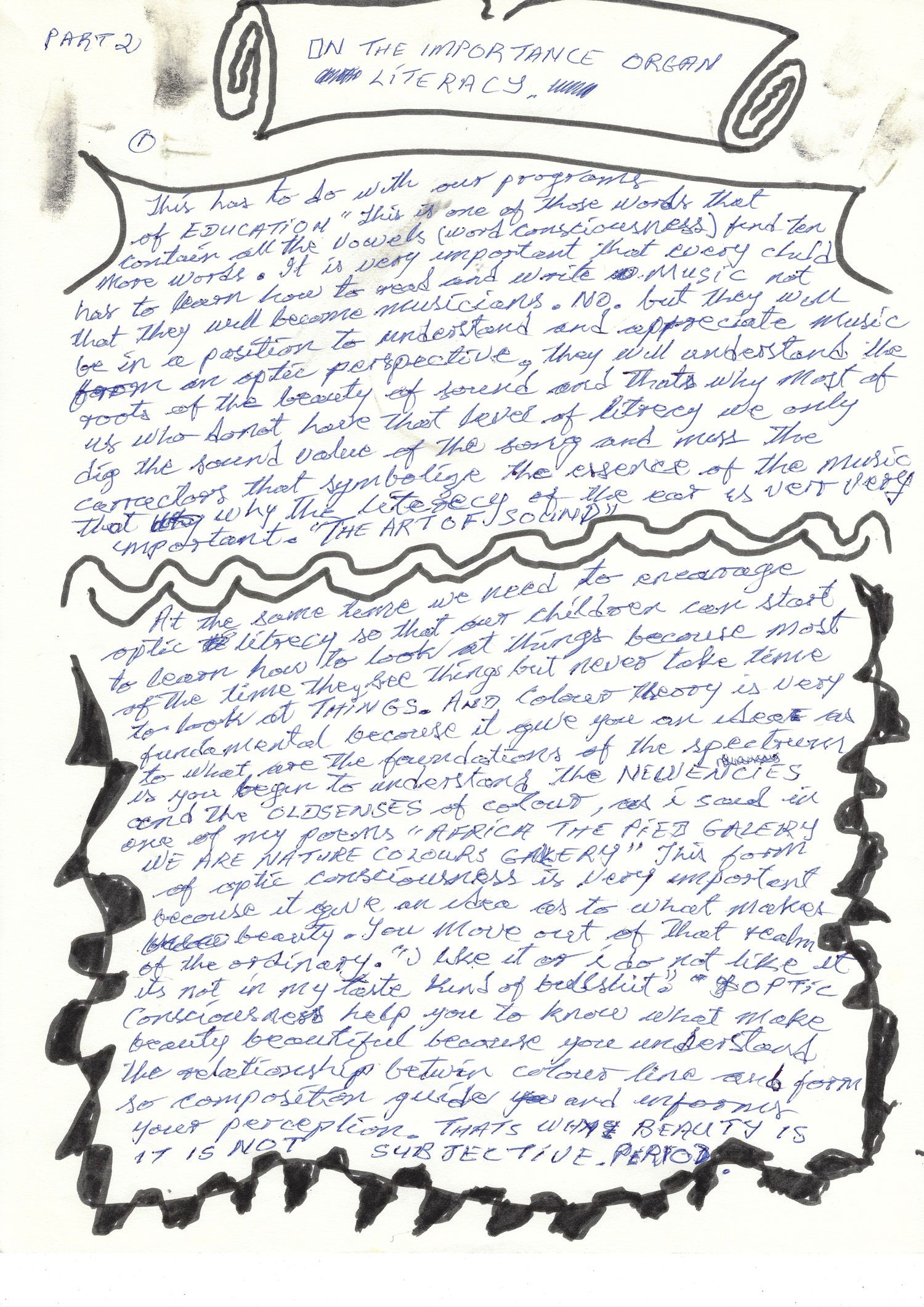
ON THE IMPORTANCE ORGAN LITERACY
This has to do with our programs of EDUCATION. This is one of those words that contain all the vowels (word consciousness) find ten more words. It is very important that every child has to learn how to read and write music, not that they will become musicians. No. but they will be in a position to understand and appreciate music from an optic perspective, they will understand the roots of the beauty of sound and that’s why most of us who don’t have that level of literacy we only dig the sound value of the song and miss the characters that symbolize the essence of the music that’s why the literacy of the ear is very very important. THE ART OF SOUND.
At the same time we need to encourage optic literacy so that our children can start to learn how to look at things because most of the time they see things but never take time to look at THINGS. And colour theory is very fundamental because it gives you an insight as to what are the foundations of the spectrum. As you begin to understand the NEW SENSES and the OLD SENSES of colour, as I said in one of my poems “AFRICA THE PIED GALLERY WE ARE NATURE COLOURS GALLERY” This form of optic consciousness is very important because it gives you an idea as to what makes beauty. You move out of that realm of the ordinary. “I like it or I do not like it it’s not in my taste” kind of bullshit. OPTIC consciousness helps you to know what makes beauty beautiful because you understand the relationship between colour, line and form so composition guides you and informs your perception. THAT’S WHY BEAUTY IS NOT SUBJECTIVE. PERIOD. Lefifi Tladi.