KEITH ADAMS
Vakalisa Arts Associates, 1982–1992: Reflections
South Africa has undergone many political, social and economic changes since the arrival of the colonists on its shores in the early 17th century. Both British and white Afrikaner minority rule effectively dispossessed the local black majority of land, resources, and basic human rights. The apartheid era precipitated different forms of resistance, and amongst the dissidents were artists, or cultural workers. Vakalisa Arts Associates, the well-known 1980s Cape Town group, exemplified the use of art as a tool of liberation.
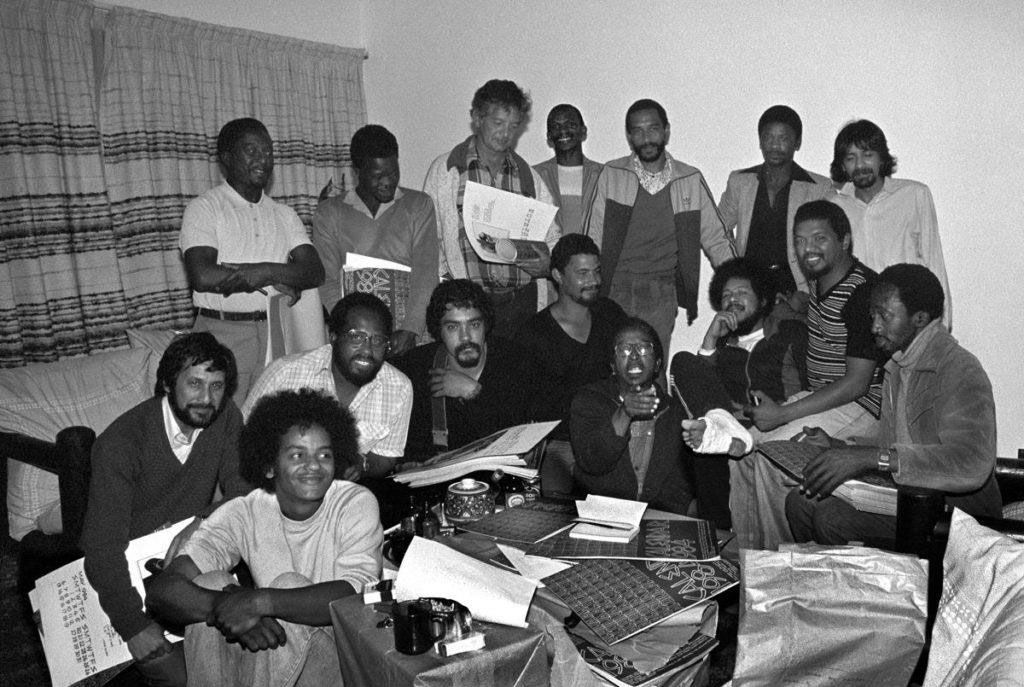
In the years before Vakalisa formed, the future members were a loosely knit group of individual artists who knew each other well. In 1982, preparations began at the Community Arts Project (CAP) for the Culture and Resistance Conference that would be held in Gaborone in 1982. Lionel Davis was involved in the facilitation, despite some recent political tensions at CAP.[1]Although Lionel Davis stated that “CAP was a place for making contact with other artists and a training resource for those with little or no training in the visual arts, writing, photography, dance and drama,” it was not a politically neutral site. CAP had previously been boycotted by many Cape Town artists due to its acceptance of funding from the Urban Foundation to pay its rent in 1977-1978. Many considered the Urban Foundation to be an organisation whose sole purpose was to create an acquiescing middle class, rather than to support mass working class liberation struggle. The centre ultimately rejected UF funding after 1978, and artists like Davis who had raised questions about UF were in attendance at the planning meetings for CRC. The meetings brought many Cape Town artists into conversation together.
The effect of the Gaborone conference was that it filled the returning artists with a renewed sense of purpose. Many felt that artists should not stand on the side-lines and that their art should be a weapon in the fight against the apartheid regime. This lead to some new activities at CAP, including a revival of its photography section and the establishment of a department that would endure in various forms, until the centre’s eventual closure.[2]Activities at this department included a series of poster-making workshops, which began soon after the Culture and Resistance Conference. Importantly, in terms of the inception of Vakalisa, an art exhibition took place at the Luyolo Recreational Centre in Gugulethu, Cape Town with the assistance of the Nyanga Arts Centre. Amongst others, artists Peter Clarke, Hamilton Budaza and Mervyn Davids, who would all become part of Vakalisa, took part. Further, at this time, the Nyanga Arts Centre was run by the Holo brothers, Patrick and Sydney, who would also join Vakalisa.
Vakalisa: Politics, Structures, Objectives
In 1984, two years after the Culture and Resistance Conference, the idea of Vakalisa was born. At the inaugural meeting, the group agreed on their name. ‘Vakalisa,’ loosely translated, means ‘to propagate,’ ‘to spread,’ ‘to publish’ or ‘to inform.’ It is an isiXhosa derivative of ‘vuka’ meaning ‘wake up.’
The core group was a nucleus of twenty men, and other artists were continually invited to participate in Vakalisa’s activities.[3]Mervyn Davids, Hamilton Budaza, Patrick Holo, Sydney Holo, Jimi Matthews, Rashid Lombard, Rudien Holman, Michael Barry, Peter Berry, Mario Sickle, Keith Adams, Kenneth Baker, Johann Davids, Hein Willemse, Peter Clarke, Lionel Davis, Garth Erasmus, James Matthews, Willie Adams and Basil Coetzee. In 1985, the organisation would bring women on board for the first time, including Mavis Smallberg, Gladys Thomas, Beverley Jansen and others later on.[4]The fact that there were no women in the initial group was something most members wanted to address. Even though close-knit friendships flourished in the all-male terrain, it was felt that it was imperative that women participate in all Vakalisa’s activities and be part of the collective.
While its members represented a cross-spectrum of the political landscape, including charterists, black consciousness adherents and workerists, inside Vakalisa itself, the black consciousness grouping held sway.
So although some members worked with white people in their own creative fields, membership was only open to black people, or ‘people of colour,’ who endorsed the views of the organisation. What held Vakalisa’s diverse political strands together was the fact that many of the members had longstanding friendships, and all members shared a passion for creative processes and felt that their art should contribute to the struggle for meaningful change in South Africa.
The group opted for an administrative committee that included a secretary, project organiser and treasurer, and although Mervyn Davids was the unanimous choice of secretary, he filled all three positions when required.[5]Mervyn Davids was capable, astute and well versed in the fragmented art scene in the Western Cape at the time. But regardless of these structural formalities, it was a group decision that Vakalisa remain as flexible as possible. Members wanted to avoid long, tedious meetings and unnecessary bureaucratic procedures, wanting to keep their energy focused on art production. Meetings would take place at a member’s house, with the host having to supply food and drinks.
But certain members thought that the group structure was too relaxed and lacked the necessary discipline. They felt that there was too much food and drink at meetings, which inevitably led them into becoming social gatherings, and that the group needed a more formal, rigid structure. One member even left because of what he called the ‘laissez faire’ tone of the meetings. However, the majority felt that Vakalisa was meant to be an opportunity for friends to hang out and discuss important matters in a relaxed atmosphere.[6]James Matthews had a phobia about joining organisations but nevertheless felt comfortable in Vakalisa. The group’s less formal structure allowed members to both connect as friends and to work together. So although there were robust debates, these were always tempered with mutual respect.
Vakalisa’s approach was defined by collaboration and the by-passing of established art institutions. The artists would not only work together, but would also formulate their own spaces for exhibition.
A 1984 Grassroots article, ‘Artists of Vakalisa,’ explains, “Vakalisa sees its work as being politically motivated by the struggles of the working class and rejects the idea of the artist as being individualistic, eccentric and politically divorced from his or her social reality.”[7]Unknown author, “Artists of Vakalisa,” Grassroots 5 (1984): 11. The group photograph accompanying the article shows the original membership of Vakalisa, including five members who have subsequently passed on. These are celebrated artists Peter Clarke, Mario Sickle and Kenneth Bakers, poet Willie Adams and musician Basil Coetzee. Their choice to operate in their own communities, rather than within elite art institutions, was in keeping with this.
Collective Work and Connected Work
Vakalisa’s most prominent activities were the making and distribution of their calendars, as well as holding exhibitions and performances in community spaces like libraries. Additionally, the group brought out a poetry anthology called Vakalisa Writers in 1986, featuring writers from the group.
Aside from this collective work, the Vakalisa members made various connections through work, art, writing and political organising. Apart from the politically-oriented work of Vakalisa, many members were involved in other political activity. During the 1980s, Rashid Lombard and Jimi Matthews were, at times, covering conflict in South Africa and abroad for news agencies. Some members were doing various work overseas in the US, and so on. Through all this, Vakalisa kept the lines of communication open, updating one another about what was happening in the artistic realm.
In 1984, Vakalisa was asked to assume responsibility for organising a meeting of all Cape Town based cultural workers at CAP, toward some sort of unification. Cape Town has always had a divided artistic base, and there were various interest groups at the meeting that sought to protect their territory. Even though Vakalisa was well respected by most artists in the province, factionalism proved too strong, and the notion of one united artistic body fell apart.
Over the years, members have met and allied with many institutions, publications and individuals, and they have facilitated and participated in numerous discussions on the arts. Further, many Vakalisa members have made tremendous personal achievements in their own lives. Worth mentioning outright are the retrospective exhibitions of two Vakalisa members, Peter Clarke[8]Clarke’s retrospective at the Iziko South African National Gallery in 2012 included a panel discussion consisting of Vakalisa members, including Peter himself. They talked about the artist’s work and also about his important contribution to Vakalisa, where he was an integral member, providing guidance and mentorship. The session addressed the gender make-up of Vakalisa, its shortcomings and its impact on the Cape Town artistic panorama. Founding member, Michael Barry, came all the way from the Nelson Mandela University in Port Elizabeth, where he headed their art department. This would be the last time that most of the Vakalisa members would see Clarke again. and Lionel Davis[9]Vakalisa member Lionel Davis was responsible for many posters and sweaters that adorned the insignia of the Mass Democratic Movement in the 1980s and the years leading up to democracy. His exhibition opening at the Association for the Visual Arts Gallery in Cape Town, and his retrospective at the Iziko South African National Gallery, were both well attended by Vakalisa members. which, apart from being important historical moments, have provided connection points for returning to discussion on Vakalisa’s work in more recent years. Furthermore, it is a measure of the influential nature of Vakalisa members, that four of them – James Matthews, Gladys Thomas, the late Peter Clarke and Rashid Lombard – have received Ikhamanga National Orders from the Presidential Office in the categories of music, art, literature and journalism.
The Vakalisa Calendars
The first calendar appeared in 1984. Vakalisa saw calendars as a useful form for collaboration between artists and writers. Of course, they were also a widely distributable product and, initially, the group had seen them as a way to potentially raise funds for their next projects. However no money was actually made because of the banning order. Because Peter Clarke had a fine, calligraphy-style of handwriting, he was tasked with writing each text that appeared in the calendars which carried strong political messages.
The statement on the first calendar’s cover called for closer co- operation among artists, encouraging community-oriented work. After the first, each had a specific theme that was agreed upon by the general body, but all were strongly political. From 1984, all Vakalisa calendars were banned for distribution under the ‘Publications Act’, by the censorship board.
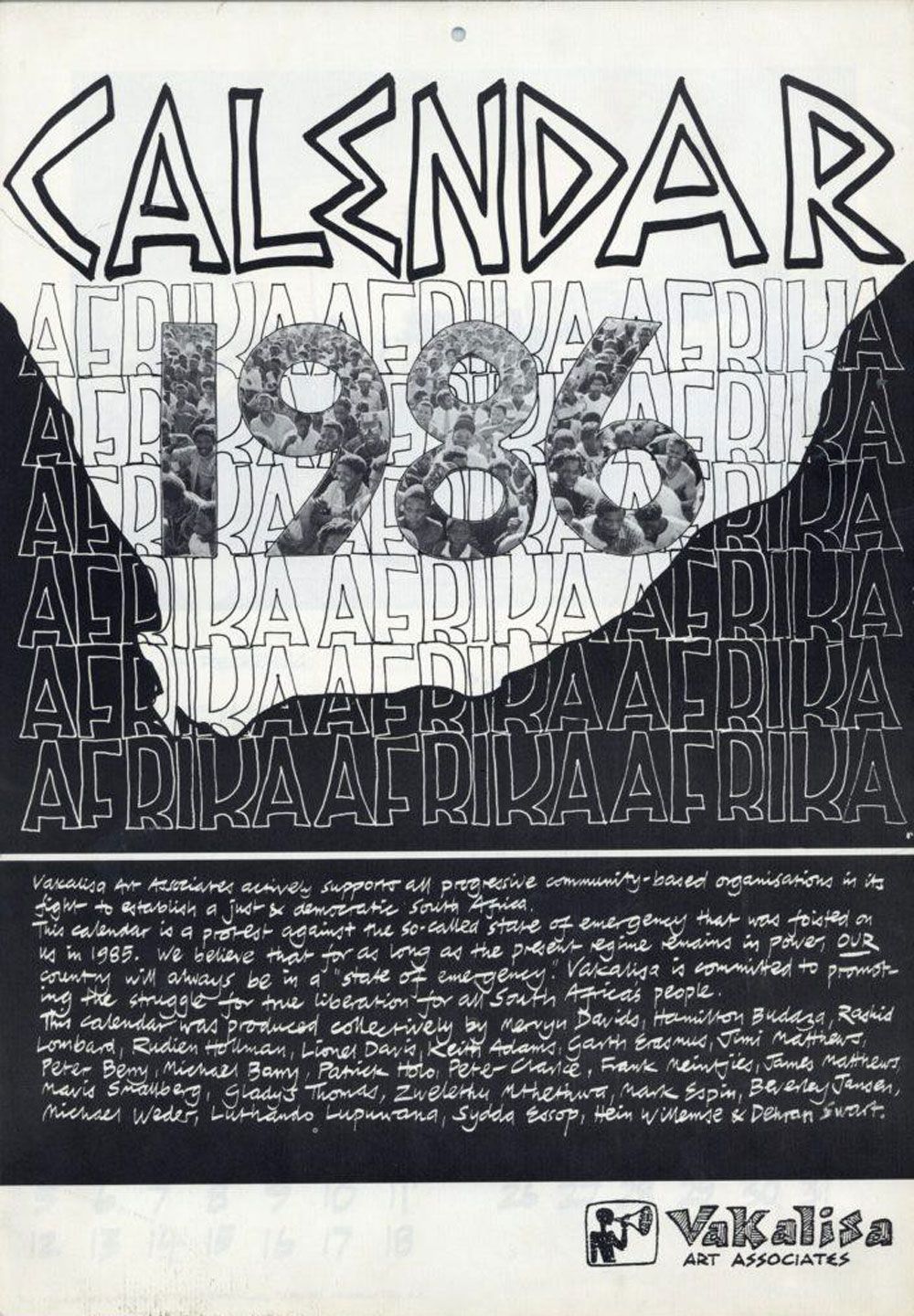
Regardless of the banning orders, Vakalisa always managed to get their calendars out to the community. They became collector’s items, and people would be calling throughout any given year requesting the calendar.
In 1986, in a calendar where Vakalisa protested the State of Emergency, the collective proclaimed solidarity with progressive community-based organisations, and re-stated their commitment to promoting the struggle for true South African liberation. Because of the banning, Vakalisa was not able to make money from the calendars and distributed them for free, rather than having them seized by the state. Printers were always of the understanding that payment might not be forthcoming or may even be late, depending on circumstances.
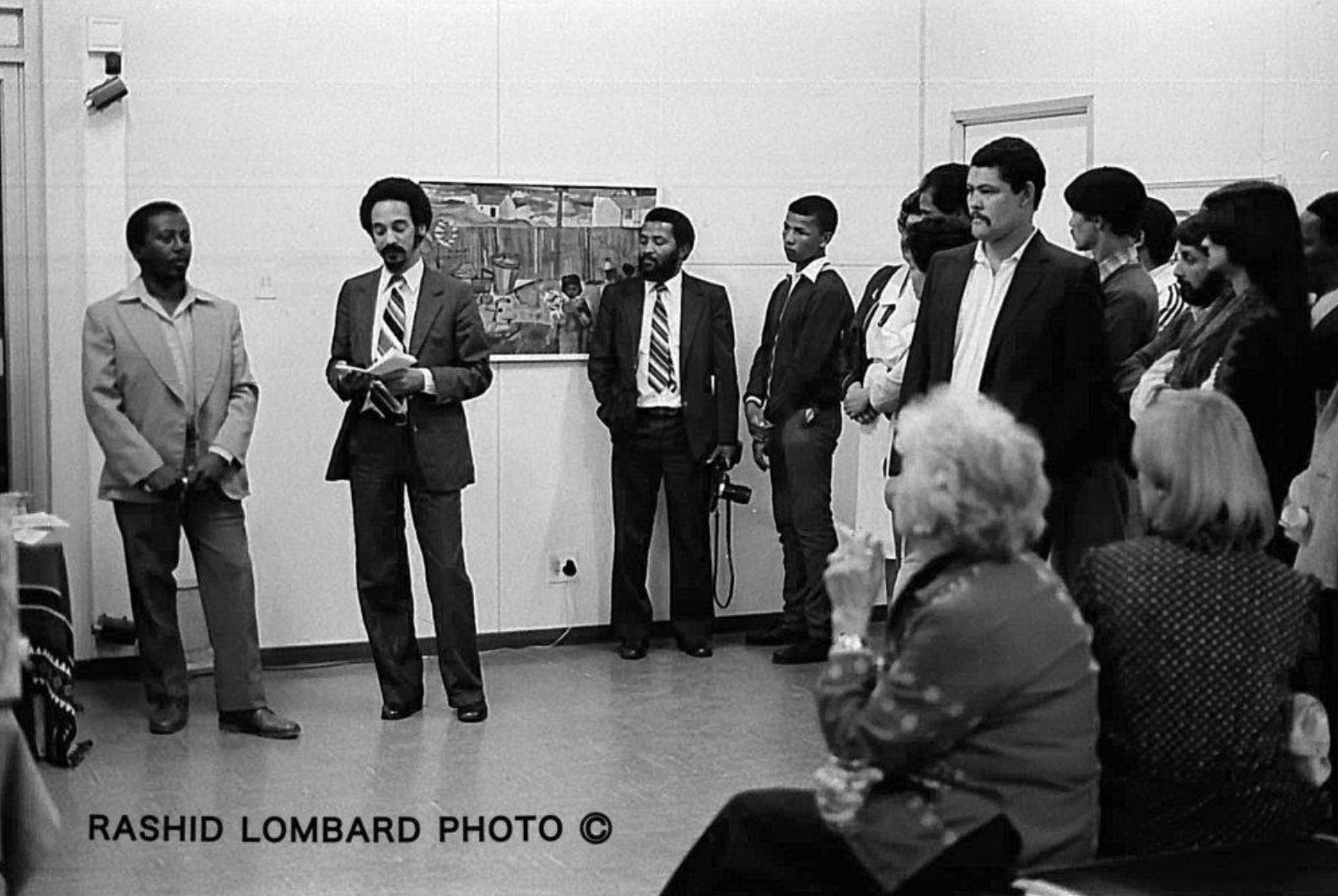
Images from this calendar appeared in an exhibition at the Bellville Library. The late Jakes Gerwel, former rector of the University of the Western Cape, was one of the guest speakers at the exhibition alongside Peter Clarke who spoke on behalf of Vakalisa.
Zenzile Khoisan, who wrote notes to accompany the exhibition, explained, “Artists were at the very centre of the struggle to destroy apartheid and build a new society and the works of that period reflected the depravity of the state, the intensity of repression and the quest to build a new society where the human spirit could triumph and be celebrated. One of the organisations which served as an umbrella for these compatriots was the Vakalisa Arts Associates.”[10]Zenzile Khoisan, Notes to the accompanying exhibition (Cape Town, 1986).
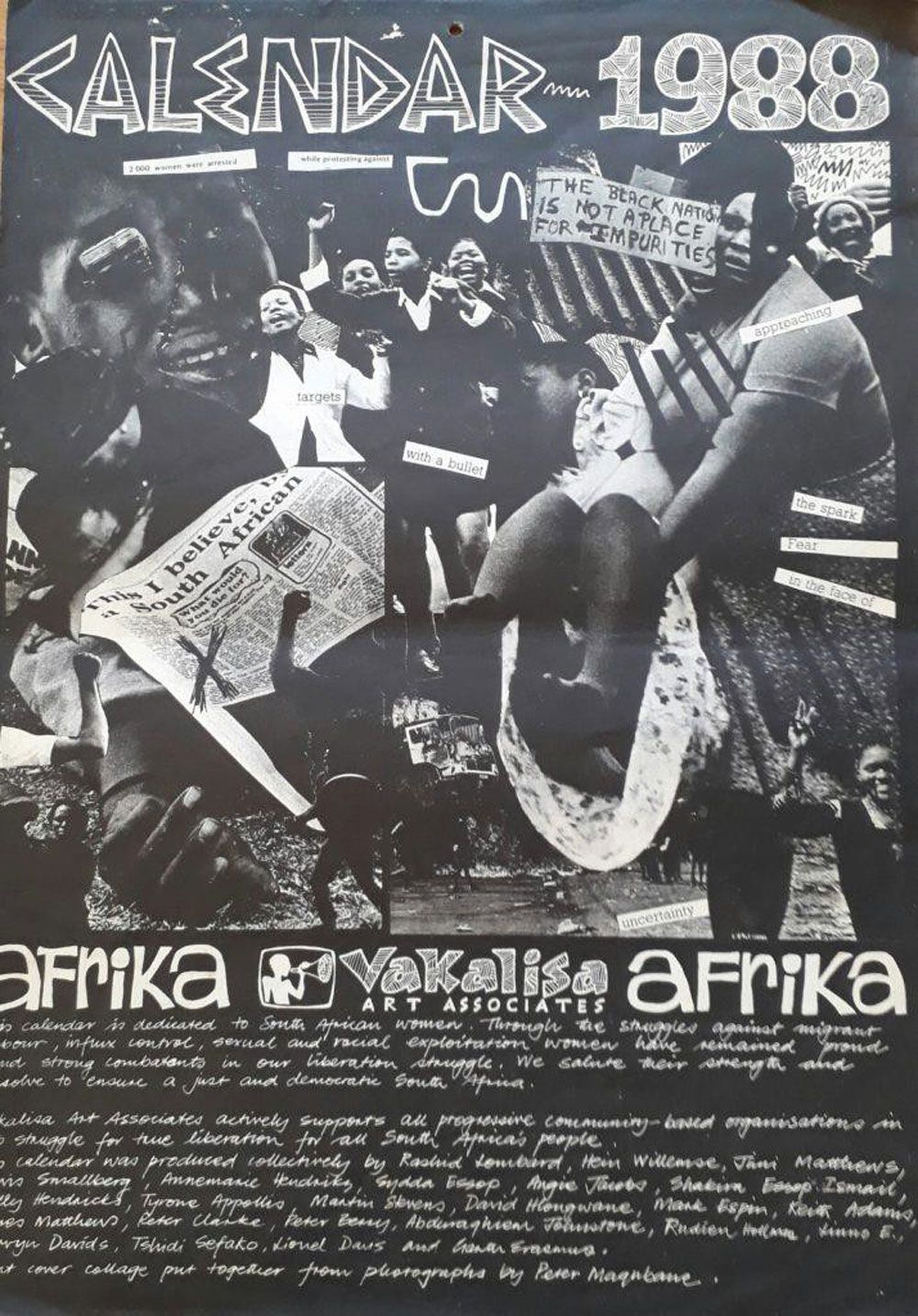
In 1988, the Vakalisa calendar was dedicated to women. It proclaimed this statement, recognising the strength women had shown in the liberation struggle, around the violence of migrant labour, influx control and sexual and racial exploitation. Although the front cover collage was put together from photographs by Peter Magubane, women artists featured prominently in this issue.
For the 1989 calendar, members sent in their texts and artworks from wherever they found themselves, whether in South Africa or overseas. This was a time of great upheaval, when artists, including those of Vakalisa, were asked to participate in the activities of the United Democratic Front, the labour movement and civic organisations. The 1989 Vakalisa calendar reiterated that the group supported all progressive community-based organisations in its fight to establish a just and democratic South Africa.
Due to heightened political activity of this time, Vakalisa members, amongst cultural workers more broadly, were involved in various ways in civic, community and political organising. Thus, they effectively stopped functioning as a unit in 1989.

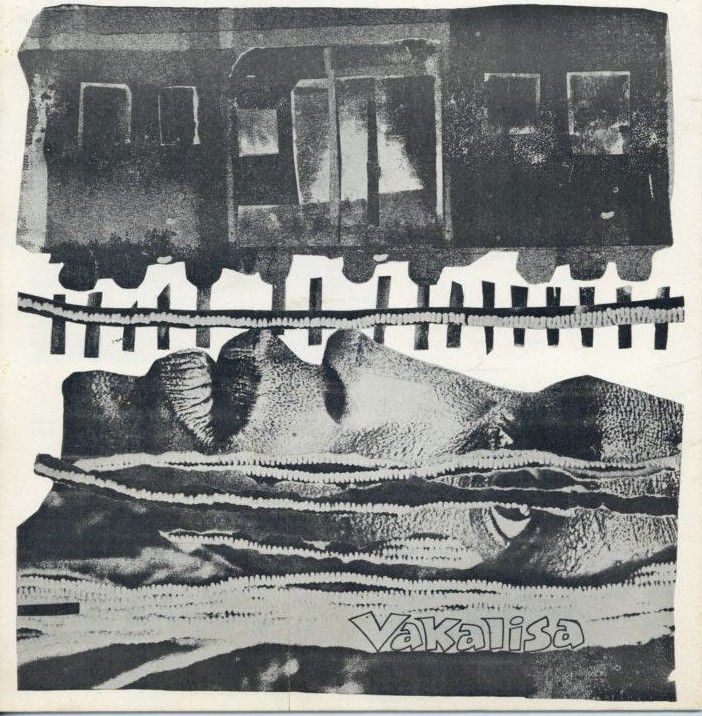
But in February 1991, in the context of deep political violence and unrest, the political and economic negotiations, and the artistic environment in a state of flux, Vakalisa decided to re-emerge. The need to look beyond art as a cultural weapon was tabled in a 1989 speech by the ANC’s Albie Sachs. The speech was published and circulated as an essay, generating a lot of discussion in the South African arts community in the years following. These discussions filtered into Vakalisa too, with members divided on the call to reassess their approach to cultural work.[11]See Albie Sachs, “Preparing Ourselves for Freedom: Culture and the ANC Constitutional Guidelines,” TDR 35, no. 1 (1991): 187–193.
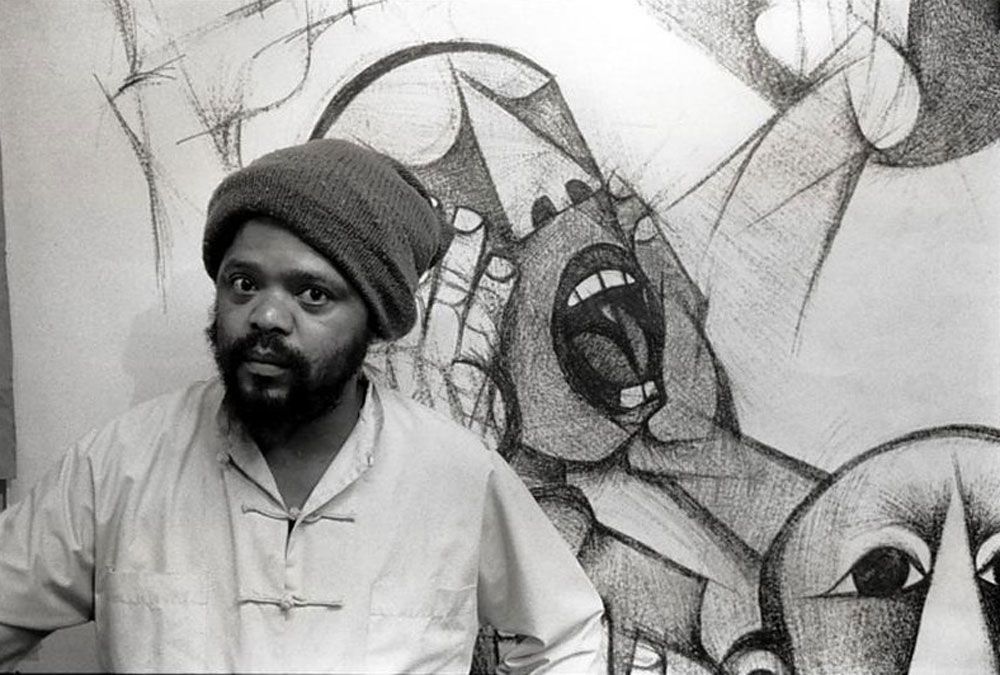
A series of informal social gatherings culminated in a larger meeting, which resulted in working on a final calendar that would come out in 1992. This was dedicated to the memory of artist Dumile Feni. Some members were close friends of Feni, others had just met him, but they were familiar with his work, and it was felt that an artist of his stature should be recognised and honoured.
The Vakalisa Exhibitions
In the years after forming, and during the times they were making calenders, Vakalisa organised numerous group exhibitions at different libraries in Cape Town, such as Elsies River, Rocklands, Belhar and Grassy Park. At the Grassy Park exhibition, musicians Basil Manenberg Coetzee and Cliffie Moses performed. The idea of musicians being part of an exhibition was a theme of Vakalisa projects. Whilst Basil was a member, Cliffie was a collaborator on this particular project. This was part of their approach in using alternative exhibition spaces which would better serve the communities in which the artists lived. Vakalisa also made an effort to connect with artists and artistic communities slightly further afield. In Paarl, Vakalisa artists were once hosted by artist Selwyn Pekeur. On this trip, they met with the Paarl arts community, exchanged ideas and shared what Vakalisa had been doing with the Paarl artists.
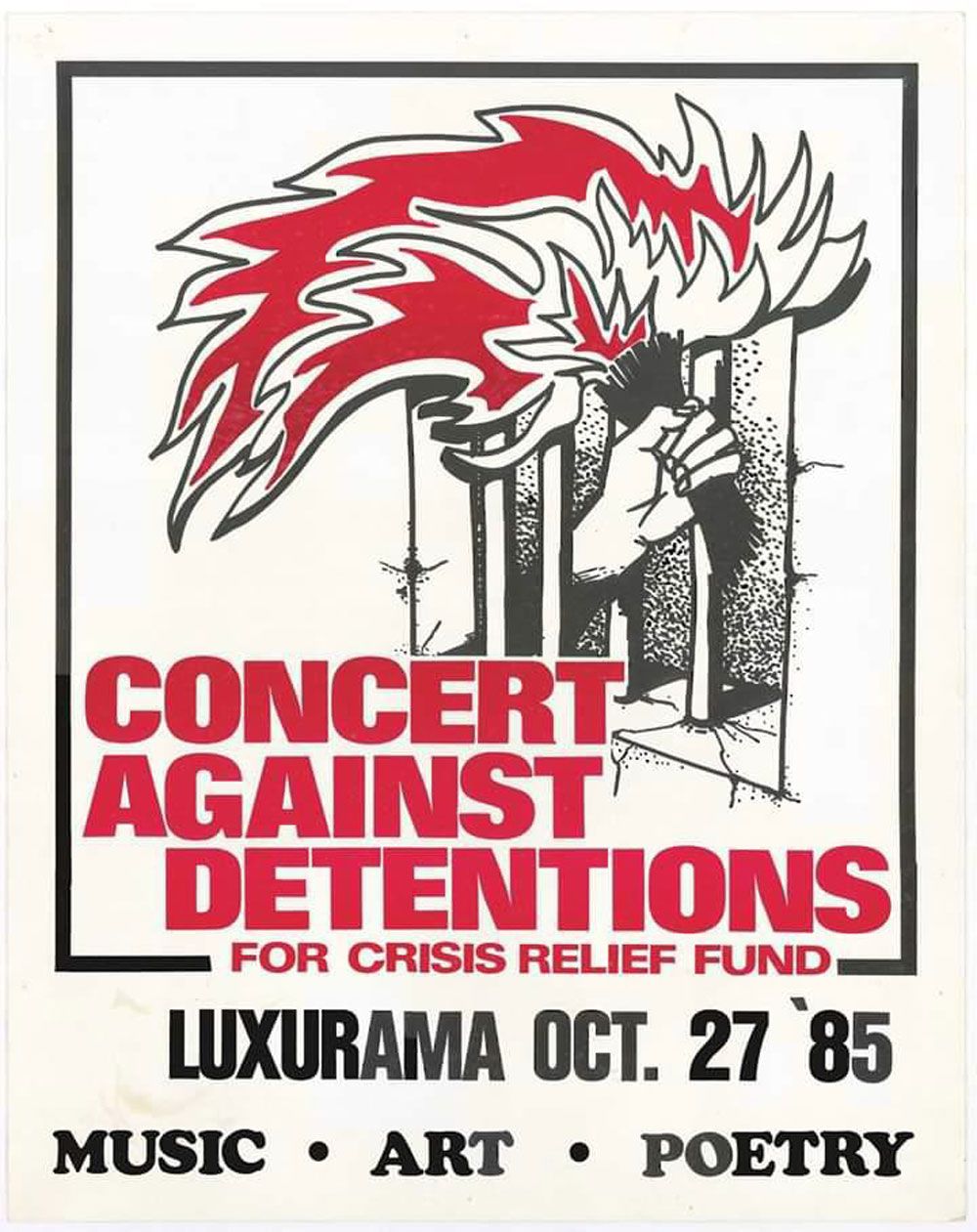
In 1985, there was a spate of prison detentions without trial, and many artists felt that they needed to contribute to the protest against this injustice. Albert Hess, Akbar Khan, Eion (Chunky) Brown and Keith Adams organised a fundraiser for the detainees by hosting a multi-media show. After months of planning and consultation, the event, Concert Against Detentions, took place in October at the Luxurama Cinema in Wynberg. It involved live music, writers performing their work in the theatre and artists exhibiting in the foyer. But before the start of the concert, the organisers were summoned to the police station and informed that all artworks in the foyer should be taken down, otherwise they would be confiscated. The artists refused to take down their works, stating their solidarity, despite potential loss of works. Only one person, an invited artist from the national gallery, ended up taking his work down. But despite the policing, the event was a huge success – the first of many concerts that would follow a similar theme. Arch Sydow, who was in charge of the door that evening, decided to let everyone in for free, because police casspirs outside were edging people onto the pavements and towards the glass doors.
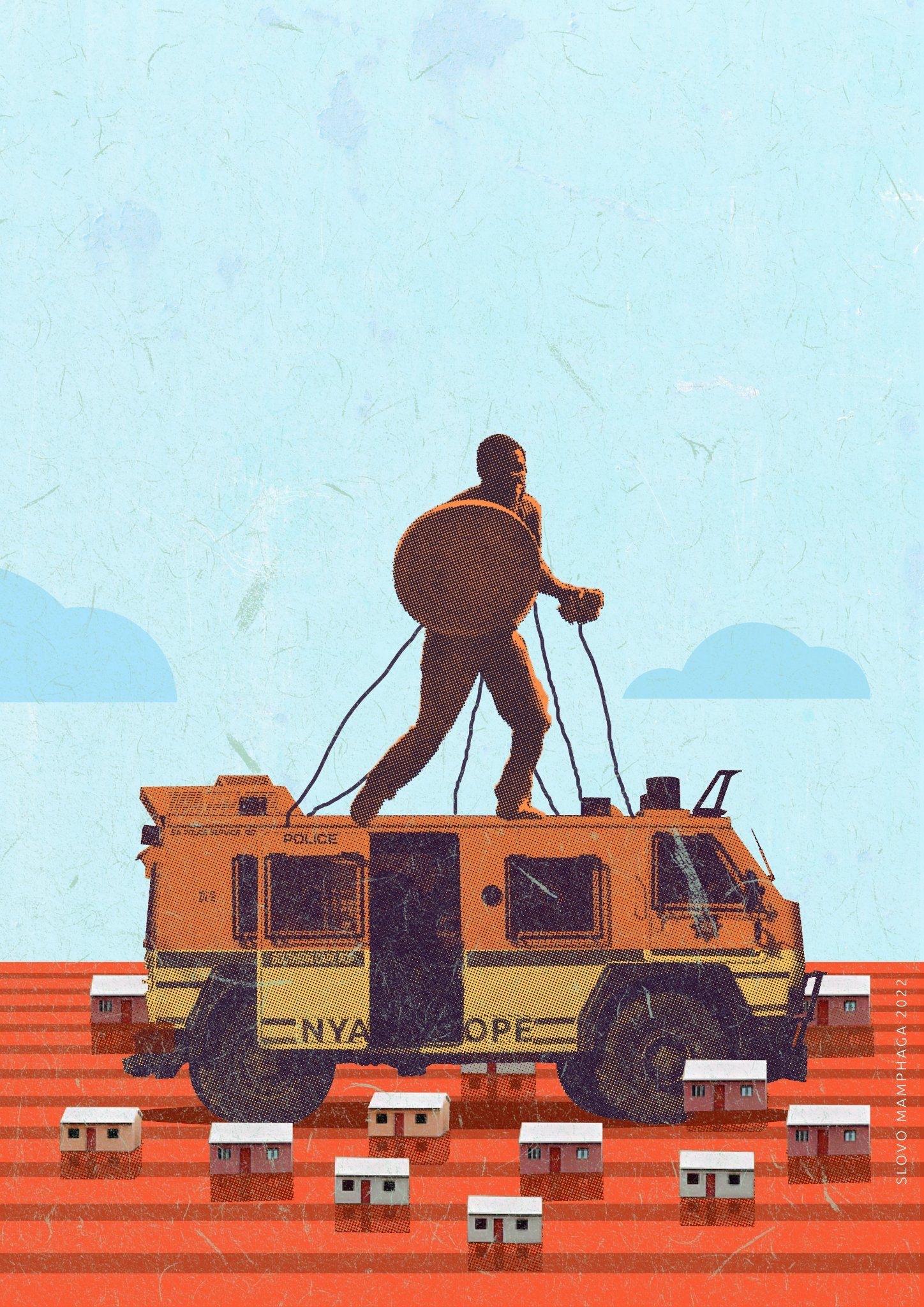
Vakalisa members have been involved in separate art and writing organisations and projects, and participated widely in conference panels, forums, fellowships, publications, exhibitions and performances in South Africa and abroad. The group has made numerous connections with individuals, institutions and other collectives over time.[12]Spaces Vakalisa has connected with include The African Arts Fund (affiliated with the United Nations Centre Against Apartheid), the African Refugee Centre, The Schomberg Centre in Harlem, The Smithsonion National Museum ofAfrican Art, Africa Centre, Third World, Pig Iron Press, Poets House, World Radio Poetry and American Pen. Additionally, the group connected with the Scottish Writers Union through author and Booker Prize winner James Kelman when he was in South Africa for the ANC’s first Department of Arts and Culture ‘s Consultative Conference.
In 1984, some Vakalisa members were involved in the establishment of the Writers’ Forum, which held its first meeting in July of 1985 in Johannesburg. Prominent writers, including Farouk Asvat and Don Mattera, drove the process from Johannesburg. Vakalisa members were invited, with James Matthews, Hein Willemse and Mavis Smallberg attending. The second meeting took place in 1986 in Cape Town and was hosted by Vakalisa members. The Writers’ Forum was the forerunner to The Congress of South African Writers.
Throughout the late 1980s and into the 1990s, Vakalisa members were invited to participate at various panels and events, including the 1987 International Book Fair Spotlight on Southern Africa in Washington DC, as well as a literary festival organised by Poets House. The African Research Communications Inc. organised the International Book Fair. It took place at the National Press Club in Washington DC, in the United States. Two Vakalisa participants were invited for two panels. Jimi Matthews was invited to the panel on censorship, and Keith Adams for the panel on the writer as an agent for social change. Unfortunately, Matthews was unable to make it to the conference. In the same year, in New York, Poets’ House organised a South African literary festival. Two Vakalisa members, Keith Adams and Hein Willemse, participated in the two day festival.
In 1988, members participated in a conference panel at Georgetown University. Keith Adams was invited to chair a panel at the university for a second conference on Southern Africa, organised by the African Research Communications Inc. This time, Gladys Thomas, a Vakalisa member, came all the way from South Africa to participate as well. African Research Communications Inc. was the brainchild of the late Henry Isaacs, former president of the South African Students Organisation (SASO), who was living in exile in the United States at the time.
Locally, James Matthews and Keith Adams shared a panel with Afrikaans celebrated writer, Breyten Breytenbach, at the Weekly Mail Book Fair at the Baxter Theatre, where Garth Erasmus and Mavis Smallberg also spoke on a panel called “Love, Lust, Hate and Vengeance.”[13] Much later, in 1992, Vakalisa was asked to chair the Western and Southern Cape region discussions at the first National Arts Policy Plenary in Johannesburg. These discussions were attended by artists throughout the country. Keith Adams chaired the highly emotive regional sessions. These left the Western Cape region dissatisfied. Adams realised that the brief was not inclusive enough and that the concerns of the Western Cape region were valid.
Vakalisa artists were regularly showing work in various exhibitions and presentations. Following the 1987 conferences in Amsterdam, Culture in Another South Africa, and at the University of the Western Cape, Peoples’ Culture Symposium, Vakalisa received an invitation for an exhibition in Amsterdam in 1988. The Amsterdam conference was a combined effort between the African National Congress in exile and the Nertherlands anti-apartheid movement. It was meant to widen the debate on culture and provide an opportunity for artists in exile to meet with artists inside the country. Vakalisa members who participated in the conference were writers Gladys Thomas, Mavis Smallberg, Hein Willemse and Basil Coetzee. The UWC conference was organised jointly with Vakalisa and the Department of Afrikaans and Nederlands. For the exhibition, invitations were sent to Vakalisa through Jimi Matthews and Rashid Lombard.
In the same period, members participated in a multimedia exhibition at Dartmouth College in the United States, Expressions of Resistance. Rashid Lombard’s photographs were displayed along with South African artists Karina Turok and Jonathan Shapiro’s works, and Keith Adams performed a reading.
In the late 1980s, Rashid Lombard held showings of his photographic work. Rashid worked with Magnum, a major photography agency. He exhibited at various venues around the United States, coordinated sometimes by Rachel Weiss, an art curator and historian who was the head of the art department at Massaachusetts College of Art in Boston at the time. One of Lombard’s photography exhibitions took place at Boston University in 1986, where Keith Adams performed his poetry with Sathima Bea Benjamin and Windsong.
Lionel Davis presented his work in Brooklyn for a group of Park Slope United Methodist members. As an interesting connection point, these same members were responsible for inviting Daniel Ortega from Nicaragua to speak in Park Slope, Brooklyn after the overthrow of the Somoza regime and the triumph of the Sandinistas. One of the people present for the talk that night was lawyer Martha Mann. She was responsible for drafting the divestment bill that barred American companies in the City of New York from doing business with South Africa.
Mervyn Davids and Garth Erasmus were also active in the United States, bringing valuable artistic insight to the institutions where they were involved.
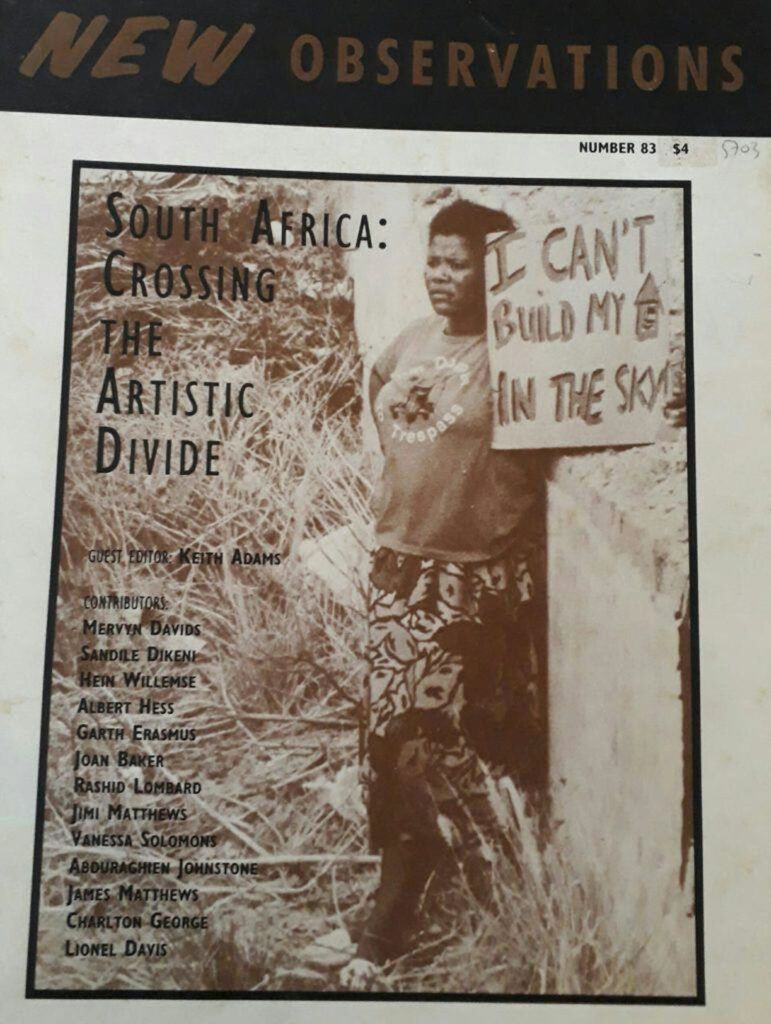
1988 saw New York magazine, New Observations, inviting Vakalisa member Keith Adams to be the South African editor for its forthcoming edition. New Observations has guest editors from all over the world, and it seeks to give theoretical meaning to artistic forms and practices. The edition Adams edited was called “South Africa: Art at the Crossroads,” and it dealt with South African art and the implications of the struggle for political change in the country. It included contributions from Vakalisa members Peter Clarke, Mavis Smallberg, Mario Sickle, Garth Erasmus and Rudien Holman, as well as from Kim Berman, Henry De Leeuw, Julian De Wette, Dumile Feni, Rajen Govendor, David Hlongwane, Don Mattera, Marlene Samuels, and T. Phil Wakashe.[14]See Keith Adams (ed.), “South Africa: Art at the Crossroads,” New Observations 56 (April 1988).
Another edition in 1991 looked at the changed artistic dynamics in the country and all its contributions were from Vakalisa members. This one was called “South Africa: Crossing the Artistic Divide.” The focus was on the changes taking place in South Africa and the response of the artistic community. Contributors included Joan Baker, Mervyn Davids, Lionel Davis, Sandile Dikeni, Garth Erasmus, Charlton George, Albert Hess, Abduraghien Johnstone, Rashid Lombard, Jimi Matthews, Vanessa Solomons and Hein Willemse.[15] See Keith Adams (ed.), “South Africa: Crossing the Artistic Divide,” New Observations 83 (May–June 1991).
In 1996, Vakalisa member Rashid Lombard collaborated with the editorial committee of the children’s magazine, Molo Songololo. Lombard contributed to the Molo Songololo Children of Africa series which is currently housed in the Nederlands Institute voor Zuidelijk Afrika (Amsterdam).
Vakalisa members have been published in collections and have written books. Amongst others, members are included in The Return of the Amasi Bird: Black South African poetry 1891-1981. I Qabane Labantu: Poetry in the emergency was edited by Hein Willemse with Ampie Coetzee. Keith Adams wrote We came for Mandela: The cultural life of the refugee community in South Africa. The 2001 book was launched at the Castle of Good Hope, and Adams sought the opinions of Vakalisa members regarding the accompanying exhibition. The exhibition included artists who were refugees and dealt, alongside the book’s theme, with the cultural life of the refugee community in South Africa. Additionally, Keith Adams’ book Suck the Bone, included an author photograph supplied by Jimi Matthews.
Rashid Lombard’s initiation of a discussion on lost histories of artists eventually birthed the book Memory Keepers, a project dealing with national living treasures and their connection to District Six. Keith Adams, Memory Keepers: District Six – Conversations with National Living Treasures (Cape Town: Backbooks, 2012). The book was launched at the District Six Museum in 2012. Vakalisa members such as Peter Berry, Mavis Smallberg and Garth Erasmus performed at the launch. Erasmus also did the cover of the book and the portraits of the contributors in the book. Michael Barry, Rashid Lombard and Mavis Smallberg presented textual inserts for the back cover of the book.
Later pursuits from various Vakalisa members have included helping with a Kenny Baker retrospective exhibition. The retrospective was held at the Library Centre at the Arts Association of Bellville and was organised by Vakalisa, in conjunction with the artist Conrad Theys and the Arts Association of Bellville. Due to the fact that the Kenneth Baker estate did not have sufficient works to exhibit, Vakalisa members offered their own Baker works and also scoured the Western Cape for any others that could be borrowed for the show. As a result of these efforts, there were more than enough artworks for a fully-fledged exhibition. Peter Clarke was the opening speaker, and Adams wrote the exhibition’s foreword text.
In 1999, Sanlam, in an attempt to redress the imbalances of the past, sought to give a public face to marginalised artists, looking towards “a vision of the company as being dedicated to the entire community irrespective of class, creed or any ethnic or linguistic affiliation.” They decided to have an exhibition at the Sanlam gallery in Bellville. Vakalisa was approached to spearhead the project, and Keith Adams was appointed as an external art consultant by Sanlam. The then Mayor of Cape Town, Theresa Solomons, was invited to open the exhibition of more than thirty artists, including some from Vakalisa.
Vakalisa was also involved workshopping and rehearsing with Pollsmoor prison inmates to perform the famous Beckett play Waiting for Godot. This project was spearheaded by the late Albert Thomas, husband of Gladys Thomas. He wanted to put the play on together with prison inmates and so approached Keith Adams, who was on the Correctional Services Board, in order to set it up. Thomas felt that, because the play was first performed in San Quentin prison, where it had resonated with the inmates, South African prisons would also be the perfect fit for staging Waiting for Godot. For more than a year, inmates at Pollsmoor did auditions, rehearsals and, in the lead up to the play, were coached in various artistic disciplines like writing and painting by Vakalisa members.
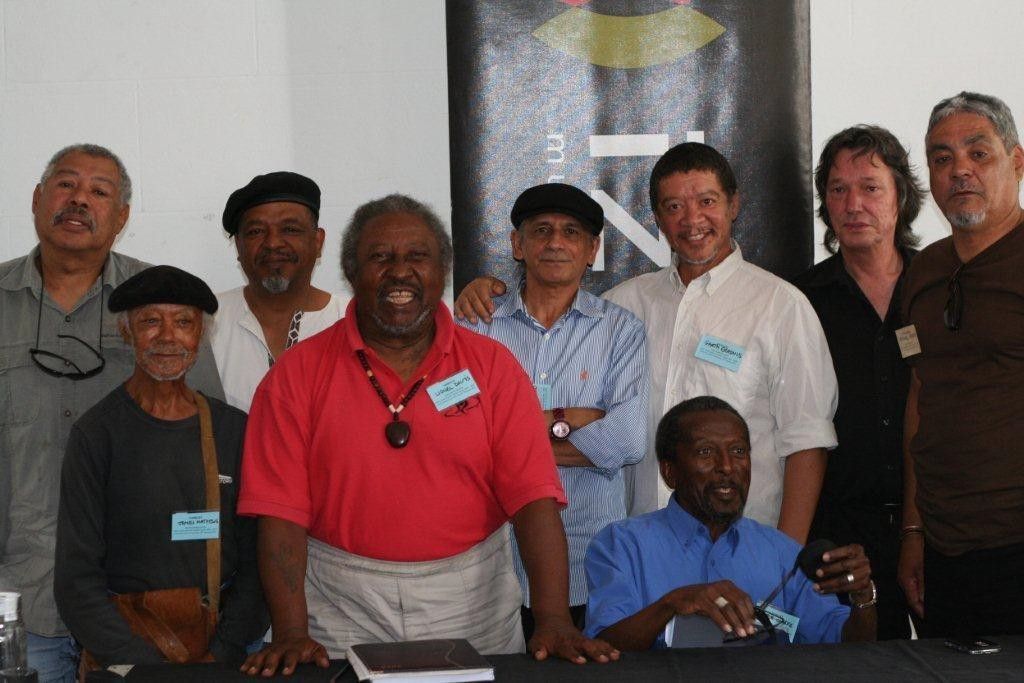
Vakalisa was significant in its ability to hold so many different political orientations together, particularly through the charged era in which the group was most productive. Even though the group has not formally produced work for a long time now, many members still consider themselves part of Vakalisa. This is itself an acknowledgement of both the relationships that held the members together and the tremendous creative contribution they made to a more equitable South Africa.
Keith Adams is a former journalist and writer. He is also founder and director of the award-winning St. Joseph’s Adult Education Programme.
This text was originally published online by ASAI in 2021 [LINK]
| 1. | ↑ | Although Lionel Davis stated that “CAP was a place for making contact with other artists and a training resource for those with little or no training in the visual arts, writing, photography, dance and drama,” it was not a politically neutral site. CAP had previously been boycotted by many Cape Town artists due to its acceptance of funding from the Urban Foundation to pay its rent in 1977-1978. Many considered the Urban Foundation to be an organisation whose sole purpose was to create an acquiescing middle class, rather than to support mass working class liberation struggle. The centre ultimately rejected UF funding after 1978, and artists like Davis who had raised questions about UF were in attendance at the planning meetings for CRC. |
| 2. | ↑ | Activities at this department included a series of poster-making workshops, which began soon after the Culture and Resistance Conference. |
| 3. | ↑ | Mervyn Davids, Hamilton Budaza, Patrick Holo, Sydney Holo, Jimi Matthews, Rashid Lombard, Rudien Holman, Michael Barry, Peter Berry, Mario Sickle, Keith Adams, Kenneth Baker, Johann Davids, Hein Willemse, Peter Clarke, Lionel Davis, Garth Erasmus, James Matthews, Willie Adams and Basil Coetzee. |
| 4. | ↑ | The fact that there were no women in the initial group was something most members wanted to address. Even though close-knit friendships flourished in the all-male terrain, it was felt that it was imperative that women participate in all Vakalisa’s activities and be part of the collective. |
| 5. | ↑ | Mervyn Davids was capable, astute and well versed in the fragmented art scene in the Western Cape at the time. |
| 6. | ↑ | James Matthews had a phobia about joining organisations but nevertheless felt comfortable in Vakalisa. The group’s less formal structure allowed members to both connect as friends and to work together. |
| 7. | ↑ | Unknown author, “Artists of Vakalisa,” Grassroots 5 (1984): 11. The group photograph accompanying the article shows the original membership of Vakalisa, including five members who have subsequently passed on. These are celebrated artists Peter Clarke, Mario Sickle and Kenneth Bakers, poet Willie Adams and musician Basil Coetzee. |
| 8. | ↑ | Clarke’s retrospective at the Iziko South African National Gallery in 2012 included a panel discussion consisting of Vakalisa members, including Peter himself. They talked about the artist’s work and also about his important contribution to Vakalisa, where he was an integral member, providing guidance and mentorship. The session addressed the gender make-up of Vakalisa, its shortcomings and its impact on the Cape Town artistic panorama. Founding member, Michael Barry, came all the way from the Nelson Mandela University in Port Elizabeth, where he headed their art department. This would be the last time that most of the Vakalisa members would see Clarke again. |
| 9. | ↑ | Vakalisa member Lionel Davis was responsible for many posters and sweaters that adorned the insignia of the Mass Democratic Movement in the 1980s and the years leading up to democracy. His exhibition opening at the Association for the Visual Arts Gallery in Cape Town, and his retrospective at the Iziko South African National Gallery, were both well attended by Vakalisa members. |
| 10. | ↑ | Zenzile Khoisan, Notes to the accompanying exhibition (Cape Town, 1986). |
| 11. | ↑ | See Albie Sachs, “Preparing Ourselves for Freedom: Culture and the ANC Constitutional Guidelines,” TDR 35, no. 1 (1991): 187–193. |
| 12. | ↑ | Spaces Vakalisa has connected with include The African Arts Fund (affiliated with the United Nations Centre Against Apartheid), the African Refugee Centre, The Schomberg Centre in Harlem, The Smithsonion National Museum ofAfrican Art, Africa Centre, Third World, Pig Iron Press, Poets House, World Radio Poetry and American Pen. Additionally, the group connected with the Scottish Writers Union through author and Booker Prize winner James Kelman when he was in South Africa for the ANC’s first Department of Arts and Culture ‘s Consultative Conference. |
| 13. | ↑ | Much later, in 1992, Vakalisa was asked to chair the Western and Southern Cape region discussions at the first National Arts Policy Plenary in Johannesburg. These discussions were attended by artists throughout the country. Keith Adams chaired the highly emotive regional sessions. These left the Western Cape region dissatisfied. Adams realised that the brief was not inclusive enough and that the concerns of the Western Cape region were valid. |
| 14. | ↑ | See Keith Adams (ed.), “South Africa: Art at the Crossroads,” New Observations 56 (April 1988). |
| 15. | ↑ | See Keith Adams (ed.), “South Africa: Crossing the Artistic Divide,” New Observations 83 (May–June 1991). |