CARSTEN RASCH
Searching for the Branyo
Overhead, the blackening cloud mass is building up for a downpour as the Grab driver drops me off in the Portuguese Settlement, just a few kilometres from the historical centre of Malacca. I step out of the cool, air-conditioned car into the heat that envelops me like a long-lost friend. (I’m not getting used to it, this heat.) I do a slow 360, taking in the surroundings: a large stage; a conical Christmas tree dripping with decorations; a few potted plants and cement sculptures — some barges, one with a bearded figure dressed in robes, two entwined swordfish, and a larger-than-life Christ statue surrounded by a picket fence. There’s a small sign attached to the fence reading: “No alcohol beyond this point.”
I’ve been told that this is the place to be during Christmas, this Catholic area, a small enclave of around 28 acres, surrounded by Islamic Malaysia, but I’m not so sure. Where is everybody? The square, no doubt the heart of this community, feels abandoned, the gigantic Christ — a replica of Rio de Janeiro’s Redeemer — mournfully keeping watch. I wander off towards the ocean and an adjacent roofed area that appears to house the communal seating of a series of eating houses, all with Portuguese names. Not a soul in sight, despite it being close to lunchtime. There’s a jetty pointing into the sea — or the mud, rather, because the tide is out. It’s all a bit forlorn.
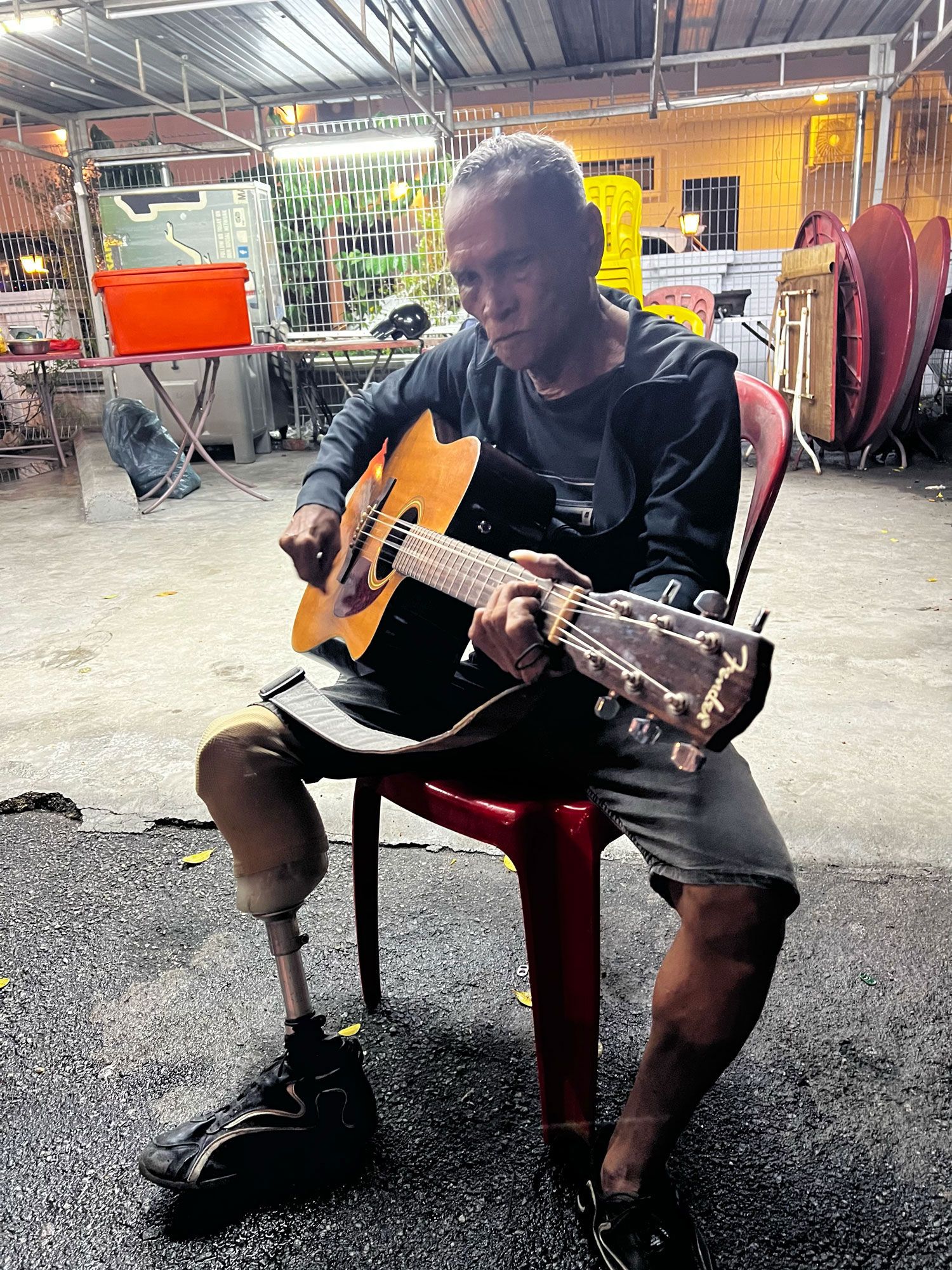
In the distance, I hear someone strumming a guitar and spot a lone player sitting in the shade of a stall at the other end of the promenade. I head in that direction where I’m welcomed by a man with one leg.
“Hello!” he says warmly, putting the guitar aside. “How are you?”
I’m tempted to say “hot”, but of course he’d be the same. “Very well, thank you,” I say instead. “I’m looking for the Kristang community?”
“Aha!” he responds, smiling widely, revealing a mouth with many teeth missing. “You have found it! I am Nicholas and I am Portuguese!”
Nicholas de Souza is indeed a distant descendant of the Portuguese who, under Afonso de Albuquerque, attacked and captured the port of Malacca from Sultan Mahmud Shah in 1511, starting a history that rolls on to this day. But for Nicholas to refer to himself as “Portuguese” would be like this writer, of Afrikaner descent, referring to himself as Dutch — not quite false, but not quite true either. Certainly the Dutch wouldn’t agree, and neither, I suspect, would the Portuguese. Nicholas is one of a dwindling number of Malaysians who identify as Kristang: a 400-year-old community of Catholic converts and mestiços with a unique heritage, neither fully Malay nor Portuguese, yet containing aspects of both.
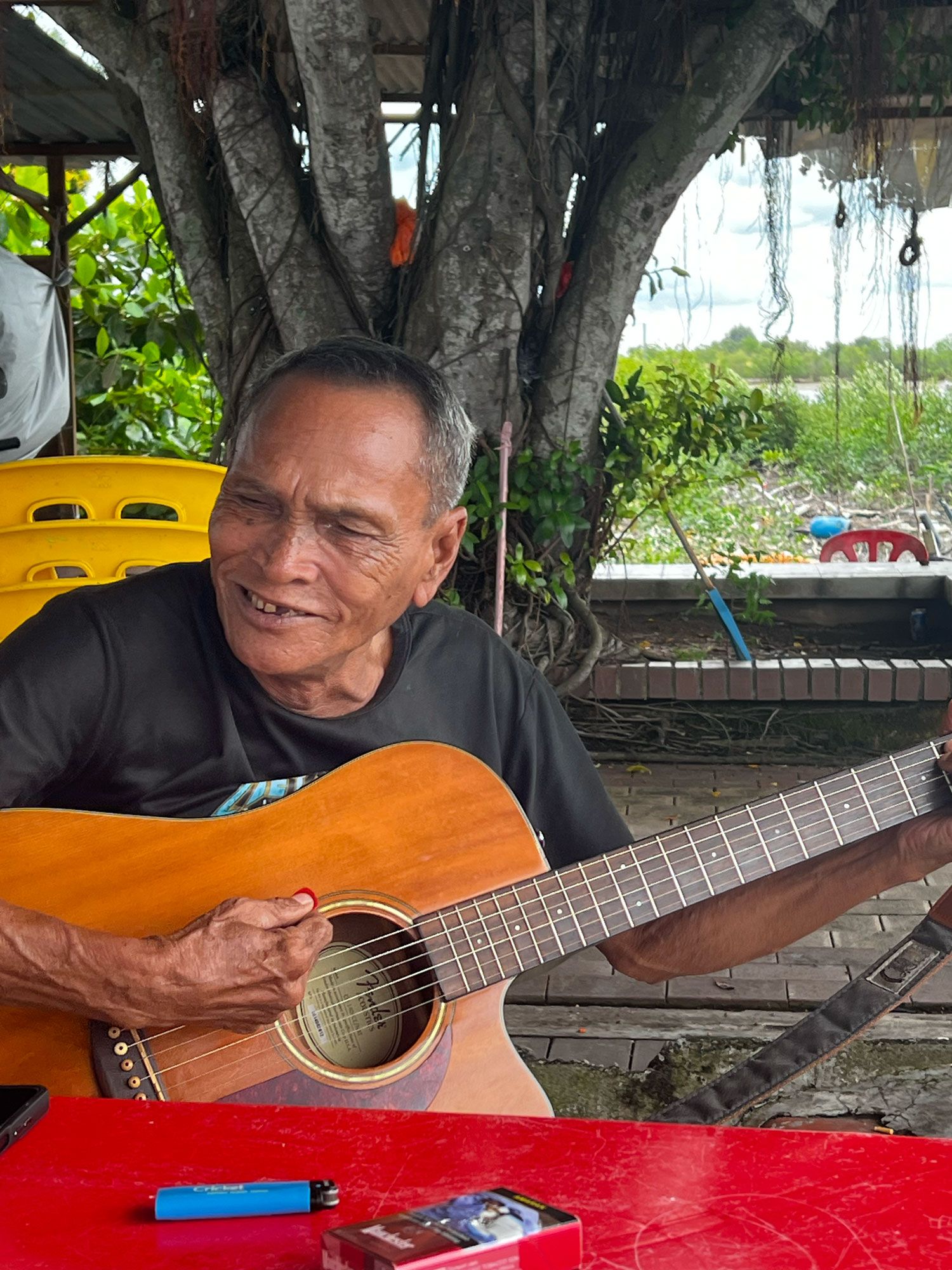
I’m happy to come across Nicholas, clearly a musician, because my mission is to find something called Kristang — a syncretic music, I imagine, much like ghoema, which formed at the Cape of Good Hope. I say as much to him.
“You are looking for music?” he says. “I play for you. What do you like? Elvis?” He picks up his Fender and launches into Marie’s the Name, followed by Dock of the Bay.
The Early History
While trawling the streets of Malacca’s old town, I happened to have breakfast at The Daughter on Jalan Bunga Raya, an eclectic antique shop with a kitchen and an excellent collection of vintage books. While waiting for my breakfast, I asked the daughter — who actually exists — where they keep their books on Malaysia.
“There-lah…” she said, pointing to a shelf in the kitchen, where I spotted My People, My Country by Bernard Santa Maria, himself a descendant of the very miscegenation he describes. It is one of a handful of books recounting Malacca’s colonial history, and a valuable find.
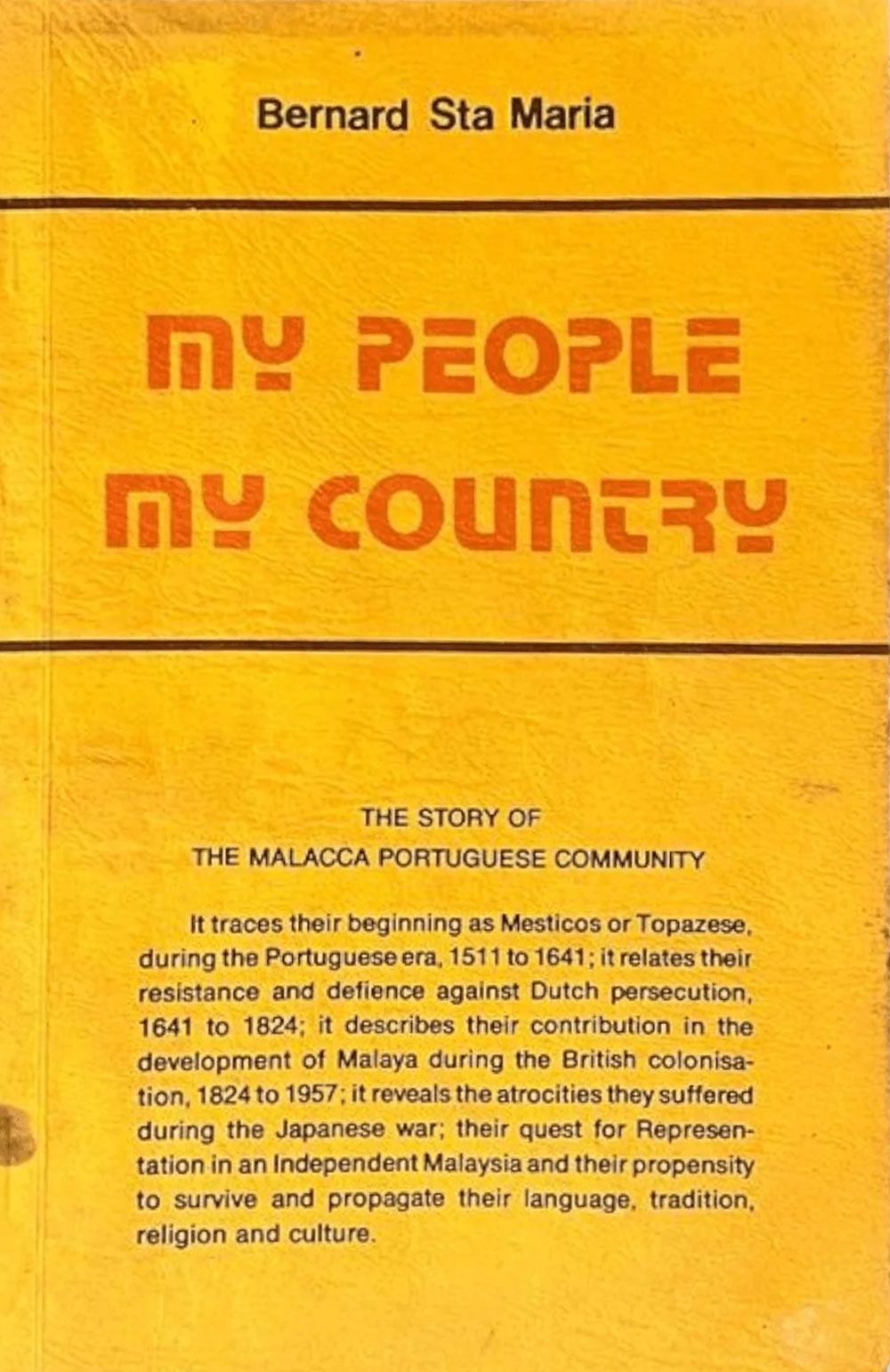
Malacca, in its day, was a bustling port: the centre of trade linking the Muslim sultanates of Mecca and Cairo with Gujarati, Chinese, Japanese, Javanese and Bengali traders. By taking Malacca, the Portuguese could control traffic through the Strait — a major milestone in their grand plan to establish a Christian empire in the East and monopolise the spice trade.
For those unfamiliar with how — and why — the world is what it is today, we need to go back to June 7, 1494, when ambassadors of Spain and Portugal met in the Spanish town of Tordesillas to affirm the papal division of “the New World.” A line was drawn 370 leagues (1,185 miles) west of the Cape Verde islands. Lands west of it (the Americas and the Caribbean) could be claimed by Spain; lands east of it (the African coast and beyond) by Portugal. (Brazil, fortuitously for Portugal, proved to be the exception.)
The key difference between Spanish and Portuguese explorers was the cunning strategy of successive Portuguese kings. According to Kristang historian Bernard Santa Maria,
“the Portuguese went to great lengths to identify with the dark skin (sic) tropical population. To foster integration (they) encouraged mixed marriages as one of the principal methods of cultural interpenetration.”
The result was a mestiço population that eventually outnumbered the “pure” Portuguese ten to one. When the Portuguese were defeated by the Dutch in 1641 and retreated to Goa, Ceylon and Macau, the mestiços were left behind, clinging stubbornly to their faith and creole culture.
The Dutch had little interest in developing Malacca itself. Their own port, Batavia (Jakarta), was the priority, but by taking Malacca, they broke the 150-year stranglehold the Portuguese had in the East. Malacca declined terminally as a centre of trade under Dutch rule, who sacked the city and tried everything in their power to assimilate the Kristang. Instead, the Portuguese creole community not only survived, but over time assimilated the Dutch.
Sinhalese Girl
As he strums the last chords of Dock of the Bay, Nicholas cracks a wide smile. “What would you like to hear now? I know many, many songs…”
“Something Kristang?” I suggest.
“Kristang is not music,” he corrects me, wagging his finger. “It is my language. It is my community. The music is called branyo… I will play Jinkli Nona.”
Jinkli Nona, or “jingling maiden”, has its roots in the Portuguese corridinho style introduced to Malacca in the 16th century. It is a fine example of creolisation: the blending of Portuguese and Malay cultures as settlers intermarried with local women, and customs, language and music shifted accordingly. Corridinho became branyo; the Portuguese language became Papiá Kristang.
More significant still are the lyrics, sung entirely in Kristang. Jinkli Nona is not just any love song. It’s about a Portuguese man who likes black and white (pretu, brangku, minya bontandi), wooing a Ceylonese girl (nona minya, Sinhalese nona, na minya korsang — my girl, Sinhalese girl, come into my heart). Its seven stanzas take us straight back to the period in which the Kristang came into being. It is, in effect, the story of their creation that has become their informal anthem.
Nicholas, a man indelibly marked by a life of adversity, comes alive when he performs. But something deeper emerges when he sings Jinkli Nona. Eyes closed, fingers strumming, good foot tapping, head thrown back, he sings with an almost tangible longing for a rich, colourful Kristang past. A glorious past that will never return.
From Corridinho to Branyo to Joget
“Ah, so you’ve met Nicholas?” Martin Theseira smiles knowingly. It’s a few days later, and we’re sitting at a table in — again — a completely empty restaurant in Medan Portugis. “He used to be a big star, you know. Performed all over Southeast Asia. Even did a private concert for the Sultan [of Malacca]”
Martin, who describes himself as a “fisherman, musician and cultural activist”, is related to Bernard Santa Maria. “He was my uncle,” he says when I show him the book. He graciously agreed to an interview on very short notice, and is now explaining the history of the branyo, illustrating subtle rhythmic differences on his ukulele. The distinctions are small — almost imperceptible to my ear — yet they completely change a song’s context.
Exactly how branyo developed is hard to determine; nothing was written down, of course. But it differs markedly from ghoema, samba, zydeco and Caribbean or Indian Ocean creole musics, where African rhythms underpin European melodies. Those musics are best understood as responses to slavery and displacement, tools of survival. While samba and branyo share a Portuguese presence, they actually sit at opposite ends of the same historical process. Comparing them tells us a lot about how music creolises under different conditions.
The differences are stark. Samba is syncopated, polyrhythmic, large-scale and performative. Branyo uses small ensembles, stable rhythms and contained, almost prudish, line dances. In Brazil, entire regions were colonised, involving many animist ethnic groupings, their rhythms and instrumentation blending with the various West African beats of the many thousands of slaves, and, eventually, Portuguese military marching bands. In Malacca, Portuguese occupation was limited to the Islamic port city already shaped by Arabic, Turkish, Tamil and Chinese influences. With no mass importation of African slaves, the palette was narrower, and lacked the rhythmic input so typical of the syncretic music of the “New World”.
For branyo to thrive, it had to appeal to Malacca’s Muslim majority — and fortunately it did. Perhaps it was the absence of physical contact between dancers, but over time it was absorbed wholesale into Malay culture as the joget, sharing rhythms and structures but with Malay lyrics. This sideways move saved branyo from extinction: without it, it would have disappeared with the Portuguese rulers in 1641. Kristang influences on Malayan society lessened each time power shifted, from the Dutch to the British, and eventually to the Malayan Islamic Republic which gained independence in 1957. This final transition marked the lowest point for the diminished Kristang community, now numbering around a hundred impoverished families pushed right up against the tepid waters of the Malacca Strait and its dwindling fish stocks they made their living from.
Kristang Today, Gone Tomorrow
A culture is only as healthy as the population that practises it, and by the 1950s the Kristang were perilously close to the end. Dutch persecution, British anglicisation, and class divisions between English-speaking “Eurasians” and Kristang-speaking “poor Portuguese” all contributed to their decline.
The dances, music and history nearly forgotten, their Portuguese connection along with it, the Kristang, as a socio-religio grouping, were on the verge of extinction. If it wasn’t for the fortuitous arrival of a visiting Portuguese Minister for Overseas Territories in 1952, the Kristang today would almost certainly be found only as a footnote in history books.
As it happened, with Malayan nationalism on the rise, and the English-speaking Eurasian minority keen to distance themselves from the British, the various factions found common ground in their “Portuguese-ness” and the idea of being Kristang was rekindled, albeit subjected to some innovative manufacturing. Jinkli Nona and a few other songs were revived, their lyrics dug out from distant Portuguese communities in Jakarta and Timor, along with the branyo dance steps. Some Portuguese folk costumes were donated by the Macau Portuguese community. It was as if someone had flicked a switch that turned on a light in a room that had been in darkness for so long, no-one even knew there was a switch.
Earlier, under the British, the Portuguese petitioned the Governor to set aside a piece of land as a kampung for the severely impoverished remnants of the community. He eventually, reluctantly, granted them a mangrove swamp at Ujung Pasir, a few kilometres from Banda Hilir, a Malaccan slum where the “poor Portuguese” were slowly sinking into deprivation. The mangroves cleared and the swamp drained, Kristang that had scattered all over the Malay Peninsula were enticed to move back. The Portuguese Settlement slowly knitted the community together again, using the song and dance of the branyo as the yarn.
In the eighties, the Malaccan authorities, realising that their city had little else to offer tourists except history and culture, identified the Portuguese Settlement at Ujung Pasir as a heritage focal point. Malacca was twinned with Lisbon, money was set aside for the Medin Portugis and the promenade, and the scene was set for the Kristang community’s movement upward.
Grand Funk Railroad at Medin Portugis
It’s Friday night, a week from Christmas, and at last, the Medin Portugis is alive in its full glory, a queue of cars waiting to enter the enclave, Christmas lights everywhere, all the eating houses packed to the brim. I was expecting groups of branyo players and dancers to entertain the festive crowds – why should this music be limited to performances on special occasions? Alas, we were subjected to the all-pervasive Spotify playlist of Christmas rat-pack tunes at full volume. Malacca hums with energy, from the historic river area up Jonker Street and all the way to the Portuguese Settlement, but the only other music you’ll hear is straight from the American Top 20 of yester-year. That damned American songbook…
As I’m thinking that, our waiter, a lanky, louche Kristang of indeterminate age plonks down our pints of the local Tiger brew. He’s wearing a Grand Funk Railroad t-shirt that must be at least 40 years old. My grievance about the American song book momentarily forgotten, I say “one of my all-time favourite bands, that …” nodding towards his chest bearing the legend. He agrees laconically, and we start a conversation of snippets, stopping by whenever he can squeeze in a free moment. He’s a Da Costa, a relation of the owner of the eating house. He saw Grand Funk back in the day, in the States. He was a sailor. Tells me he visited Saldanha when he learns I’m South African. What? Saldanha was a Portuguese? He didn’t know. We talk about history. “Here,” he waves his arms to include everyone around, “we are all Kristang, and we all have our own history. My history is mine, his is his,” pointing at some arbitrary fellow, who cocks an eyebrow at him “…and we have the Kristang history. We come from everywhere. My grandfather is Filipino, my great-great grandfather, from the Portuguese. Maybe.” He grins. “That’s our history…”
I came to Malacca, hoping to find some “Kristang”, not realising that it was not a music but a language, and a community. That, I found quite easily. Branyo, the music, was a bit more difficult, though I found that as well – thankfully in the small doses of authentic, passionate solo performances by Nicholas de Souza and Martin Theseira. Thankfully, because I’m not too sure about the touristic version of the branyo, complete with period Portuguese outfits that you can rent from an enterprising Kristang seamstress in the Settlement. But, if it takes a manufactured identity for a community to rediscover its history, so what? The point, as always, is to survive. As academic Margeret Sarkissian notes: “The image of smiling Portuguese dancers is, of course, a romanticized ideal. People don’t walk around the Settlement wearing stylized Continental Portuguese folk dance costumes. [But] the once- imported [branyo] songs and dances [are] clearly linked [to] Settlement residents, not to far- off Portugal, but to their Malaysian neighbours.”
The Kristang, a minority among minorities, cannot afford to be the stick in the mud. They have, quite skilfully in my opinion, managed to survive, even thrive, in the often hostile waters of a post-colony. And they have done this by assimilation, by accepting they are Malay while keeping their cultural identity, albeit at the opposite pole, unthreatening. It is hard to ignore, though, the deep double irony that the fading Catholic mestiço culture of a previous colonial master was saved from extinction by being a tourist attraction in an Islamic city, with the branyo surviving solely because it transitioned into the joget — all thanks to a Sinhalese maiden with jingling anklets.