ALICE PATRICIA MEYER
Timbila Poetry: Vonani Bila’s Poetic Project
Introduction
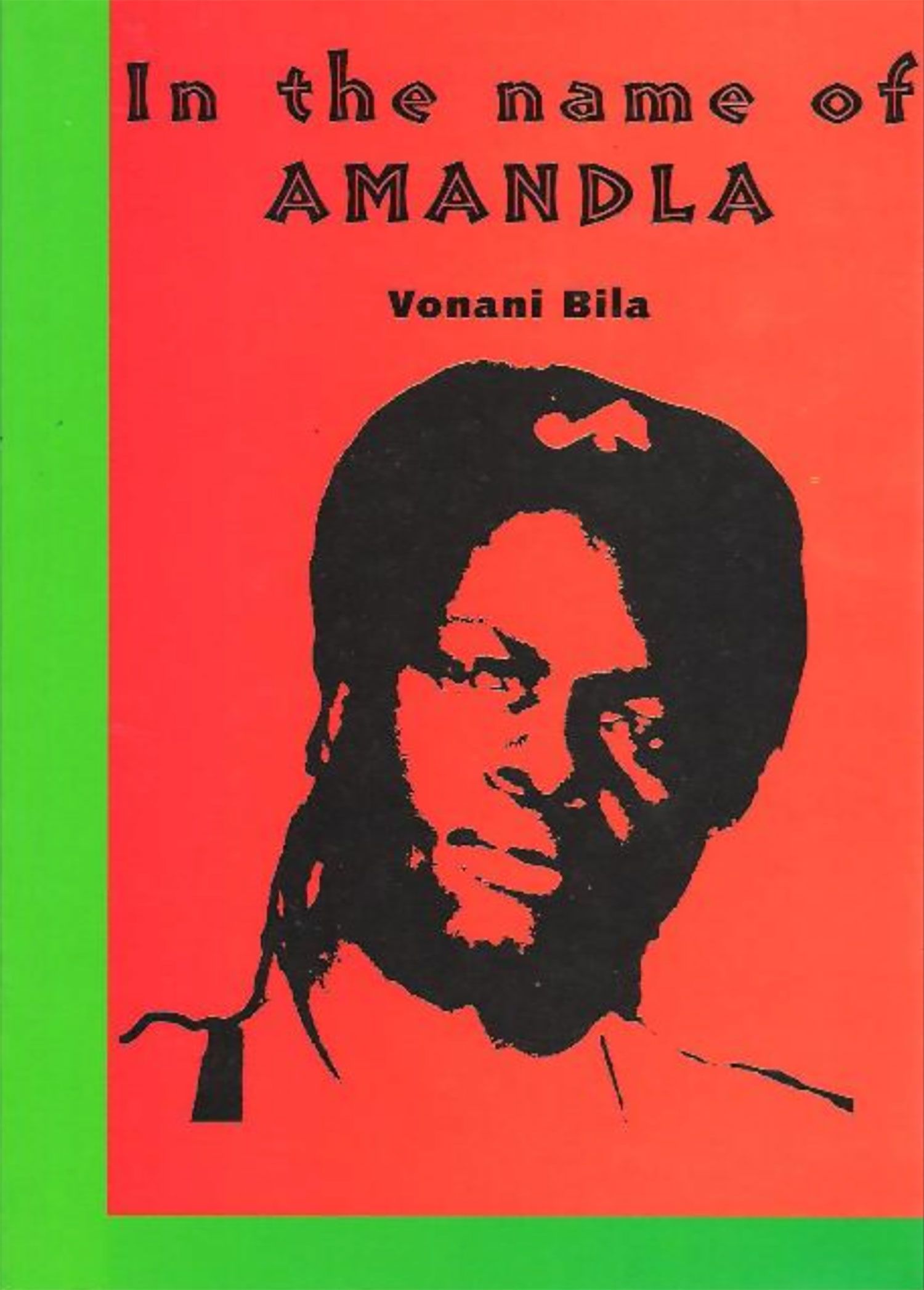
This chapter of my PHD Poetry and Politics in Post-Apartheid South Africa examines the work of poet-Activist Vonani Bila, author of No Free Sleeping (1998), In the Name of Amandla (2004), Magicstan Fires (2006), Handsome Jita (2007) and Bilakhulu (2015). Firmly committed to preserving the culture of his native Elim, Bila works in both English and Xitsonga. He is a prominent advocate of the vitality of South African languages and is founder of the multilingual arts journal Timbila, which he runs from within his home village. I unpack Bila’s poetics through reference to his Timbila poetry project. I argue that Timbila writing heralds a new aesthetic category in post-Apartheid South Africa and that this style is exemplified in Bila’s own work.
Timbila writing is a literature of social necessity that plays a vital role in recording the inequities and injustices of particular South African communities. This poetry makes masterful use of narrative style. I highlight Bila’s narrative craftsmanship, which chronicles the realities of his home province of Limpopo. I strive for a deeper understanding of Bila’s art as well as to contribute to a revitalised South African aesthetic vocabulary, one that walks in time with its historical moment.
Bila has sought to chart new trajectories for contemporary South African poetry but his poetics have yet to be fully expounded. I aim to elaborate the intellectual potential of Bila’s aesthetic statements through reference to his Timbila Poetry Project. Timbila’s aim is to craft a ‘necessary poetry’ adequate to the political conditions of South Africa today. I argue that such an approach is best exemplified in Bila’s own poetry, which is defined by a clear-sighted commitment to exploring difficult and pressing realities, specifically the poverty of his home province of Limpopo.[1]Robert Berold, “Poetry of political betrayal, domestic cruelty”, The Sunday Independent, 16 January 2005, 18. Through tracking Bila’s poetics and reading for their emergence in his creative work, I move towards a more precise critical idiom in contemporary South African letters. One that fully takes on board the relationship between politics and the pen, context and style.
The state of contemporary South African poetics is dire and the significance of re-assessing our literary vocabulary is paramount. Literary scholarship offers scant resources for understanding post-Apartheid poetics. In a 2015 interview in Grahamstown, Robert Berold emphasised the failure of South African literary criticism by stating that thus far members of the academy have proved ‘the worst people’ in understanding the country’s poetry.[2]Alice Meyer, “Interview with Robert Berold” (Grahamstown: 4 September 2015). Both Berold and Kelwyn Sole argue that it is creative writers themselves who have the clearest understanding of post-Apartheid poetry and they urge readers to be attentive to the cultural world-views of poets.[3]Sole, “The Endless Deferral of Value: ‘Formal’ vs. ‘Sociological’ Criticism in Black South African Poetry”, p.2; Alice Meyer, “Interview with Robert Berold” (Grahamstown: 4 September 2015). In paying close attention to the poetic statements of Vonani Bila, an artistic practitioner, I take my cue from Berold and Sole in order to register new literary aesthetics in South Africa. Bila’s poetics have not been synthesised or systematised into anything that might approach a more general theory of literature and society and here there is scope for productive academic work to take place. I begin with a brief outline of Bila’s life and work before moving to a discussion of his poetics and poetry.
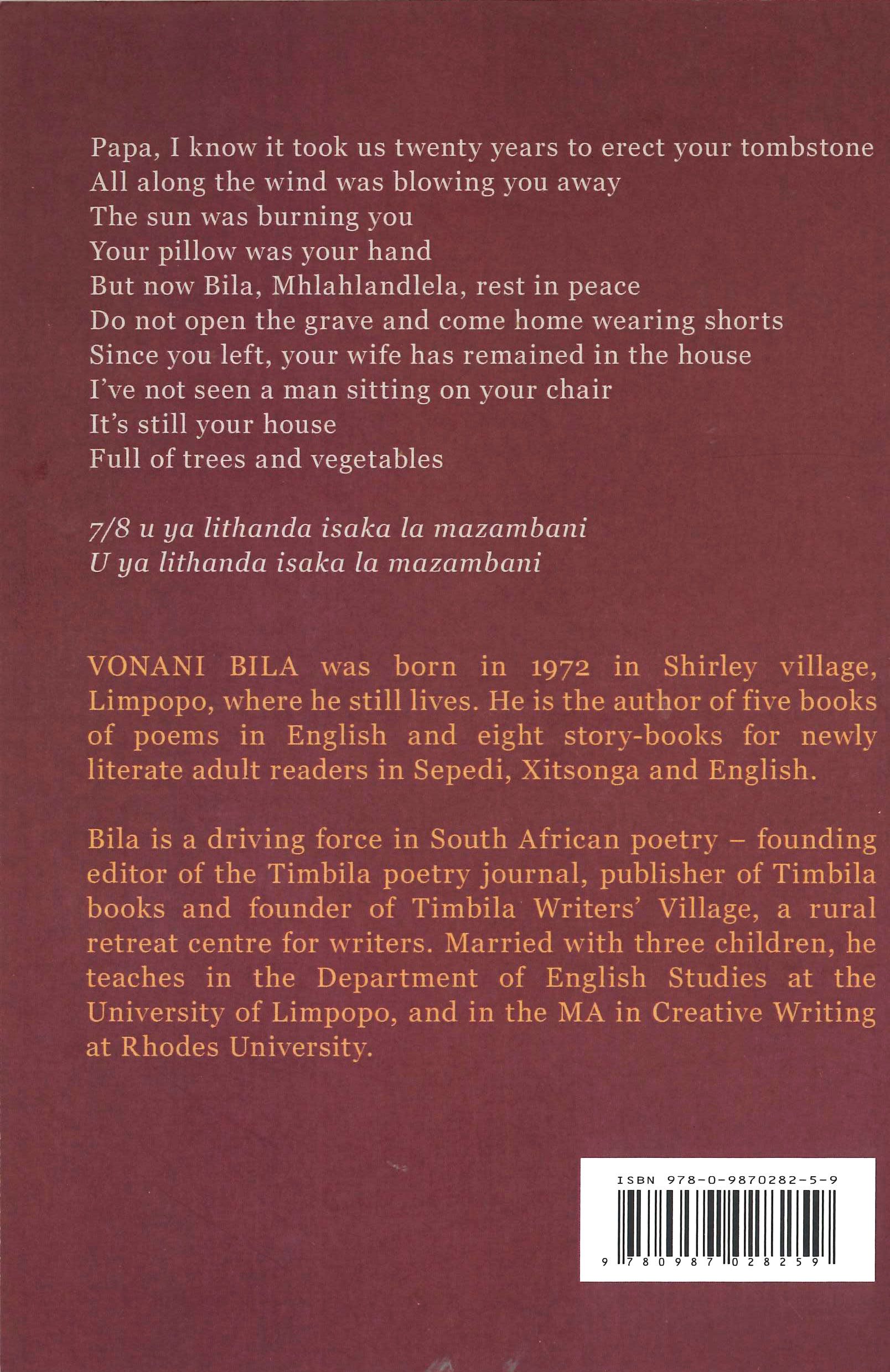
Born in 1972, Bila came of age at the dawn of the post-Apartheid era. He has lived all his life in the rural village of Shirley, Elim, which is located in South Africa’s northernmost, and most poverty stricken, province of Limpopo. A veteran of the South African poetry scene, Bila has authored five books of poems: No Free Sleeping (1998), In the Name of Amandla (2004), Magicstan Fires (2006), Handsome Jita (2007) and Bilakhulu! (2015).[4]Liesl Jobson, “Vonani Bila”, Poetry International, 1 September 2008 poetryinternational [Accessed 7 September 2015] (Para. 7 of 7) and Gary Cummiskey, “Launch of Bhilakhulu by Vonani Bila”, Dye Hard Press, 26 July 2015 dyehardpress [Accessed 7 September 2015].
Bila writes in both English and Xitsonga. His passion for nourishing and preserving African languages has seen him put together eight books of literacy for young adult readers in English, Xitsonga, and Sepedi.[5] Gary Cummiskey, “Launch of Bhilakhulu by Vonani Bila”, Dye Hard Press, 26 July 2015 dyehardpress [Accessed 7 September 2015] (Para. 4.of 5). Bila is also a pioneering editor, founding the arts journal Timbila in 2000.The journal takes its title from the African word mbira meaning ‘finger-harp’ and it endeavours to ‘intelligently synthesise form and content to articulate fresh poetry, reaffirming poetry’s cultural multiplicity and its diverse modes of expression’.[6]Vonani Bila (ed). Timbila, 1:1 (2000), p. 3. & Bila, “Introduction, Our Relationship With The Word & The World”, p. 10.
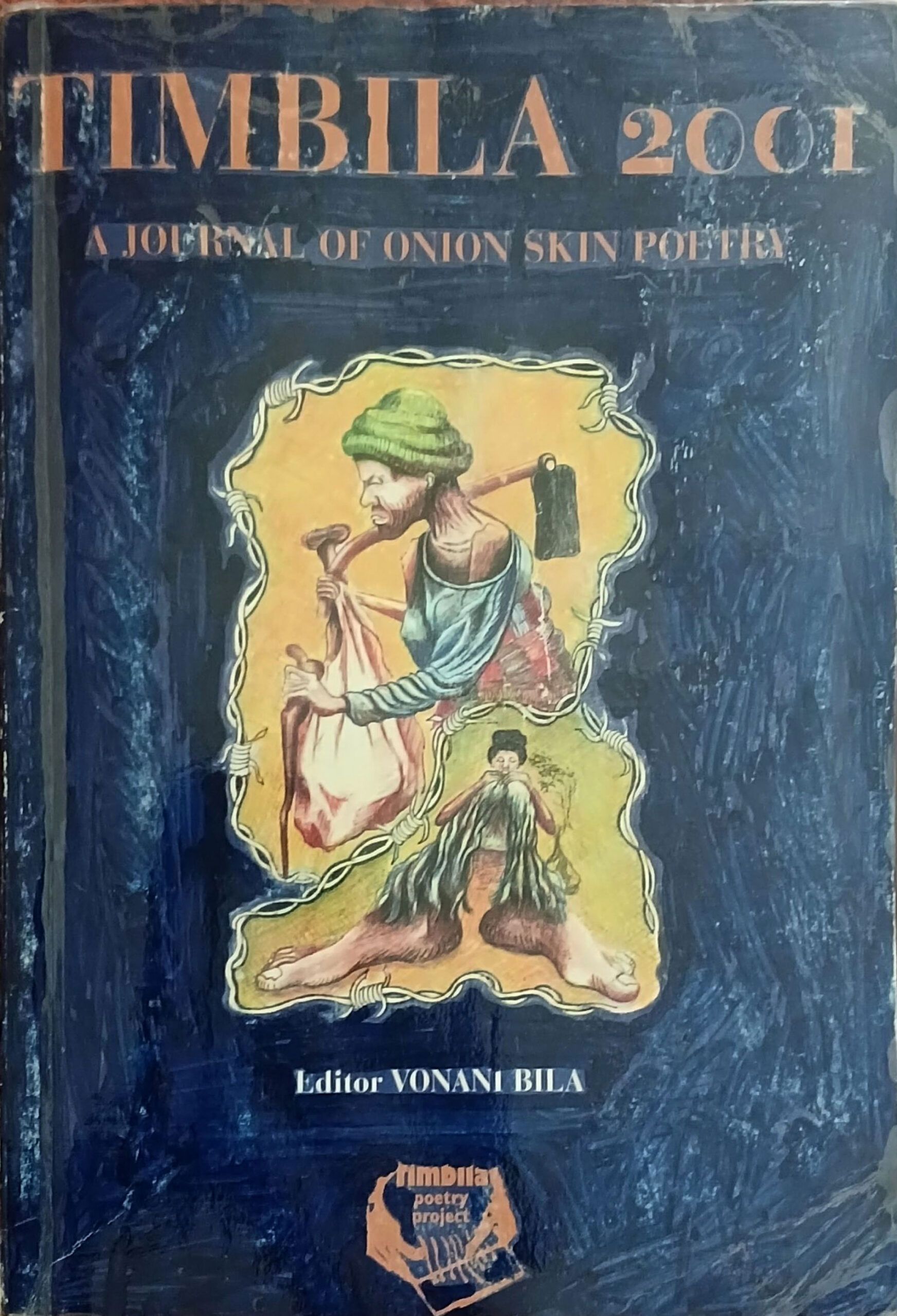
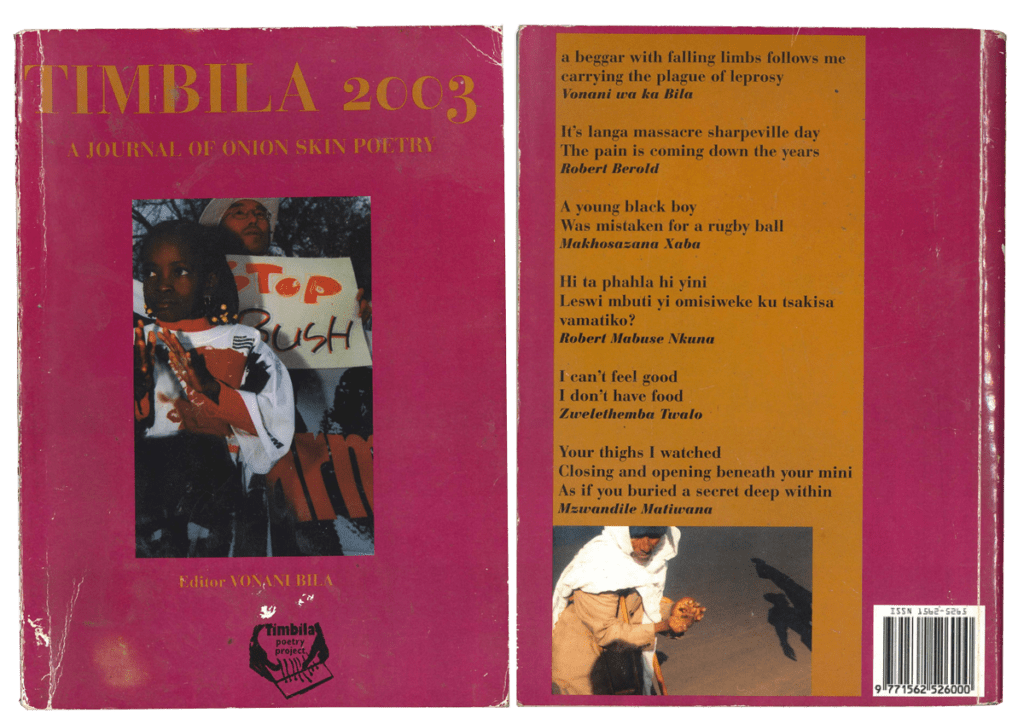
Operating from the heart of Elim, the multilingual publication has called into being a new generation of South African writers who exhibit a novelty of artistic vision and experiment with the expressive possibilities of poetic language. The journal has been pivotal in launching the careers of relatively famous writers like Makhosazana Xaba and regularly features work by some of South Africa’s most exciting living poets, such as Mxolisi Nyezwa, Liesl Jobson, and David Wa Maahlamela.
Since its inception in 2000, Timbila has developed into a fully-fledged non-profit cultural movement conducting workshops, seminars, readings and performances across South Africa, most recently opening a rural retreat for writers in Elim.[7]Vonani Bila, “Building Socially Committed Writers through the Timbila Writing Model”, 1-25 (pp.1-2); Tshifhiwa Mukwevho, “Own village for regions’ authors and artists”, Limpopo Mirror, 13 December 2013 limpopomirror [Accessed 7 September 2015]
Timbila is a key platform from which Bila formulates his poetics and explores poetry’s relationship towards pressing social issues of our time. He describes the journal as a work of ‘Onion Skin Writing’, which designates the ability of its artists to demonstrate a raw, authentic and startling writing praxis.[8]Vonani Bila, “Introduction, Our Relationship With The Word & The World”, Timbila, 1:1 (2000), 11-17 (p.11). Like fastidiously prising apart the layers of an onion’s skin, the skill of Timbila’s work lies in its ability to unravel myriad levels of socio-economic and cultural reality in the post-Apartheid era. The description of Timbila’s poetry in its first edition, offers invaluable insight into Bila’s poetics. He frames Timbila poetry as,
Provocative, harsh, vivid, graphical, probing, direct, revolutionary, zigzagging, scattering, muscular, fertile, different, surreal, lucid, rhythmic, musical, refreshing, stimulating, therapeutic, sensual, moving, electric, oral, written, dramatic, exquisite. It’s a kind of necessary poetry that records the personal and the social conscience. It’s poetry that cannot be ignored. It’s powerful.[9]Bila, “Introduction, Our Relationship With The Word & The World”, p. 11.
The array of suggestive adjectives such as ‘surreal’, ‘oral’ and ‘dramatic’ conveys the fact that a journal of Timbila poetry encompasses a great range of styles and moods in order to do justice to the diversity of the post-Apartheid milieu. Yet, arguably, it is the umbrella category of ‘necessary poetry’ that truly defines the journal’s aesthetic and political aims, enfolding myriad registers that pivot upon a single purpose. The adjective ‘necessary’ encapsulates the full scope of Bila’s poetry and that of contemporary literatures of social conscience.
The necessary denotes that which is ‘indispensable, vital, essential, requisite’ and the word underlines that for Bila, socially powerful poetry is a basic requirement of a healthy political climate.[10]“necessary, adj.”, in OED Online (Oxford: Oxford University Press, September 2015). oed [Accessed 6 January 2016]. The sentiment reverberates throughout Timbila’s 2001 poetry manifesto, which proclaims, ‘We, poets of South Africa, declare for all the country and the world to know that a country that does not appreciate poetry is a doomed country, that our poetry, just like our music and dance, contributed a great deal to South Africa’s present dispensation’.[11]“Timbila Poetry Manifesto” (Adopted at the Timbila Poetry Workshop, Polokwane, 2001). These words articulate that poetry played a dynamic role in building the new South Africa and that if the nation is to prosper then it must take the poetic medium seriously. Beyond his journal, Bila has sought to establish the political relevance of Timbila poetry through the creation of a ‘Republic of Poetry’.
The ‘Republic of Poetry’ was launched in 2006 and builds on Percy Bysshe Shelley’s famous dictum that ‘Poets are the unacknowledged legislators of the world’.
The initiative seeks to connect a national network of writers who raise collective consciousness, call attention to salient civic matters and fight for social justice.[12]Vonani Bila, “Editor’s Notes”, New Coin, 49:1 (2013), 1 (p.1). Vonani Bila, “The Republic of Poetry project: Timbila launches a writer development programme”, The Books Newsletter, 14 March 2006, 2-4 (pp. 2-3). Bila’s ‘Republic of Poetry’ demonstrates that a socially necessary writing is grounded in accountability to place and community. The programme aims for each municipality in South Africa to have its own Poet Laureate. These new Poet Laureates are to be public figures that offer critique of political leaders and insight into issues of governance. Here, the role of poetry is to engage in the politics of its specific locale in order to produce art that connects with objective conditions of human struggle, misery and pleasure.
‘Necessary’ is a controversial aesthetic category. This is given the fact that it is usually a term that denotes moral or practical outlooks. This question is precisely what is at stake in re- appraising South Africa’s literary vocabulary. The aesthetics of socially aware artistic movements have been underworked in a discussion of South African literature precisely because poetic movements of political conscience have not been conceptualised as craft. Thengani H.Ngwenya criticises the fact that politicised writing, such as that of the Black Consciousness poets, has all too often been glibly dismissed as artless, functional and lacking in form.[13]Thengani H. Ngwenya, “Black Consciousness poetry: writing against apartheid”, in The Cambridge History of South African Literature, ed. by David Attwell and Derek Attridge (Cambridge: Cambridge University Press, 2012), pp. 500-522 (p. 507). Conversely,
I contend that Timbila’s necessary poetry is a literature that roots itself in the needs of South Africa’s impoverished people and emerges as a disciplined, artistically rigorous mode of writing.
In this chapter, I focus upon Bila’s manipulation of narrative in order to unpack the creative finesse of Timbila poetry. The art of storytelling forms the backbone of his poetic project.
A driving force in Bila’s writing is the desire to narrate the stories and beliefs of overlooked spaces in South Africa, particularly those of rural areas. This is a socially necessary literature to the extent that it records and pays tribute to cultures and realities that are often ignored by commercial centres. The poet’s strongest writing is that which grounds itself in the immediacy of his home province of Limpopo. In an interview I conducted with Bila in Shirley in August 2015, he elaborated the centrality of his social and economic environment to his poetry,
It is the basis of my poetry […] Place is very central in the creation of work because how do you divorce yourself from your place? […] A writer, a poet you know is a product of society, a product of place so I see my work as some kind of social construction, belonging to this environment.[14]Alice Meyer, “Interview with Vonani Bila” (Shirley, 29 August 2015).
Bila’s words convey the fact that Timbila writing is site specific. It is a literature that tailors its form to the social, economic and ecological environment in which it is situated.
Bila’s commitment to crafting poetry salient to the needs of his lived surrounds is epitomised in poems that confront immiseration in Elim. Relying heavily on narrative form, the poems that focus on his hometown are content-dense and intensify concentration on some of the area’s most urgent social troubles.[15]Robert Berold, “Poets who do not soothe or create distance from our turmoil”, The Sunday Independent, 9 May 2009, p.20. An example is the poem “Giyani Block”, which speaks of death in Elim’s local hospital. The title “Giyani Block” refers to a ‘ward for critically ill patients at Elim hospital’ and the poem offers a sobering account of illness and disease in the area,[16]Bila, In the name of Amandla, p. 118.
When the sun recedes.
into the Soutpansberg,
Giyani Block puts on
a black adder coat;
a mirror of death and despair.[17]Bila, “Giyani Block”, in In the name of Amandla, p. 7, ll.1-4.
Just as a poisonous and deathly black adder has a shining dark coat so does the ward of Giyani take on a dark and ominous hue as the sun begins to set. The metaphorical association forged between the hospital ward and a predatory creature personifies Giyani Block and grants it a beastly life of its own. So begins Bila’s narrative of doctors, nurses and village citizens who wage war on this “faceless, tailless monster” who is said to walk ‘like a dragon snake in the mountain’.[18]Bila, “Giyani Block”, in In the name of Amandla, p. 7, l.10 & l.13. As is evident in the comparison of the hospital to a beast, Bila deploys elements of fantasy and myth to interpret rural life. Thus, Death is said to be ‘a burrowing mole;/ [a lion]/ with sharpened teeth, awaiting a rabbit’.[19]Bila, “Giyani Block”, in In the name of Amandla, p. 7. Death’s fatal power imbues it with both the surreptitiousness of a mole and the ferocity of a lion. Furthermore, it is said,
Whether you are the most feared inyanga
with a calabash full of muti,
or a priest with the bible in hand
[…]
Giyani Block remains a black sea
that wrecks our boats,
leaving no evidence or trace.[20]Bila, “Giyani Block”, in In the name of Amandla, p. 7.
Bila’s mythical language intimates that no one is able to escape Giyani Block’s ‘black sea’ and neither priests nor traditional healers (inyangas) can overcome its fatal currents.
Buttressing the striking and dramatic descriptions of death, Bila’s poem also contains other extraordinary comparative language. The strongest section of the poem is that which presents the speaker’s feeble neighbour Ncindhani, one of the hospital’s suffering inhabitants. Ncindhani is said to be so weak that he can be ‘washed away like a rope’. As “Giyani Block” moves ever deeper into a moving description of Ncindhani, the man’s frail body begins to take on its own story, climate and timescale of suffering. His eyes are filled with ‘clouds of death’,
deeply sunken like the sun falling
into the mouth of the horizon.[21]Bila, “Giyani Block”, in In the name of Amandla, p. 8, l.38 & ll.39-40.
Such metaphors and similes convey the depth of the man’s suffering and grant it an expansiveness usually reserved for natural forces such as clouds or the sun itself. In the final dramatic gesture of “Giyani Block”, it is said of Ncindhani,
fleshless ribs and his amulet stand out
like a rinderpest, drought-stricken goat
by the stream.[22]Bila, “Giyani Block”, in In the name of Amandla, p. 8, ll. 43-45.
The shocking way in which the man’s ribs and amulet protrude from his bony frame is compared to the physiology of a plague-ridden goat. The force of the comparison is derived from its originality and this is due to the fact that the images and linguistic turns of Bila’s poem are drawn from Xitsonga.
“Giyani Block” was originally composed in Xitsonga, and later translated into English. The poem introduces the speech patterns of Limpopo into Bila’s text. The remarkable use of language is politically transformative because it startles the reader out of familiar habits of cognition and casts new light on ordinary scenes such as the travails of the desperate Ncindhani. Bila’s style is marked by an agile and idiosyncratic use of idiom that infuses the strong and sombre narrative vision with intensity and force. It is in this sense that the additional meaning beneath the word’ ‘giya’ in the poem’s title is most apposite. ‘Giya’ means ‘to dance in Xitsonga and IsiZulu’ and the word well-captures the flair and innovative qualities of Bila’s poetry, which introduces fresh concepts and idiom into English expression in order to weave compelling narratives.[23]Bila, In the name of Amandla, p. 118. The unexpected and unnerving qualities of Bila’s writing regenerate the English language and mould a poetry that plays a revitalising social function through awakening one’s senses to stories of death and poverty. Bila underscored the ability of poetry to metamorphosise human perception in my 2015 interview with him, ‘If we have good poetry which is really sharp, it will renew us […] and [we will] see the world differently’.[24]Alice Meyer, “Interview with Vonani Bila” (Elim: August 2015). In the case of “Giyani Block”, innovation of language sheds light upon rural reality and in this process of lexical overhaul, Bila succeeds in drawing heightened attention to the plights of Elim’s community.[25]Alan Finlay, “’Making it Visible”, Interview with Vonani Bila”, Bleksem, 7 (1999); Jenkins, “Freedom is flying in all directions”, p.20.
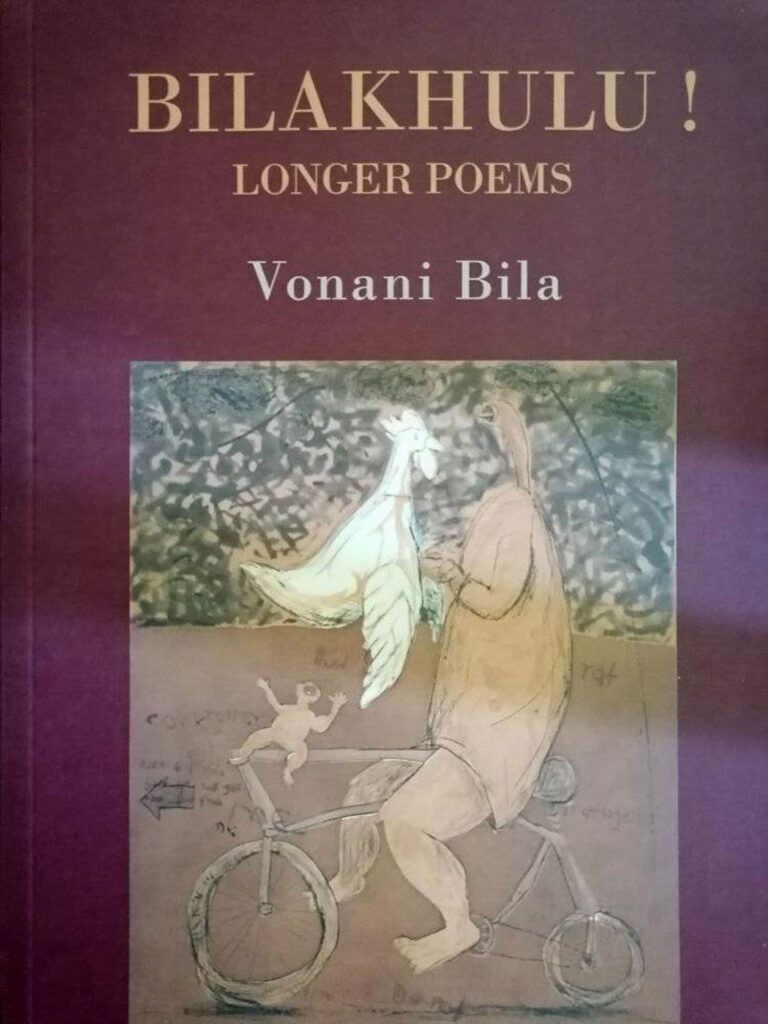
Bila’s desire to pay witness to the reality of his living milieu is nowhere more evident than in his most recent collection. Published in 2015, the highly autobiographical Bilakhulu! is composed of seven long narrative poems, which disclose memories of the Bila family and the history of their life in Elim. Physical, concrete, contextualised: the book speaks through visceral rhythms and clear description in order to capture Bila’s heritage, lived surrounds, and own artistic journey. Zoning in on the historical background of Bila’s own family tree, the poet’s greatest achievement is to interpret a rich local terrain through relating its characters and valourising the political depth of their experience. One is confronted with a register of ‘necessary’ writing that primarily records the personal aspects of place. Focusing upon the lives of individuals in an impoverished area, Bila portrays their emotions and experiences as worthy of being chronicled in art.
Bilakhulu! traces Bila’s own path to intellectual maturity, including his education in Economics and Business Economics at Tivumbeni College in the early 1990’s. The poems sketch the lives of Bila’s family members and relate noteworthy stories of local figures. “Missing” speculates upon the unknown whereabouts of Bila’s lost cousins Daniel Makhubele and Joel Hon’wana while “N’wa-yingwani” tells the tale of Xiringa, a young man native to Elim who was forced to leave the village after killing a white farmer who mistreated his aunt. The collection is distinguished by carefully plotted and well-thought out experiments in prose poetry. It includes poems of substantial length such as “Autobiography”, which is twenty-four pages in total. Throughout Bilakhulu!, Bila controls and sustains the vitality of the long narrative form by working through a range of tones, registers and themes. An example of this is the poem “Images from Childhood”, which forms the opening to Bila’s latest book. The social importance of the poem lies in its ability to enshrine unique Apartheid histories. Indeed, “Images from Childhood”, works through a series of Bila’s memories in order to convey vivid and unaffected portrayals of his youth such as this image of his schooling experience,
winter days at lemana high
white teachers opened windows
for the chilly air to freeze our toes
the same teachers who were paid a tolerance bonus to teach a black child.[26]Vonani Bila, “Images from childhood”, in Bilakhulu! Longer Poems (Grahamstown: Deep South, 2015), p.10, ll.1-4.
Memory is used to critique institutional racism through description of the fact that white teachers were paid a ‘tolerance bonus’ for the supposed trial of teaching black students. Compounding the indignity of being taught in a racist institution, it is said that Bila and his peers were intentionally frozen by their white educators, who would open windows during the coldest time of year. Later in the poem, one is also told of the manner in which Bila’s family home was systematically excluded from electricity by being left in darkness and ‘smog’ while wealthier inhabitants of the area attained the privilege of warmth,
the wooden electric pole behind our house
planted in the family cemetery

cables of modern fire that galloped kilometres
from town to supply a certain dombani, victor,
magantawa
and Bernard with warmth
bypassing our darkness and the smog.[27]Vonani Bila, “Images from childhood”, in Bilakhulu!, p.10, ll.40-41 & ll. 44-47.
This is a poetry that seeks to record rather than reminisce and lines are not introduced through use of an egoistic ‘I’ but begin with depictions of places, spaces, and people.
Syntactically, it is the external world of ‘winter days at lemana high’, ‘white teachers’, and particular objects, such as the ‘wooden electric pole behind our house’ that are foregrounded. In these instances, memory is neither private nor self-centred and the writing pivots upon factual observation.
Despite the poem’s fixedness upon real figures and events, “Images from Childhood” retains a dreamlike quality through juxtaposing disparate experiences, which are introduced without any explanatory scaffolding. The most striking memory is that of the large dam in which Bila used to play with friends and family as a young boy. The site is introduced as a ‘colossal deep dam of death’ built and owned by the economically privileged Dombani. It embodies the asymmetrical power relations between the rich and the poor. Even though black youth enjoy merriment in the dam’s waters, it is ultimately not a place where they can embrace carefree naked swimming. This fact is lucidly related in the following lines,
i remember
dombani the hefty burly-surly man
clad in khaki wear and veldskoene
the man with a bloodthirsty temper
wielding a rifle
on horseback
at sunset
cracking shots in the air
reptiles and porcupines retreating to holes
riding around the dam
watching for the black boy
to raise his head above water
to fire with delight
to crack the boy’s skull
to halt his breath
or to just see the little boy consumed by water
to teach him a lesson

the dam is not for naked black boys
it’s not for a speck of village dust
but it’s for sailing white men in boats
who catch fish.[28]Vonani Bila, “Images from childhood”, in Bilakhulu!, p.10, ll.53-74.
The dam’s depths are remembered as a kind of graveyard, where innocent children are shot by a cruel master. It is made apparent that the childhood of the disadvantaged cannot be sheltered or protected but is marked by oppression, humiliation, and fear. The above excerpt’s rhythm underscores the gravity of the ordeals undergone by the young black boys. The accretion of adjectives, such as ‘colossal’ and ‘deep’ impel the reader to pause in a fashion akin to the way in which the breath of the young black boys is stopped by bullets. Similarly, the structure of Bila’s statements forces one to halt and more fully comprehend the fundamental injustice of the circumstance portrayed. Prose-like statements such as, ‘to fire with delight/ to crack the boy’s skull/ to halt his breath’ are broken into short lines which instantiates a foreclosure of poetic rhythm. Baldness and simplicity of diction throw one back upon the underlying reality behind language and accentuate an atmosphere of reflection. Rather than deploying highly wrought or melodramatic vocabulary, Bila’s narrator sparsely details a world in which the pleasure of the powerful is bought at the expense of the weak. Verbs such as ‘fire’, ‘crack’, ‘halt’ and ‘teach’ are easily digestible and gain their resonance and power from the fact that these simple actions have sobering consequences in the lives of real people.
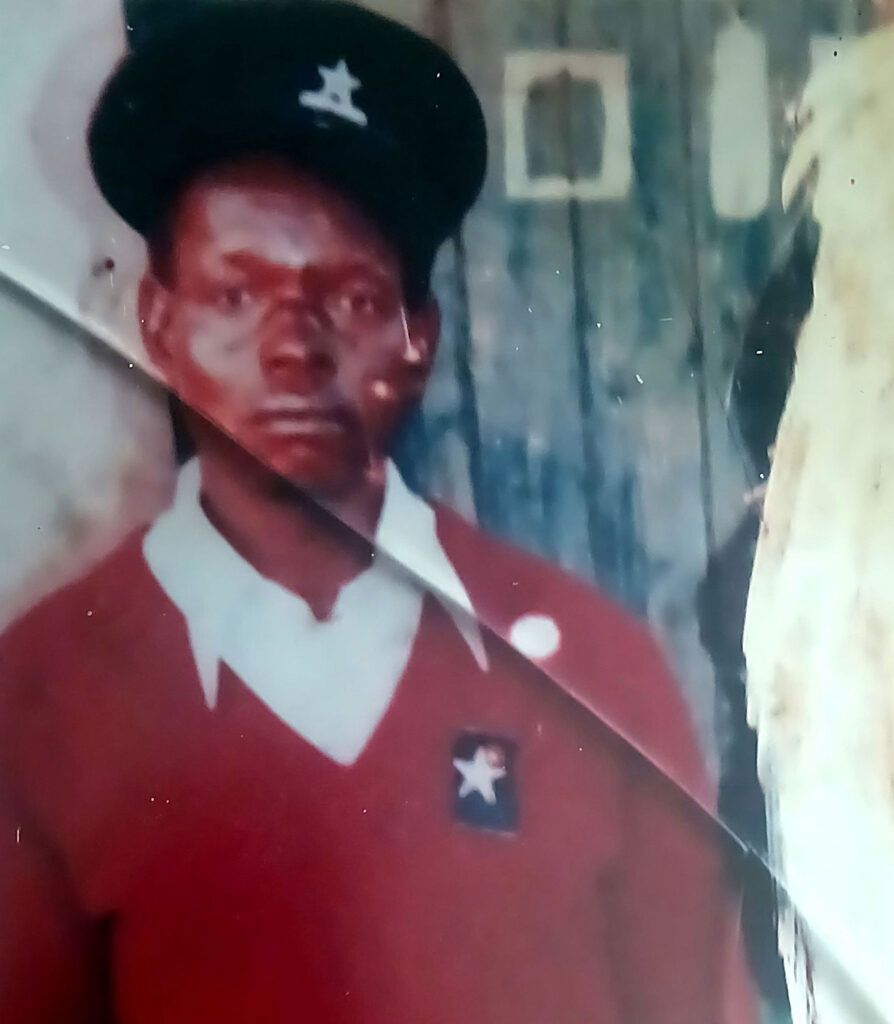
Bilakhulu! narrates and sketches the social importance of individual life. This is foregrounded in “Ancestral Wealth”. The poem is a tribute to Bila’s father, Risimati Daniel Bila, who died in 1989 and it explores his tough existence in Elim. In the following scene, one hears the narrator, who is presumably Bila himself, being taken aside by his dying Father as he outlines his will,
You sat on your three quarter bed
Wearing that brown striped t-shirt from Pep stores
Eyes fixed on the old leaking zinc roof
Then you paged through the Old Mutual policy document
And you said:
Mhana Oom (he called me Oom)
Lwangu leri i ra khale (the roof is old)
Switina ndzi xavile (I have bought the bricks)
Kambe a swi nge eneli ku aka yindlu ya kahle (But they’ll not be enough to build a decent house)
Loko va ku nyika swimalana swa mina swa phenxeni (When they give you my little pension fund)
Vumbuyindlu(Build a house)[29]Bila, “Ancestral Wealth”, in Bilakhulu!, p. 30, ll. 70-81.
The last living wish of Risimati Daniel Bila is to have a respectable house built in his memory. The humility of Risimati Daniel Bila’s living conditions and the modesty of his pension fund, express the trials of his own life, which involved performing some of Elim Hospital’s most difficult practical tasks, such as taking patients into theatre and scrubbing floors, all for a paltry salary. The moment in which Bila’s father relates the dying request to his son is portrayed with penetrating exactitude. Deft descriptions, such as the observation of the father’s ‘pep’ t-shirt forge an inimitable immanence of expression. The mention of one of South Africa’s best-known cheap clothing brands is painstakingly meticulous, setting a scene of under-stated poetic realism. In a similar line of thought, the instructions of Bila’s father are narrated in Xitsonga, which allows the reader to make contact with the cadences and speech patterns of people in the community of Elim. The inclusion of local language grants the narrative an authentic texture, allowing for an intimacy with Bila’s father’s last night on earth.
“Ancestral Wealth’s” close attention to Risimati Daniel Bila’s poverty, and testing living conditions, passes comment upon issues of infrastructural failure and resource scarcity in Elim as a whole. Risimati Daniel Bila’s personal ordeals are interlinked with the inadequacy of medical care in Elim,
Papa, you came home to rest forever
Because the groaning and wailing movie never stops in the hospital
Some pale-faced patients urinate in coffee mugs and plates
The very same mugs they use for coffee and tea
Some patients jump from the bed like impalas
Tearing drips and tubes away
They race around the ward wearing the catheters
Bubbling with urine tea.[30]Bila, “Ancestral Wealth”, in Bilakhulu!, p. 38, ll. 342-354.
Bila’s narrator spurns politeness or delicacy of tone by openly discussing the unacceptable standards of hygiene at Elim Hospital where patients are forced to drink tea and coffee out of the very same vessels in which they urinate. One is not only made to feel that Risimati Daniel Bila cannot cope in this environ but also that the hospital is uninhabitable for anyone aspiring towards a basic level of human dignity. The section offers powerful political critique and the simile likening frenzied patients to leaping ‘impalas’ is particularly arresting. Conventional English idiom is subverted and a novel expression is established for the madness and fear that overcomes many people when desperately ill or close to death. The poet’s idiomatic flair allows a sharpened view on the everyday health battles towards which the wealthy and privileged seem to have become numb or apathetic. The startling comparative language proves that poetry committed to tackling social immiseration need not come off as flat-footed but can be surprising and even exhilarating.
“Ancestral Wealth” concludes through describing the act of honour and homage that Bila has paid to his father through erecting a tombstone in his memory. The physical act of paying tribute to Daniel Risimati Bila in the built environment parallels the poem’s own narrative commemoration of Bila’s father,
Papa, I know it took us twenty years to erect your tombstone
All along the wind was blowing you away
The sun was burning you
Your pillow was your hand
But now Bila, Mhlahlandela, rest in peace
Do not open the grave and come home wearing shorts.[31]Bila, “Ancestral Wealth”, in Bilakhulu!, p. 41, ll.456-461.
These concluding words deploy an unconventional bricolage of linguistic registers,
The sun was burning you
Your pillow was your hand
But now Bila Mhlahlandela, rest in peace
Do not open the grave and come home wearing shorts.[32]Bila, “Ancestral Wealth”, in Bilakhulu!, p.41, ll. 458-461.
A lyrical and tender address describes the way in which Risimati Daniel Bila’s earthly remains are finally given a place to rest after twenty years of dwelling amongst natural forces such as wind and sun. Contrasted with this philosophical, and also physical meditation on rituals of burial and commemoration, is the injunction, ‘Do not open the grave and come home wearing shorts’. The picture of a jauntily dressed man arising from the grave dressed in shorts is not straightforwardly literal and hits a note of the bizarre. The image arises from translating Xitsonga expression into English and it has the effect of injecting the language with new potency. A dissonance of tone compels attention to the story at hand while also suggesting that seemingly unlike realms such as the beautiful and the absurd, or the dead and the living, are closely related. In this respect, “Ancestral Wealth” is representative of Bila’s sustained ability to yoke together a wide range of subject matter and literary styles in order to narrate detailed and personal accounts of poverty.

It has become evident that the narrative turn in Bila’s writing is able to make profound connections between individual and community, part and whole. This style portrays the fact that Timbila poetry is able to make socially necessary use of narrative. The aesthetic has a centripetal function, absorbing the minutiae of personal lives into a cohesive and structured account of society. The worth of such writing lies in its capacity to dexterously unveil the connectedness of subjective pain to broader political issues. Many of Bila’s poems are concerned to connect isolated situations of injustice to centralised government power and the structural violence of capitalism. Such writing allows insight into the plights of poor areas and the roots of inequity in South Africa today. Given that the bulk of South African literature focuses on metropolitan and middle class scenes, Bila’s poetry is socially vital.
The title poem of Bila’s second collection, In the Name of Amandla, tackles the lack of socioeconomic change in an unnamed village and it presents the community’s plights as embodying the failures of the post-Apartheid nation. The poem offers an acute critique of the uneven and unequal nature of South Africa,
In the name of Amandla
Tell me what has changed in this village
There’s no food in the kitchen
Bare children with chapped lips can’t go to school
Another hungry child knocked down by a rich man contributed to a cheap coffin
Everyone thought he would rot in prison.
It’s winter, the school has no desks, textbooks & windows
Our leaders send their children to private schools
Ask them

In the name of Amandla
Tell me what has changed in this village[33]Bila, “In the name of Amandla”, in In the name of Amandla, p.98, ll.1-12.
A key aspect of “In the Name of Amandla’s’ aesthetic is an endeavour to connect with an audience through creating an atmosphere of dialogue. In this way, Bila’s poetry is reminiscent of Fanon’s description of national art in the struggle for liberation. For Fanon, ‘every time the storyteller narrates a new episode, the public is treated to a real invocation.’[34]Frantz Fanon, The Wretched of the Earth (New York: Grove Press, 2004), p.174. Similarly, Bila’s poem is not content to passively describe the post-Apartheid era but actively seeks to rouse national consciousness. Formally, the poem pivots upon the recurrence of the phrase ‘in the name of Amandla’ and the rallying cry invokes an historic community. ‘Amandla’ means ‘power’ in isiZulu and isiXhosa and was a famous slogan of the anti-Apartheid movement during the time in which it sought to establish a liberated South Africa.
Departing from the sentiments of the past, Bila’s poem is less concerned to build unity than to question national cohesion. The poetic speaker repeatedly invokes ‘Amandla’ in order to emphasise the disparity between the ideals of those who fought the brutality of Apartheid and present day socioeconomic circumstances in a supposedly free and non-racial country. Bila himself has noted that ‘if you use a chant properly—it becomes such a powerful political poem. If you do it intelligently it is effective’.[35] Meyer, “Interview with Vonani Bila“.The poet’s point is lucidly illustrated through the continual cry of Amandla, which condenses anger towards past and present social injustice into a single word. The poem’s combination of repetition and apostrophe craft a tone that is structurally comprehensible and conversational. The reverberation of ‘Tell me what has changed in this village’ calls out the lack of transformation in the speaker’s everyday environment and also has the effect of soliciting response and engagement. Here, South Africa is not an object to be spoken at, or about, but a public to be invited into debate. The reader is invited to help construct the country’s history, present, and future.
The poem’s simplicity of diction clearly speaks of particular aspects of poverty. One hears of the reality of hunger, ‘bare children with chapped lips’ who cannot attend school or a ‘hungry child’ run over by a wealthy and reckless driver. The difficult life of a grandmother is most closely traced. Magogo has lived through Apartheid and its aftermath, finding scant opportunity for transformation or upliftment,
In the name of Amandla
Tell me what has changed in this village
The tap is dry
coughs hot air
The pump is off
Granny has no cash to buy diesel
She walks distances to draw dirty water
In the still pool
In the poisoned dam
Where people share water with animals
Granny washes in a cracked red plastic basin
She buys water and pushes a wheelbarrow
She is old, 70!
Her hut collapsed during the days of the flood
She survived,
Because she was busy collecting wood in the bush
She waited for her pension at 60 years of age
She stands in a queue, shoving and shuffling
Someone of her age collapses in the smothering sun
She closes her eyes, sniffs snuff
She sneezes, tears run down her cheeks[36]Bila, “In the name of Amandla”, in In the name of Amandla, p.98, ll. 11-31.
Like her home village, the elderly woman has experienced little positive change since liberation in 1994 and her story embodies the disempowerment of countless black women in South Africa. Magogo’s everyday routine is punishing and she has to walk miles to draw water for drinking and cleaning. The water source is not even hygienic but emanates from a poisonous dam. Washing in contaminated water, the old woman is forced to clean herself in the same ‘cracked red plastic basin’ day in and day out, only dreaming of one day taking a shower.
Later in the poem, it is related that Magogo’s lack of access to adequate hygiene means that she actually offends commuters on taxis through smelling of urine.
Years on from liberation, Magogo still has to stand in queues for a paltry pension that towards the poem’s conclusion one learns can only purchase the most basic of food in the form of mieliemeal. It seems that Magogo’s one piece of luck in life was to survive the collapse of her hut during a flood, though this very event underscores the sub-standard nature of her housing. The reason she was not at home was that she was out collecting ‘wood in the bush’. Given that Magogo’s years have passed with no hope of betterment, there seems little reason for the old grandmother to celebrate her existence and its lack of dignity.
The conclusion of “In the name of Amandla” highlights the relationship between the travails of people like Magogo and African National Congress policy,
In the holy name of Amandla
Tell me what has changed in this village
Our RDP house leaks when it rains
We can’t fit, it’s a toilet
We hear & see them making love In a room divided by a curtain
There can’t be any secret
We sleep in the kitchen
Wake up like elephants early in the morning
Verwoerd, my enemy, built much bigger houses
Trevor Manuel can’t stop buying submarines, corvettes and jetfighters
Our taxes can do something better
War is coming we are told.[37]Bila, “In the name of Amandla”, in In the name of Amandla, p.98, ll.71-84.
The poem criticises the fact that houses built by the supposedly progressive Reconstruction and Development Programme leak and do not have adequate space to house their inhabitants. Dwellers are forced to live in uncomfortably close quarters where they can hear one another making love or must use the kitchen floor as a bedding place. It seems that the reason for sub-standard housing does not reside in there being insufficient funding but rather is owing to the fact that a disproportionate amount of tax money has been spent on arms by ex-finance minister Trevor Manuel. The irony of big budget military spending for supposed purposes of defence is that this use of funds actually threatens South Africa’s internal security. Arming for wars that never materialise seems a gross waste of resources in light of the fact that the country’s rural areas are currently suffering severe poverty and would benefit from greater financial support. The poem connects particular disadvantaged circumstances to government incompetence on the part of the African National Congress. Bila chooses to characterise the failures of the post-Apartheid era through reference to finely detailed accounts of personal deprivation while always taking care to underscore that individual narratives are connected to a larger political whole.
“Comrades, Don’t We Delude Ourselves?” is another poem that perceptively relates community and personal suffering to Apartheid rule and present day capitalism and it similarly relies on chant in order to invite an audience to reconstruct the story of South Africa’s political reality. The speaker cries,
Comrades, comrades, don’t we delude ourselves?
Malan, Pee Wee die Krokodil, Mango, De Klerk,

Hasahasa! Jackals of this world walk scot free;
It’s total amnesty
Justice is but a jamboree,
Poverty grinds the poor in the bundus of Elim,
Bare-skinned children have nothing in their mouths,
Victims always get a raw deal,
Fat cheques, perks and sex are for leaders,
Them and their First World comfort in Third World
Africa—

Comrades, don’t we delude ourselves?[38]Bila, “Comrades, don’t we delude ourselves?”, in In the name of Amandla, ll.19-30.
In a comparable fashion to “In the Name of Amandla”, Bila’s poem aims for engagement from the heirs of liberation. ‘Comrades’ was a common appellation among communist and anti-Apartheid resistance movements and is still used by African National Congress members today. The repetition of “Comrades, don’t we delude ourselves’ incites thought and action regarding the state of South Africa. Poetic technique decries the notion of nation as an inert and pre-given reality, and vigorously seeks to create discourse surrounding the country’s future. The reality of justice in post-Apartheid South Africa is explicitly mocked and said to be ‘a jamboree’ implying that it is merely a grand celebration lacking in political substance.
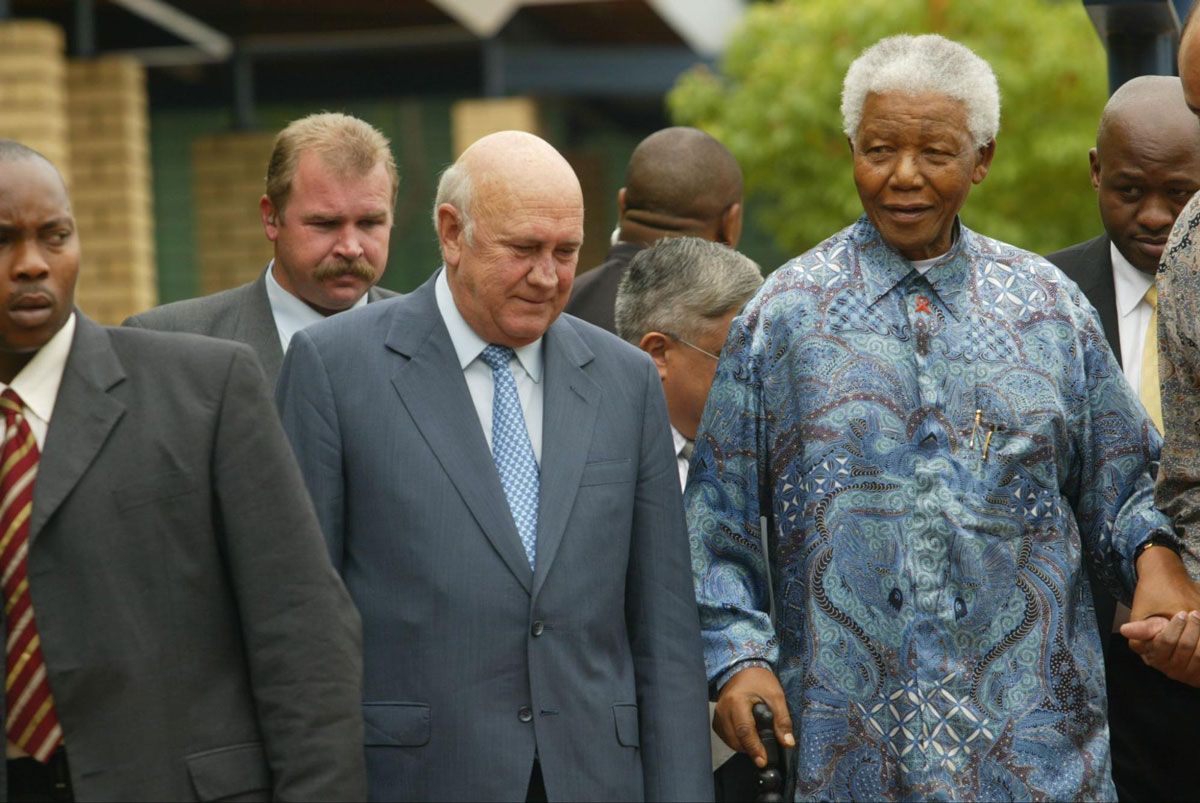
The reason for this is that those who perpetuated Apartheid brutality, such as P.W Botha or F.W De Klerk, have never been called to account. The latter was even awarded a Nobel Peace prize for his work in South Africa’s transition to democracy. For Bila’s speaker such ceremonies are shams that fail to understand or bring white racism to justice. In the poem, the economic structures that these white leaders supported and implemented are still seen to be in place under the new government of the African National Congress. Neo-colonialism persists in the form of ‘pure capitalism’ and as a result, those in the ‘bundus of Elim’ and other rural areas continue to be structurally disadvantaged. Under a fiscally conservative economic dispensation, the ‘fat cheques’ are reserved for leaders without an equitable redistribution of the country’s wealth.
“Comrades, don’t we delude ourselves” skilfully interweaves calls to action in a variety of African languages. The writing bridges tribal divides and works towards creating an ethnically cosmopolitan national consciousness,
Corporatism swells on red mother earth,
Pacts between elites are confused as RDP,
E-e, a hi swona!
It’s neo-colonialism!
It’s pure capitalism we abhore.
Haves always climb the bread and butter ladder,
Have nots, ek tell djou:
Mphe-mphe ya lapisa,
Munhu u hanya hi swa yena.
Vuk’ uzenzele dyambu ri humile,
The sun has risen,
but that terrible drought has no mercy.
It has killed all my father’s cattle.
Now I watch ladies and gentlemen
Pulled aboard the gravy train,
Pain rocks through my weary face,
I weep like a half burnt witch Asazi!
Aredzi![39]Bila, “Comrades, don’t we delude ourselves?”, in In the name of Amandla, p. 83, ll. 104-122.
The words, ‘Mphe-mphe ya lapisa,/ Munhu u hanya hi swa yena./ Vuk’ uzenzele dyambu ri humile’ stand out. The lines fuse Sesotho, Swahili and isiZulu, and can be translated as ‘begging sucks/ a man depends on his own sweat/ wake up and do it yourself, the sun has risen’. The lines urge the public to be proactive about taking charge of their own futures instead of helplessly allowing African National Congress greed and corruption to dictate their destinies. Here, the gesture of writing in the mother tongues of black people is a subversive act that reinforces rebellion to public government rhetoric.
Indeed, despite a constitution that officially enshrines eleven official languages, in reality it is English that is the lingua franca of the corporate and political world in South Africa.
The fact that SeSotho, Swahili and IsiZulu are used to inspire hard work and travail is one way of wresting the discourse of labour away from capitalist power. Bila aims to speak with disenfranchised voices on their own terms and his use of language from many different parts of the country acknowledges the range and diversity of South African culture.
Skilful use of non-English diction and idiom drawn from local Limpopo is key to Bila’s poetic strategy. The technique recurs throughout his oeuvre. This is exemplified in the poem “Dahl Street Pietersburg”. The poem is dedicated to Tebego, a retired prostitute, who is one of many to have suffered from the degenerate quality of life in the town of Pietersburg, which is now known as Polokwane. In the following extract, one is faced with the gross dilapidation of Dahl Street’s beer-hall. Bila’s continual engagement with local speech and non-English lexicon dramatises the many voices of Dahl Street. In the process, the poet stakes a claim for literature to play an important role in expressing the lived circumstances of Limpopo’s urban populace,
Dahl Street Pietersburg
Eeh, the beer-hall is stuffy
Satan has taken over the world’s saints
Ku nuhwa khehele
Most are water adversaries
Their armpits smell, rotten eggs
They wear dirty takkie
Dance spantsula on smoking dust
Blasting kwaito moves with nerves
Socks and underpants thick with dirt
Some dance with unzipped trousers
Some kiss with dagga-darkened lips
Burping the stench of beer
It stinks like shit Love has no borders
Just kiss those donga road-like gums[40]Vonani Bila, “Dahl Street, Pietersburg”, in In the Name of Amandla, pp.66-67, ll. 226-241.
The revolting scenes of Pietersburg are viscerally portrayed through the description of the claustrophobic beer-hall and dirty men who are seen to have smelly armpits and soiled underwear. The use of language drawn from local surrounds is integral to this vivid narrative. One is absorbed into the culture of township life through mention of Kwaito music and the vigorous style of pantsula dancing. ‘Love has no borders/ Just kiss those donga road-like gums’ is similarly noteworthy. In this quote, the holes in the gums of the beer hall’s inhabitants are compared to ‘dongas’. The latter is a South African colloquialism for holes or ruts in the road and the term makes for an original comparison in its appeal to the country’s demotic language. The distinctive likening of gums to damaged roads is surprising and draws parallels between the degradation of Pietersburg’s population and the urban environment itself.
Xitsonga, Zulu, and Afrikaans words inject the poem with the rhythms and dialect of those who frequent Dahl Street. The un-translated words stand out, dislocating the rhythm and jolting the reader into a certain position of unease to match the unattractive scene portrayed. Examples of untranslated language abound such as when the speaker incorporates the crude catcalls of the beer-hall’s men,
Chisa nyama
Woza
mtwana[41]Vonani Bila, “Dahl Street, Pietersburg”, in In the Name of Amandla, p.67, ll.250-251.
‘Chisa Nyama’ is a Zulu expression for the open space where men drink and grill meat and ‘woza mtwana’ translates as ‘come here baby’. In the passage, men are calling to women to come and spend time with them. Shortly after these Zulu lines, the speaker moves into the Afrikaans ‘vat & sit’. The latter is a slang term for a one-night stand and conveys the sense that Dahl Street is an environment of easy sexual encounters.[42]Bila, “Glossary”, in In the Name of Amandla, p.119. A final example of the incorporation of non-English voices is the quote,
Seshego se botse boshego
We are entertaining ourselves
Wa lala wa sala
U huma kwihi m’fana loyi?/ Phashasha.[43]Bila, “In the name of Amandla”, in In the name of Amandla, pp.67-68, ll.263-267.
The extract strikingly juxtaposes English and Xitsonga. Translated line by line it reads, ‘Seshego township is lovely in the night’, ‘we are entertaining ourselves’, ‘you sleep, you miss’, ‘where does this come from?’, and ‘that’s fine’.[44]Bila, “Glossary”, in In the Name of Amandla, p. 120. The section captures fragments of dialogue amongst pleasure-seeking men who encourage each other to revel the night away in the nearby township of Seshego. The use of a variety of South African languages destabilises a fluent process of reading and impels one to come to grips with the language of Pietersburg and the life force of its urban figures.
“Dahl Street” indicates that for Bila, poetic form is not an abstract or theoretical category externally imposed upon the outside world. Instead, aesthetic techniques dialogue with living circumstances and gain their relevance from the physical conditions of people. In the case of ‘Dahl Street Pietersburg’, this means infusing poetry with the jolted rhythms of city life hence drawing heightened attention to the actuality of urban Limpopo. The reader is made aware of political circumstances in a form apposite to the reality portrayed. In “Dahl Street”, the derelict urban environment is directly linked to the evils of capitalism. The beer-hall stands in shocking contrast to the Holiday Inn where leaders recline and smoke cigars,
Dahl Street
Sham festival of life lost
Wasteland Pietersburg
Leaders smoke Cuban cigars
Fidel Castro’s people are literate
In Holiday Inn, they buy beers with credit cards
Next plane to US
With navy blue suits
Hobbling from one meeting to the other
Trapped in crony capitalism.[45]Vonani Bila, “Dahl Street, Pietersburg”, in In the Name of Amandla, p.68, ll.268-277.
It is made apparent that while the majority socialise in slum-like conditions, the elite few relax in luxury hotels, buying beers with credit cards. Crucially, the pain that ‘crony capitalism’ causes to the wealthy is articulated through the description of the rich as ‘trapped’ and disabled as indicated in the use of the term ‘hobbling’. The fact that a societal structure based on hierarchical divisions is also harmful to the empowered, through gifting them with a surplus of what they need and separating them from community, is conveyed. Bila’s representations of the structural reality of Limpopo and South Africa are necessary to the extent that they pay witness to post-Apartheid corruption and call for widespread change. The links forged between microcosm and macrocosm express the importance of small communities while never losing sight of the fact that their hardships are instances of a more general, national exploitation.
Aside from his gritty and sometimes scatological depictions of rural and urban poverty, Bila also writes in a more elevated register. In this respect, his poems that pay tribute to artistic life offer moving accounts of creative genius and frequently seek to highlight the rich imaginative worlds of rural and small communities. In his article, “In the heart of the country”, Bila evinces his admiration for rural cultures and hope to detail their traditions,
Our rural areas are reservoirs of both the blended and the unspoilt language of the majority of people in South Africa. It would be worth recording their folktales the way the Finnish poet Elias Lonrot did in his country in the early 19th century. Lonrot travelled the length and breadth of rural Finland listening to people’s stories, cries and joys—patiently excavating the epic poem Kalevala.[46]Vonani Bila, “In the heart of the country”, The Big Issue, 2013/2014, pp.58-59 (p.59).
Bila has yet to write an epic poem or comprehensively transcribe South African folklore but his poetry does devote a great deal of time and care to the tales, languages, and art of South Africa’s rural cultures. An example of this is the poem “wood warrior”, written in recognition of master carver Jackson Xidonkana Hlungwani.
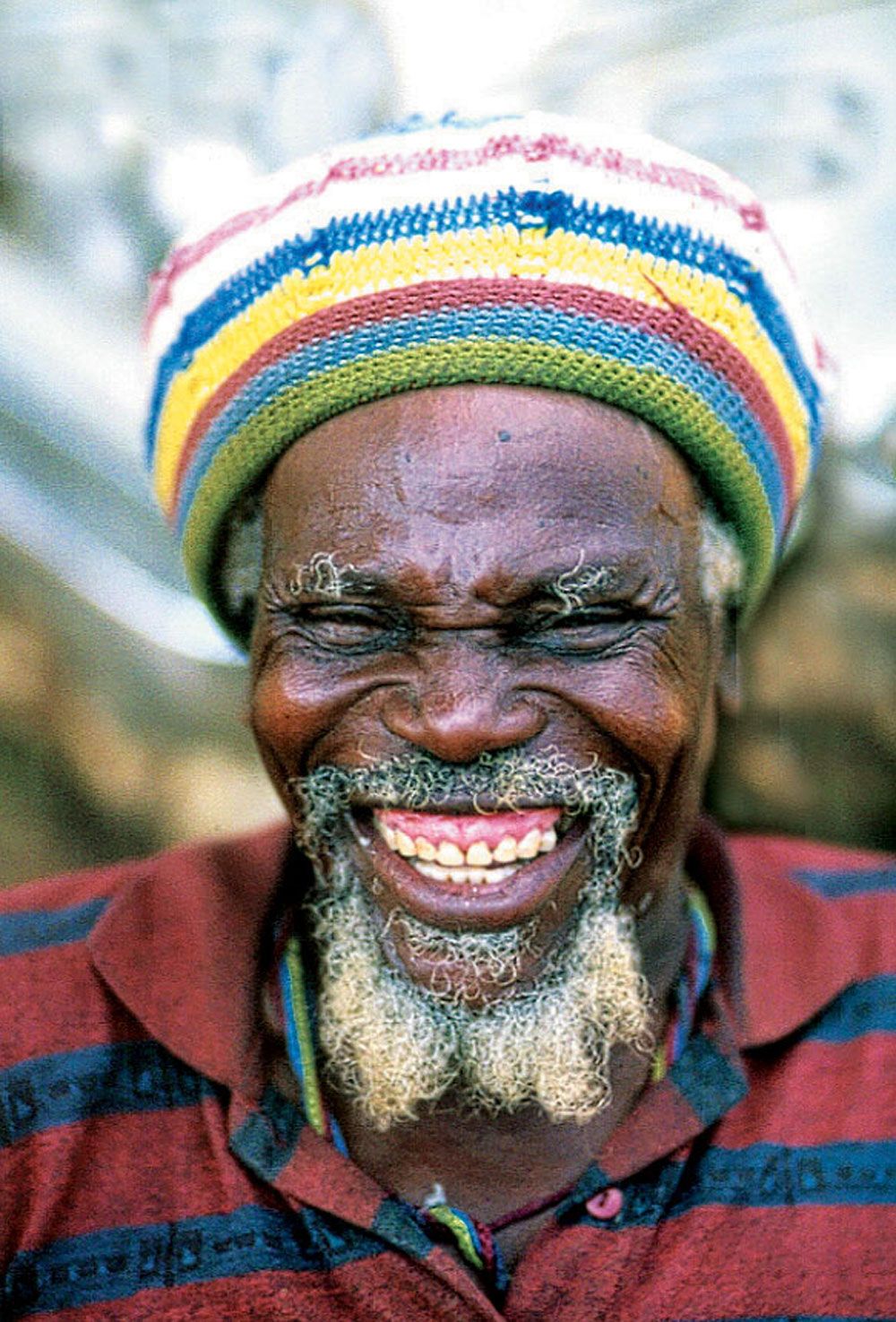
The poem exemplifies the beautiful and visionary qualities of rural culture. Hlungwani is presented as a figure that is formed by the customs of his home village of Mbhokota, which is located in the Vhembe District Municipality of Limpopo. In a complimentary vein, Hlungwani is seen as making novel contributions to the village’s artistic heritage,
regal eccentric xidonkana
son of pavalala the migrant worker
diminutive man flogging a dead tree peacefully
birds chirp cheerfully
immortal wood warrior in dawn
fighting a voodoo wood war in the bush
dew between toes

mantra with working
hands immortal wood
warrior

years ago
you saw satan with your own naked eyes
shooting arrows through your legs
you say one arrow sunk into your body
becoming a snake
then you burnt your leg & sins
warmed the rotting wound on fire
now it has healed
and the magnetized world knows
the mystic sculptures come from mbhokota[47]Vonani Bila, “wood warrior”, in Magicstan Fires (Elim: Timbila Poetry, 2006), p.12, ll.1-19.
“Wood Warrior” illustrates that a socially necessary poetry does not only operate through literal description or hard-hitting social commentary. Another manner of immanently conveying the ambience of place is to speak in the register of its spiritual and folkloric beliefs. The high tone of Bila’s poem is inherited from Xitsonga praise poetry and it celebrates the life of Jackson Xidonkana Hlungwani through highly wrought epithetic language. Hlungwani is described as a ‘wood warrior’, which attributes bravery and daring to his artistic character. In a fashion akin to African heroes of old, Hlungwani does combat with voodoo spirits, translating trees and plants from the stuff of nature into mesmerising carvings that make his village famous. Hlungwani’s dignity and pre-eminence are further elaborated when he is introduced as ‘regal eccentric xidonkana/ son of pavalala the migrant worker’. The gesture of tracing the Carver’s lineage is a form of tribute. He is praised through the adjectives, ‘regal’ and ‘eccentric’. ‘Regal’ suggests that Hlungwani is on a par with royalty while ‘eccentric’ indicates that his habits, psyche and gifts are different from those of the rest of society. ‘Xidonkana’ lends the line a note of affection. The word is Xitsonga for ‘hard-working donkey’ and it is the name by which Hlungwani was lovingly known by those in his community. It becomes clear that “wood warrior” is concerned to pay homage to Hlungwani in terms derived from the world-view of Mbhokoto.
In the final section of the poem, the villagers of Mbhokoto affirm Hlungwani in the traditional praise language of the village,
 hlunga-vukosi
 ndzhundzhu
 xikwembu xa le matini.[48]Vonani Bila, “wood warrior”, in Magicstan Fires, p.15, ll.109-111.
Hlunga-vukosi is the customary language by which the Hlungwan is praise themselves and it literally means ‘a revolutionary who brews storms to challenge the ruling class.’[49]Bila, “Glossary”, in Magicstan Fires, p. 94. The words from the villagers grant a revolutionary aspect to the force of Hlungwani’s art and radiate a sense of pride that the Carver is exemplifying the very best qualities of his clan. Ndzhundzhu’ and ‘xikwembu xa le matini’ are both terms for water gods and the inclusion of these praise words illustrates Hlungwani’s affiliation with deities and supernatural forces. One receives the sense that this is an artist with deep connections to a reality other than our own. The Carver is said to have seen ‘satan’ with his own eyes and to have been shot in the leg by the ‘devil’s’ serpentine arrow. Hlungwani’s engagement with the spiritual world inspires and infuses his woodcarvings in which,
adam wears short pants and sandals
jesus is a dribbling soccer wizard.[50]Vonani Bila, “wood warrior”, in Magicstan Fires, p.13, ll.37-38.
Jackson’s carvings are not simply content to retell old stories of religion and faith but also portray ancient figures in a new light. Jesus is dressed in the contemporary attire of shorts while Adam of Genesis is portrayed in the persona of a soccer star. The creation of Hlungwani’s art is itself a kind of supernatural process in which he patiently transforms the spirit of ‘sand & grass’ into original and memorable works of genius. Hlungwani’s own work makes a vital contribution to Mbhokota’s cultural life and is a part of its folkloric heritage. Bila’s ekphrastic homage provides an analogue for the poet’s task. Like Hlungwani, Bila seeks to portray the beauty of rural culture and enshrine it in art.
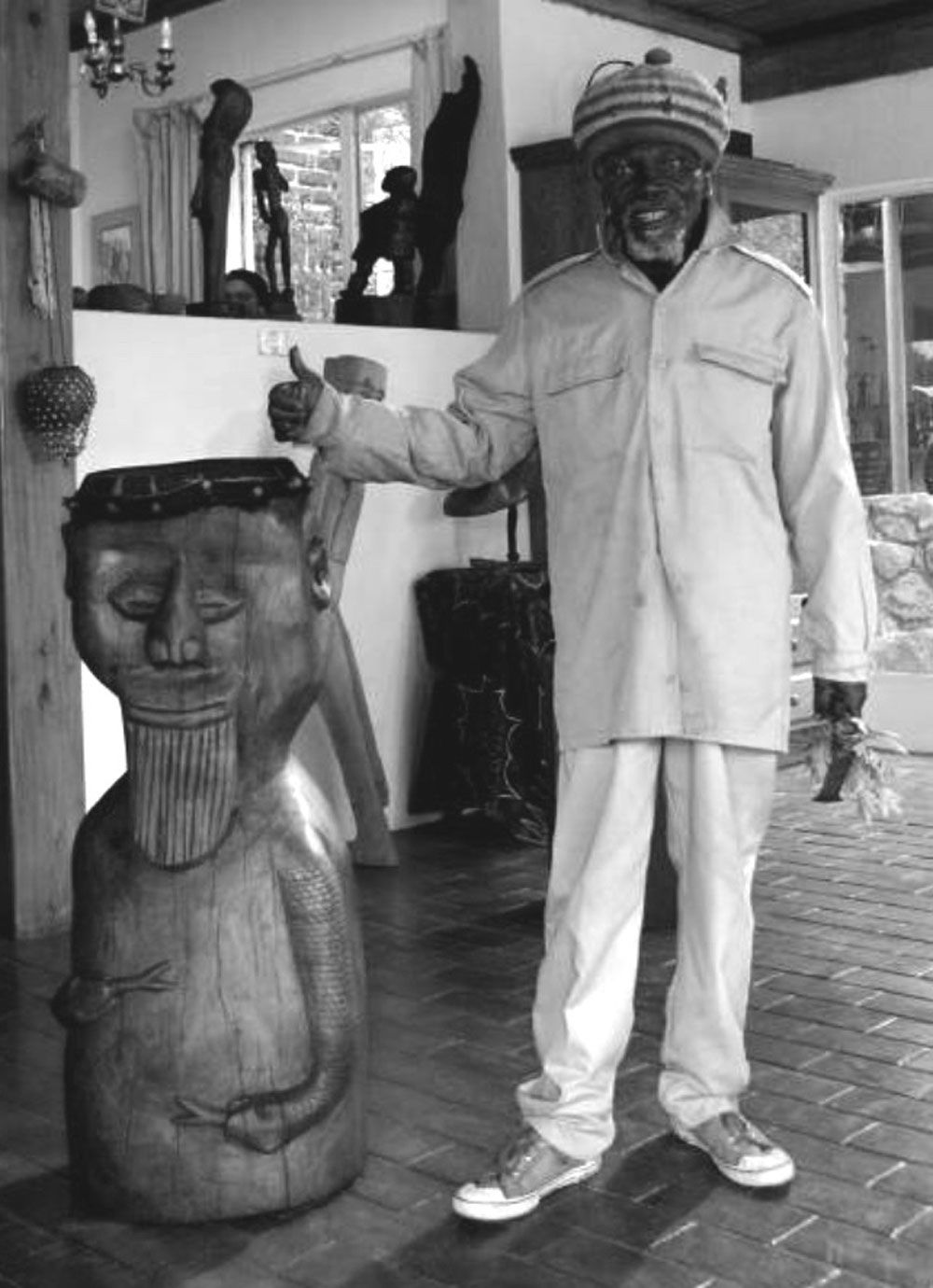
One of the most remarkable phrases of Bila’s poem is that which lauds the ethereal and spiritual properties of Hlungwani’s talent, ‘mantra with working hands/ immortal wood warrior’.[51]Vonani Bila, “wood warrior”, in Magicstan Fires, pp.12-15. The refrain recurs throughout the poem and is somewhat puzzling because it apostrophises Hlungwani through suggesting that the artist himself is a kind of mantra. It is not clear how a human being could be ‘a word or sound that is believed to have a special spiritual power’ or ‘a word or phrase that is often repeated and expresses a particular strong belief’.[52] “mantra, noun”, in Cambridge Dictionaries Online dictionary [Accessed 3 October 2015] .
Presumably, Bila is intimating that the carver’s very existence is a kind of living symbol of power and that repeated relation of his life and works is able to invoke spiritual presences of creativity. Given that mantras are rarely logical statements, it is appropriate that the construction of Bila’s address does not make literal sense and its opacity augments the atmosphere of mystery that is woven around Hlungwani. Complementing the interesting representation of man as mantra, Bila’s poem itself takes on a note of incantation through reiteration of the phrase in question. Both the carver, and the poem that seeks to capture his quintessence, are instilled with otherworldly authority and express the rich visionary world of Mbhokota.
The triumph of “wood warrior” lies in its ability to adapt tropes from Xitsonga oral culture, such as elaborate epithet, praise poetry and mystical language in order to forge an evocative and dream-like impression of Mbhokoto. The reader is connected to the village through the area’s own idiom and thus gains a profound insight into its art and culture.
The political importance of capturing rural creativity is paramount given that historically, much of South Africa’s white, colonial poetry has portrayed the South African country as empty and devoid of life.
J.M. Coetzee has singled out the English landscape poets for particular criticism, arguing that their presentation of bleak, uninhabited space is ideological and neglects South Africa’s indigenous cultures.[53]J.M.Coetzee, White Writing: on the Culture of Letters in South Africa (Yale: Yale University Press, 1988; Braamfontein: Pentz Publishers, 2007), p.182. In contrast, Bila’s poetry fills some of the country’s most out-of-the-way locations with personalities of genius and honours their heritage.
Bila painstakingly atomises South Africa’s glaring inequalities and those of Limpopo in particular. The writing is socially essential in ensuring that the lives of disempowered peoples are not forgotten or swept aside. In Bila’s own words, ‘Yes, I confront the reader with stories of shame, degradation, retrenched workers, prostitutes in substandard conditions, the unemployed and beggars—these are the stories few dare to tell with honesty, love and compassion’.[54]Gary Cummiskey, “Vonani Bila: no brand-puppet poet”, The Dye Hard Interviews, 7 May 2010 dyehard [Accessed 8 September 2015] (Para.17 of 32).
It is apparent that for Bila, locales are always filled with characters that viscerally define their landscapes. Places are not primarily characterised through reference to the built or natural environment but also by those who live in them.
The representation of place as a social entity provides vital commentary on the dissonance between spaces of empowerment and disadvantage in South Africa today. Thematically, Bila’s poetry tackles a wide range of subject matter. His poems on Elim prioritise the importance of individual lives and the realities of his home village, while his depictions of urban scenes such as “Dahl Street” dramatise the slum-like conditions of workers. In a different register, a poem such as “wood warrior” pays tribute to rural creativity and highlights the resilience of indigenous cultures amidst humble circumstances. All of Bila’s work is concerned to underscore links between poor environments and macrocosmic social structures.
Bila has stated that ‘the commitment to place is also the commitment to language’.[55]Meyer, “Interview with Vonani Bila”.
His work narrates context through vocabulary and forms drawn from the sites he seeks to represent. Techniques such as apostrophe or the chant hail from the struggle tradition and serve to interrogate the nation it fought for. Similarly, interweaving sayings, rhythms, and myth from Xitsonga and other African cultures into English immanently connects Bila’s writing to the heritage of the stories he represents. The importance of registering Bila’s poetic strategies, and those of others in the Timbila movement, is vital for understanding some of the country’s most important political critique. Fidelity to narrative is a craft and clear representations of reality require structure and form. A socially necessary writing is one that uses place and circumstance to inform its aesthetic. Through such language, poetry is confident enough to imply that words can convey truth and that this truth passes its own political and moral judgment.
Alice Patricia Meyer
Faculty of English
Queens’ College University of Cambridge
This dissertation was submitted for the degree of Doctor of Philosophy June 2017
Adorno, Theodor W, “Cultural Criticism and Society”, in Prisms, trans. by Samuel and Shierry Weber (Neville Spearman: London, 1967), pp. 19 -34
Berold, Robert, “Lesego Rampolokeng, December 1993”, South African Poets on Poetry, Interviews From New Coin 1992-2001 (Scottsville: Gecko Poetry, 2003), pp. 22-33.
Berold, Robert, “Interview: Ari Sitas”, New Coin, 31 (1995), 40-50 Berold, Robert, “Interview: Botsotso Jesters”, New Coin, 34 (1998), 23-31
Berold, Robert, “Interview: Oral Poetry, Lesego Rampolokeng and Ike Mboneni Mulla”, New Coin, 35:1 (1999), 36-45
Berold, Robert, “Interview with Lesego Rampolokeng”, 1999, in Interviews from New Coin.
Bila, Vonani, (ed). Timbila, 1:1 (2000)
Bila, Vonani, In the name of Amandla (Elim: Timbila Poetry, 2004 Bila, Vonani, Magicstan Fires (Elim: Timbila Poetry, 2006)
Bila, Vonani, “The Republic of Poetry project: Timbila launches a writer development programme”, The Books Newsletter, 14 March 2006
Bila, Vonani, Handsome Jita: Selected Poems (Scottsville: University of KwaZulu-Natal Press, 2007)
Bila, Vonani, “Editor’s Notes”, New Coin, 49:1 (2013)
Bila, Vonani, “In the heart of the country”, The Big Issue, 2013/2014, pp.58-59 Bila, Vonani, “Bilakhulu! Longer Poems (Grahamstown: Deep South, 2015)
Bila, Vonani, “Building Socially Committed Writers through the Timbila Writing Model” (2015)
Blasing, Mutlu Konuk, Lyric poetry : the pain and pleasure of words (Princeton: Princeton University Press, 2007)
Brecht, Bertolt, Brecht on Theatre, edited and translated by John Willett (London: Eyre Methuen, 1964).
Cronin, Jeremy, Even the Dead: Poems, Parables and Jeremiad (Bellville: Mayibuye, 1997)
Dladla, Angifi, the girl who then feared to sleep and other poems (Grahamstown: Deep South, 2001)
Dladla, Angifi, Maxwell the Gorilla and the Archbishop of Soshanguve (Germiston: Chakida Publishing, 2014)
Dladla, Angifi, We are All Rivers (Germiston: Chakida Publishing, 2015)
Dladla, Angifi, “Demystifying Writing and the Democratisation of the Story and Knowledge”, Current Writing: Text and Reception in Southern Africa, 27: 2 (2015) 86-95
Fanon, Frantz, The Wretched of the Earth, transl. Richard Philcox (New York: Grove Press, 1963)
Finlay, Alan, “’Making it Visible’, Interview with Vonani Bila”, Bleksem, 7 (1999)
Finlay, Alan, “Kotaz Interview: Mxolisi Nyezwa”, New Coin, 44 (2008), 20-25
Finlay, Alan William “Making Space: The counterpublics of post-apartheid independent literary publishing activities (1994-2004)” (unpublished master’s thesis, University of the Witwaterstrand, 2009)
Finlay, Alan, “Making space: the counterpublics of post‐apartheid independent literary publishing activities (1994–2004)”, Social Dynamics, 36:1 (2010), 166-178
Horwitz, Allan Kolski., et al., eds., “What is BOTSOTSO? Editorial”, Botsotso, 1 (1994) Hirson, Denis (ed), In the Heat of Shadows, South African Poetry 1996-2013 (Grahamstown: Deep South, 2014)
Horwitz, Allan Kolski, “A new spirit is our backbone”, in Marikana, A Moment in Time, ed. by Raphael d’Abdon (Johannesburg: Geko Publishing, 2013), pp. 95-100
Marx, Karl Capital Volume I, transl. Ben Fowkes (London: Pelican Books, 1976) Marx, Karl, Capital, Vol. II, transl. David Fernbach (New York: Pelican, 1978)
Metelerkamp, Joan, “Angifi Dladla, December 2001”, in South African Poets on Poetry, Interviews From New Coin 1992-2001 (Scottsville: Gecko Poetry, 2003), pp. 172-182
Meyer, Alice, “Email interview with Ari Sitas”, 7 March 2014
Meyer, Alice, “Email correspondence with Robert Berold”, 7 July 2015
Meyer, Alice, “Interview with Robert Berold”, (Grahamstown: 4 September 2015) Meyer, Alice, “Interview with Vonani Bila” (Elim, 29 August 2015)
Meyer, Alice, “Interview with Angifi Dladla” (Germiston: September 2015) Motadinyane, Isabella, Complete Poems (Grahamstown: Deep South, 2016).
Motsapi, Seitlhamo, earthstepper/ the ocean is very shallow (Grahamstown: ISEA, Rhodes University and Deep South, 1995. Reprint. Grahamstown: Deep South, 2003)
Ndebele, Njabulo S, Rediscovery of the Ordinary: Essays on South African Literature and Culture (COSAW, 1991).
Ntuli, Pitika, “Where were you when Marikana died?” in Marikana, A Moment in Time, compiled and edited by Raphael d’Abdon (Johannesburg: Geko Publishing, 2013), pp. 31-4
Nyezwa, Mxolisi, Song Trials (Scottsville: Gecko, 2000)
Nyezwa, Mxolisi, Malikhanye (Grahamstown: Deep South, 2011)
Nyezwa, Mxolisi, New Country (KwaZulu-Natal: University of KwaZulu-Natal Press, 2011)
Nyezwa, Mxolisi, “Because I did not smile”, New Coin, 49 (December 2013), 80-82
Nyezwa, Mxolisi, “It All Begins” in It All Begins, Poems from Postliberation South Africa, ed. by Robert Berold (Scottsville: Gecko Poetry, 2002)
Preminger, Alex and T.V.F. Brogan, eds., The New Princeton Encyclopedia of Poetry and Poetics (New York: MJF Books, 1993)
Rampolokeng, Lesego, Horns for Hondo (Fordsburg: Cosaw, 1990)
Rampolokeng, Lesego, Talking Rain (Johannesburg: COSAW Publishing, 1993)
Rampolokeng, Lesego, Writing the Ungovernable [Poster], (Grahamstown: The University of Rhodes, 2012).
Rampolokeng, Lesego, Head on Fire: Rants/ Notes Poems 2001-2011 (Grahamstown: Deep South , 2012)
Rampolokeng, Lesego, a half century thing, (Black Ghost Press, 2015).
Sachs, Albie, “Preparing Ourselves for Freedom: Culture and the ANC Constitutional Guidelines”, TDR, 35:1 (1991), pp. 187-193
Sitas, Ari, Slave Trades & an Artist’s Notebook (Cape Town: Deep South, 2000)
Sitas, Ari, “Marikana”, in Marikana, A Moment in Time, compiled and edited by Raphael d’Abdon (Johannesburg: Geko Publishing, 2013), pp. 20-22
Sitas, Ari, Rough Music, (Grahamstown: Deep South, 2013)
Abrams, M.H, A Glossary of Literary Terms, Seventh Edition (Boston: Heinle & Heinle, 1999)
Attwell, David, Rewriting Modernity (Scottsville: University of KwaZulu-Natal Press, 2005)
Acker, Jennifer (ed.), “Mxolisi Nyezwa”, The Common Online, (Amherst College, Massachusetts: Frost Library,2013) <http://www.thecommononline.org/bio/mxolisi- nyezwa> [Accessed 11/01/2015]
Alexander, Peter, “Marikana, Turning Point in South Africa’s History”, Review of African Political Economy, Special Issue: Revisiting The South African Developmental Impasse: The National Neoliberal Revolution, ed. by Nicolas Pons-Vignon, Aurelia Segatti and Ray Bush, 40 (2013), 605-619
Andrews, Bruce, “Poetry as Explanation, Poetry as Praxis”, in The Politics of Poetic Form, ed. by Charles Bernstein (New York: Roof Books, 1990), pp. 23-43
Ashman, Sam, Ben Fine and Susan Newman, “Amnesty International? The Nature, Impact and Scale of Capital Flight from South Africa”, Journal of Southern African Studies, 37:1 (2010), 7-25
Berold, Robert, “Poetry of political betrayal, domestic cruelty”, The Sunday Independent, 16 January 2005
Berold, Robert, “Poets who do not soothe or create distance from our turmoil”, The Sunday Independent, 9 May 2009
Bernstein, Charles, “Comedy and the Poetics of Political Form”, in The Politics of Poetic Form, ed. by Charles Bernstein (New York: Roof Books, 1990), pp. 235-244
BizCommunity, “President Obama commends Daily Maverick’s Khadija Patel”,
BizCommunity.Com, 5 July 2013 bizcommunity. [Accessed 21 April 2014]
Bofelo, Mphutlane wa “Bantu Ghost: a stream of (black) unconsciousness” kaganof.com [Accessed 03/10/2014]
Bond, Patrick, Talk Left, Walk Right: Rhetoric and Reality in the New South Africa”, Global Dialogue, 6: 3/4 (2004), 127-140
Bond, Patrick, Talk Left, Walk Right, South Africa’s Frustrated Global Reforms (Scottsville: University of KwaZulu-Natal Press, 2004)
Bond, Patrick, “South Africa Embraces Corporate Welfare: Mega Deal Subsidies Over Services for the Poor”, Multinational Moniter (2006) 22-25,40
Bond, Patrick, “South Africa’s ‘Developmental State’ Distraction”, Mediations 24:1 (2008) 8-27
Bond, Patrick, “Debt, Uneven Development and Capitalist Crisis in South Africa: from Moody’s macroeconomic monitoring to Marikana microfinance mashonisas”, Third World Quarterly, 34:4 (2013), 569-592
Bond Patrick, “Contradictions in consumer credit: innovations South African super- exploitation”, Critical Arts, 29:2 (2015), 218-239
Brown, Duncan, “Black consciousness, tradition and modernity: Ingoapele Madingoane’s ‘black trial’”, Current Writing, 9:1 (1997), 1-26
Buur, Lars, “The horror of the mob, The Violence of Imagination in South Africa”, Critique of Anthropology, 29 (2009), 27-46
Cummiskey, Gary, “earthstepper/ the ocean is very shallow by Seitlhamo Motsapi (Deep South Publishers/ ISEA, 1995)” Bleksem, 5 (1996), 13-14
Cummiskey, Gary, “Lyrical, intensely personal collections”, Business Day (South Africa), 7 February 2009 <https://global.factiva.com/ga/default.aspx> [Accessed 25/02/2015]
Cummiskey, Gary, “Khulile Nxumalo: Seeking New Ways of Saying”, The Dye Hard Interviews, 19 September 2013 dyehard [Accessed 4 September 2015]
Cummiskey, Gary, “Vonani Bila: no brand-puppet poet”, The Dye Hard Interviews, 7 May 2010 dyehard [Accessed 8 September 2015]
Cummiskey, Gary, “Launch of Bhilakhulu by Vonani Bila”, Dye Hard Press, 26 July 2015 dyehard [Accessed 7 September 2015]
Cheru, Fantu, “Overcoming Apartheid’s Legacy: The Ascendancy of Neoliberalism in South Africa’s Anti-Poverty Strategy”, Third World Quarterly,v22: 4 (2001), 505-527
Chrisman, Laura, “A Review Essay: EARTHSTEPPER/THE OCEAN IS VERY SHALLOW, by Seitlhamo Motsapi”, The Black Scholar, 26:2 (1996), 33-36
Chrisman, Laura, “Black modernity, nationalism and transnationalism, The challenge of black South African poetry”, in Beyond the Black Atlantic, Relocating modernization and technology, ed. by Walter Goebel and Saskia Schabio (London and New York: Routledge, 2006)
Coetzee, J.M, White Writing: on the Culture of Letters in South Africa (Yale: Yale University Press, 1988; Braamfontein: Pentz Publishers, 2007)
Couzens, Tim and Essop Patel, eds., The Return of the Amasi Bird: Black South African Poetry 1891-1981 (Johannesburg: Ravan Press, 1982)
Duncan, Jane, “Media underplaying police, state brutality”, Sunday Independent, 26 August 2012 iol [Accessed 21 April 2014]
Emanuel, Lesley, “Unpeeling layers of project’s potent new voices”, The Sunday Independent, 29 February 2004.
Finn Murray, Arden, & Leibbrandt Vimal Ranchhod, “Post-apartheid poverty and inequality trends”, in The Oxford Companion to the Economics of South Africa, ed. Haroon Bhorat, Alan Hirsch, Ravi Kanbur, and Mthuli Ncube (New York: Oxford University Press, 2014)
França, J.L. Junior, “Verses, Subverses and Subversion in Contemporary Postcolonial Poetry, The arts of resistance in the works of Linton Kwesi Johnson and Lesego Rampolokeng” (unpublished master’s thesis, University of Cape Town, 2009)
Fuggle, Richard, “We are still Indifferent about the State of our Environment”, Cape Times, 6 Dec. 2006 <http://lists.fahamu.org/pipermail/debate-list/2006- December/003743.html> [Accessed 23/02/2015]
Gentle, Leonard, “Marikana Miners: The Massacre of our Illusions”, Red Pepper, August 2012 <http://www.redpepper.org.uk/marikana-miners-the-massacre-of-our-illusions/> [Accessed 21 April 2014]
Gottschalk, Keith, “A Review, Seitlhamo Motsapi: earthstepper/ the ocean is very shallow, Deep South/ ISEA Foundation for the Creative Arts 1995”, Carapace, 1:5 (1996), 25
Green, Jillian, “Fitch downgrades SA to junk status”, The Daily Maverick, 7 April 2017 dailymaverick [Accessed 20/04/2017]
Greene, Rolande et al (eds), The Princeton Encyclopedia of Poetry and Poetics (Princeton: Princeton University Press, 2012)
Grootes, Stephen, “Analysis: What if Zuma refuses to go?, Daily Maverick , 19 April 2017, dailymaverick [Accessed 06/06/2017]
Gumede, William, Thabo Mbeki and the Battle for the Soul of the ANC (Cape Town: Zebra Publishing, 2005)
Haraway, Donna, “Situated Knowledges: The Science Question in Feminism and the Privilege of Partial Perspective”, Feminist Studies, 14: 3 (1988), 575-599
Harvey, David, A Companion to Marx’s Capital (London and New York: Verso, 2010)
Hesiod, The Homeric Hymns and Homerica transl. Hugh G. Evelyn-White (Cambridge, MA: Harvard University Press; London: William Heinemann Ltd. 1914) via Perseus Digital Library perseus [Accessed 26/02/2015]
Houen, Alex, Powers of Possibility, Experimental American Writing since the 1960s, (Oxford: Oxford University Press, 2012)
Isaacs, Gilad, “The Financialization of the South African Economy and the Havoc It Wreaks”, The South African Civil Society Information Service, 27 March 2014 sacsis [Accessed 22/04/2017]
Jamal, Ashraf, “The navigating harlequin: speculations on the syncretic”, Scrutiny 2: Issues in English Studies in Southern Africa, 8:1 (2003), 3-20
Jarvis, Simon, “Thinking in verse” in The Cambridge Companion to British Romantic Poetry, ed. James Chandler and Maureen McLane (Cambridge: Cambridge University Press, 2008), pp. 98-116
Jenkins, Myesha, “Freedom is flying in all directions”, City Press, 27 February 2005
Jobson, Liesl, “Vonani Bila”, Poetry International, 1 September 2008 poetryinternational [Accessed 7 September 2015]
Johnson, RW, How Long Will South Africa Survive? (London: Hurst & Company, 2015)
Kasrils, Ronnie, “How the ANC’s Faustian pact sold out South Africa’s poorest: In the early 1990s we in the leadership of the ANC made a serious error. Our people are still paying the price”, The Guardian, 24 June 2013 theguardian [Accessed 9/02/2017]
Keats, John, “Bright star, would I were stedfast as thou art”, Poetry Foundation poetryfoundation [Accessed 10/10/2016]
Kings, Sipho, Sarah Wild, Rapula Moatshe & Phillip de Wet “South Africa’s great thirst has begun”, Mail and Guardian Online, 23 January 2015 mg [Accessed 22/02/2015]
Kynoch, Gary, “Reassessing Transition Violence: Voices from South Africa’s Township Wars”, African Affairs, 112: 447 (2013), 283-303
Lazarus, Neil, “The South African Ideology: The Myth of Exceptionalism, the Idea of the Renaissance”, The South Atlantic Quarterly 103:4 (2004), 607-628
Legassick, Martin, “South Africa: Marikana Massacre – A Turning Point?”, Links, 27 August 2012 links [Accessed 21 April 2014]
Levenson, Michael, “Introduction”, in The Cambridge Companion to Modernism, ed. Michael Levenson (Cambridge: Cambridge University Press, 1999)
Mackey, Nathaniel, Discrepant Engagement, Dissonance, Cross-Culturality, and Experimental Writing (Cambridge: Cambridge University Press, 1993)
Mackey, Nathaniel, “Wringing the Word”, World Literature Today, 68:4 (1994), pp.733- 740
Madia, Tshidi, “Election results a final warning to ANC- Cosatu”, News24, 12 August 2016 <http://www.news24.com/elections/news/election-results-a-final-warning-to-anc-cosatu-20160812> [Accessed 15 August 2016]
Mahr, Krista, “South Africa’s Economy Contracts raising prospect of recession”, Financial Times, 8 June 2016 ft [Accessed 15/08/2016].
Mahr, Krista & David Pilling, “South Africa’s ANC suffers worst election result since end of apartheid”, Financial Times, 5 August 2016 ft [Accessed 15/08/2016]
Malala, Justice, “South Africa has broken the postcolonial narrative. It’s a thrilling turning point”, The Guardian, 7 August 2016<https://www.theguardian.com/commentisfree/2016/aug/06/anc-elections-south- africa-democracy-zuma> [Accessed 10/08/2016]
Mathews, Charlotte, “Platinum Woes- Can Industry Survive Crisis?”, Financial Mail, 11 September 2012 <http://www.financialmail.co.za/politics/2012/09/06/platinum-woes–-can-industry-survive-crisis> [Accessed 12 May 2014]
McClenaghan, Mauve and David Smith, “The British Mine Owners, the Police and South Africa’s Day of Blood”, The Observer, 24 November 2013<http://www.theguardian.com/business/2013/nov/24/lonmin-mine-shooting- police> [Accessed 21 April 2014]
Metelerkamp, Joan, “Where the heart is: Poetry review”, Current Writing: Text and Reception in Southern Africa, 13.1 (2001), 108-129
Milne, Drew, “In Memory of the Pterodactyl: the limits of lyric humanism”, in The Lyric Theory Reader: A Critical Anthology ed. Virginia Jackson and Yopie Prins (Baltimore: John Hopkins University Press, 2014), pp. 361-367
Mkhize, Khwezi “Neither History nor Freedom Will Absolve Us: On the Ethical Dimensions of the Poetry of Lesego Rampolokeng”, Safundi: The Journal of South African and American Studies, 12:2 (2011), 179-202
Moore, Jason W, “The Capitalocene, Part I: On the Nature & Origins of Our Ecological Crisis” (2014), 1-38 (pp.6-7)<http://www.jasonwmoore.com/uploads/The_Capitalocene Part_I June_2014.pdf> [Accessed 13 January 2015]
Moore, Jason W, “The Capitalocene, Part II: Abstract Social Nature and the Limits to Capital” (2014), 1-52 (p.3).<http://www.jasonwmoore.com/uploads/The_Capitalocene Part_II June_2014.pdf>.
Mukwevho, Tshifhiwa, “Own village for regions’ authors and artists”, Limpopo Mirror, 13 December 2013<http://limpopomirror.co.za/articles/entertainment/22572/2013-12-13/own- village-for-regions-authors-and-artists> [Accessed 7 September 2015]
Newman, Susan, “ Financialisation and the Financial and Economic Crisis; The Case of South Africa”, FESSUD, Studies in Financial Systems, 26 (2014)
Ndhlovu, Ntombi ‘Art Salvages our History’, The Star, 31 October 2012<http://www.iol.co.za/the-star/art-salvages-our-history- 1.1414600#.UxQ5_IWuR5o> [Accessed March 3 2014]
Ngwenya, Thengani H, “Black Consciousness poetry: writing against apartheid”, in The Cambridge History of South African Literature, ed. by David Attwell and Derek Attridge (Cambridge: Cambridge University Press, 2012), pp. 500-522
Nicholson, Greg, “Marikana report: Key findings and recommendations”, 26 June 2015, Daily Maverick <https://www.dailymaverick.co.za/article/2015-06-26- marikana-report-key-findings-and-recommendations/#.WNy3aWXF7zI> [Accessed 30 March 2017]
Ngulube, Patrick, “Revitalising and preserving endangered indigenous languages in South Africa through writing and publishing”, South African Journals of Libraries and Information Science, 78:1 (2012), 11-24
O’ Connor, Ted, “Letter Marikana Shooting, What workers really need”, Financial Mail, 4 September 2012 <http://www.financialmail.co.za/fm/2012/09/04/what-workers-really-need> [Accessed 12 May 2014].
Ogude, James, “Writing Resistance on the Margins of Power: Rampolokeng’s Poetry and the Restoration of Community in South Africa”, Alternation, 5:2 (1998), 251-262
Opland, Jeff, Xhosa Poets and Poetry (Cape Town: David Philip Publishers, 1998) Oliphant, Andries Walter, “Introduction, The Poetry of Lesego Rampolokeng”, in For Hondo (Fordsburg: Cosaw, 1990)
Patel, Khadija, “Abahlali baseMjondolo organise march of thousands in Durban in protest at repression”, Libcom.Org, 17 September 2013<https://libcom.org/news/abahlali-basemjondolo-organise-march-thousands- durban-protest-repression-17092013> [Accessed 25 April 2014]
Patel, Khadija, “Marikana: Putting words to tragedy”, The Daily Maverick, 24 September 2012 <http://www.dailymaverick.co.za/article/2012-09-24-marikana-putting-words-to-tragedy/#.UxKIgIWuR5o> [Accessed 3 February 2014]
Patterson, Ian “No man is an I, Recent developments in the lyric”, in The Lyric Poem, Formations and Transformations, ed.by Marion Thain (Cambridge: Cambridge University Press, 2013), pp. 217-236
Perloff, Marjorie Radical Artifice, Writing Poetry in the Age of Media (Chicago: The University of Chicago Press, 1991)
Pirie, G.H, C. M. Rogerson, and K. S. O. Beavon, “Covert Power in South Africa: The Geography of the Afrikaner Broederbond”, Area, 12:2 (1980), 97-104 (97-98).
Plumwood, Val, Feminism and the Mastery of Nature (London and New York: Routledge, 1993)
Pons-Vignon, Nicolas and Aurelia Segatti, “‘the art of neoliberalism’: accumulation, institutional change and social order since the end of apartheid”, Review of African Political Economy, Special Issue: Revisiting The South African Developmental Impasse: The National Neoliberal Revolution, ed. by Nicolas Pons-Vignon, Aurelia Segatti and Ray Bush, 40 (2013), 507-517
Pound, Ezra, “A Few Don’ts by an Imagiste”, Poetry, 1: 6 (1913), 200-206. Retrieved from jstor
Pound, Ezra “In a Station of the Metro, poets.org<https://www.poets.org/poetsorg/poem/station-metro> [Accessed 30 April 2017]
Prynne, J.H, “Poetic Thought”, Textual Practice, 24 (2010), 595-606
Radithlalo, Sam, “The seeds of a storm within, Seitlhamo Motsapi. 1995. earthstepper/ the ocean is very shallow. Grahamstown: Deep South/ ISEA”, Scrutiny 2, 3:1(1998), 82-84
Raditlhalo, Tlhalo Sam, “Review: ‘Rampsteranterage’: Snot-Kop Poetry revisited Head on Fire: Rants/ Notes/ Poems 2001-2011”, New Coin, 49:1 (2013), 109-113
Ramakuela, Ndavhe, “Stepping with Seitlhamo Motsapi: Direction for South African Poetry”, English Studies in Africa, 40 (2), 1997, 33-40, (p.34)
Reuben, Aaron and Omar Malik, “Troubling Trends for South Africa”, Yale Center for Environmental Law & Policy, 19 November 2012<http://environment.yale.edu/envirocenter/chinas/P105/ > [Accessed 22 February 2015]
Ridley, Mark, “Pavlov, Ivan Petrovich”, in The Oxford Companion to the Mind, ed. by Richard L.Gregory, 2nd edn (Oxford: Oxford University Press, 2004), via Oxford Reference Online<http://www.oxfordreference.com/view/10.1093/acref/9780198662242.001.0001/ acref-9780198662242657p=emailAMU5lKyxWtYXQ&d=/10.1093/acref/9780198662242.001.0001/acr ef-9780198662242-e-657> [Para of 9of 16 [Accessed 2 September 2014]
Riley, Denise, The Words of Selves (California: Stanford University Press, 2000)
Saba, Athandiwe, “Remembering Marikana: The Man in the Green Blanket”, City
Press, 8 September 2012 <http://www.citypress.co.za/news/remembering-marikana-the-man-in-the-green-blanket-20120908/> [Accessed 3 March 2014]
Saul, John S. and Patrick Bond. South Africa – The Present as History. 1st ed. Woodbridge, UK: Boydell & Brewer, 2014. University Publishing Online. Web. 22 February 2015. http://universitypublishingonline.org/boydell/ebook.jsf?bid=CBO9781782042433
Scheub, Harold, “The Amasi Bird”, South African Voices- University of Wisconsin Digital Collections, 2006 <http://uwdc.library.wisc.edu/collections/SouAfrVc> [Accessed 25 February 2015]
Savides, Matthew, “IFP wins a commanding majority on the Nkandla Council”, Business Day, 4 August 2016 <http://www.bdlive.co.za/national/politics/2016/08/04/ifp-wins-a-commanding-majority-on-the-nkandla-council>[Accessed 15 August 2016]
Simbao, Ruth Kerkham, “The Thirtieth Anniversary of the Soweto Uprisings: Reading the Shadow in Sam Nzima’s Iconic Photograph of Hector Pieterson”, African Arts, 40:2 (2007), 52-69 (pp.52-52).
Sinwell, Luke, Thapelo Lekgowa, Botsang Mmope and Bongani Xezwi, “Introduction: Encounters in Marikana”, in Marikana, A View from the Mountain and a Case to Answer, by Peter Alexander, Luke Sinwell, Thapelo Lekgowa, Botsang
Mmope and Bongani Xezwi (Jacana Media: South Africa, 2012; London: Bookmarks Publications, 2013), pp. 13-22
Smith, David, “Nelson and Winnie Mandela’s Marriage ended, but the bond was never broken”, The Guardian, 6 December 2013< https://www.theguardian.com/world/2013/dec/06/nelson-winnie-mandela- marriage> [Accessed 9 November 2017]
Sole, Kelwyn, “Bird Hearts Taking Wing: Trends in Contemporary South African Poetry Written in English”, World Literature Today, 70:1 (1996), 25-31
Sole, Kelwyn, “The Witness of Poetry: Economic Calculation, Civil Society and the Limits of Everyday Experience in a Liberated South Africa”, New Formations, 45 (2001), 24-53
Sole, Kelwyn, “Timbila 2004: A Journal of Onion Skin Poetry”, New Coin, 40:1 (2004)
Sole, Kelwyn, “Licking the Stage Clean or Hauling Down the Sky: The Profile of the Poet and the Politics of Poetry in Contemporary South Africa”, Mediations, 24:1 (2008), 132-165
Sole, Kelwyn, “‘I Have Learned To Hear More Acutely’: Aesthetics, Agency and the Reader in Contemporary South African Poetry”, Cross-Cultural Poetics, 21/22 (2009), 240 – 266
Sole, Kelwyn, “‘Inside our bodies/ the terrible words must burn’: editing a new selection of South African poetry’, in New Coin, 49:1 (2013), 105-108
Sole, Kelwyn “Introduction”, in Maxwell the Gorilla and the Archbishop of Soshanguve (Germiston: Chakida Publishing, 2014)
Sole, Kelwyn, “The Endless Deferral of Value: ‘Formal’ vs. ‘Sociological’ Criticism in Black South African Poetry”, presented at Writing South Africa Now, Cambridge, 26-27 June 2015
Sosibo, Kwanele, “Lesego Rampolokeng: Fragments of obscurity”, Mail & Guardian Online, 11 May 2012 <http://mg.co.za/article/2012-05-11-lesego-rampolokeng-fragments-of-obscurity> [Accessed 24 September 2014]
Southall, Roger, “The coming crisis of Zuma’s ANC: the party state confronts fiscal crisis”, Review of African Political Economy, 43. 147 (2016), 73–88
Sphar, Juliana, Everybody’s Autonomy, Connective Reading and Collective Identity (Alabama: The University of Alabama Press, 2001)
Titlestad, Michael and Mike Kissack, “‘The mangled flesh of our griots’: music in the verse of Seitlhamo Motsapi”, Scrutiny 2: Issues in English Studies in Southern Africa, 9:1 (2004), 56-67
Tleane, Console “Bold Attempt to Revive the Power of Poetry”, Hola, 8 October 2000
Valentine, Doug, An Interview with Lesego Rampolokeng, Post-Freedom Poetry, in Counterpunch, 13-15 September 2013 <http://www.counterpunch.org/2013/09/13/post-freedom- poetry/> [Accessed 01/10/2014]
Valéry, Paul, The Collected Works of Paul Valéry, ed. by Jackson Mathews, 15 vols (London: Routledge & Kegan Paul Ltd, 1957-1975), VII; The Art of Poetry, trans. by Denise Folliot (1958)
Veit-Wild, Flora, “Carnival and Hybridity in Texts by Dambudzo Marechera and Lesego Rampolokeng”, Journal of South African Studies, 23 (1997), 553-564
Von Hallberg, Robert, Lyric Powers (Chicago and London: University of Chicago Press, 2008)
Wallerstein, Immanuel, “South Africa’s ANC Is Slipping Away”, Immanuel Wallerstein, commentary 431, 15 August 2016 <http://iwallerstein.com/south-africas-anc-is-slipping- away/> [Accessed 16/08/2016]
Warnes, Christopher, “Postcolonial Writing in South Africa”, in The Cambridge History of Postcolonial Literature, Volume I, ed. Ato Quayson (Cambridge: Cambridge University Press, 2012), pp. 329-351
Wessels, Paul, “‘deep in it…’”, Donga, 3 (2001).
Whittles, Govan, “Zuma pays back the money- but where did he get the R7.8 million?”, Mail & Guardian, 12 September 2016, <http://mg.co.za/article/2016-09-12-zuma-pays- back-the-money-but-where-did-he-get-the-r78-million> [Accessed 29/09/2016]
Wolpe, Harold, “Capitalism and Cheap Labour Power in South Africa, From segregation to apartheid”, in Segregation and Apartheid in Twentieth-Century South Africa, ed. by William Beinhart and Saul Dubow (London and New York: Routledge, 1995), pp. 60-90
Wright, Joanna, “Syncretism as a strategy of political resistance in the poetry of Lesego Rampolokeng”, Scrutiny 2: Issues in English Studies in Southern Africa, 9:1 (2004), 88-98
Zuidema, Ritske, “The Changing Role of Poetry in the Struggle for Freedom, Justice & Equality in South Africa”, South and Southern African Literature, A Review, ed. Eldred Durosimi Jones (Oxford: James Curry, 2002), pp.11-21 –Eastern Cape Socio Economic Consultative Council (ECSECC), 24 June 2011 <http://www.ecsecc.org/files/library/documents/LED_choices_in_PE.pdf> [Accessed 26/02/2015], pp. 1-31
N.Author, “Marcus Garvey”, in The Oxford Companion to United States History, ed. Paul Boyer (Oxford: Oxford University Press, 2001), Oxford Reference Online<http://www.oxfordreference.com/view/10.1093/acref/9780195082098.001.0001/ acref-9780195082098-e-0593?rskey=rIXfoE&result=2> [Accessed 20/02/2017]
N.Author, “Mugabe, Robert Gabriel”, in A Dictionary of Political Biography, 2nd edition, ed. Dennis Kavanagh and Christopher Riches (Oxford University Press, 2013), Oxford Reference Online <http://www.oxfordreference.com/view/10.1093/acref/9780191751080.001.0001/ acref-9780191751080-e-529?rskey=Uy8u8E&result=7> [Accessed 04/03/2017]
N.Author, “Mxolisi Nyezwa: A new dawn for poetry”, The Dye Hard Interviews, 7 January 2012 <http://dyehardinterviews.blogspot.co.uk/2012/01/mxolisi-nyezwa- new-dawn-for-poetry.html> [Accessed 25/02/2015]
N.Author, “neologism, n.”, in Oxford English Dictionary Online <http://www.oed.com/view/Entry/126040?redirectedFrom=neologism&>[Accesse d 24/09/2014]
N.Author, “Our Constitution”, in Parliament of the Republic of South Africa <http://www.parliament.gov.za/live/content.php?Category_ID=11> [Accessed 28/09/2014]
N.Author, Pan-Africanist Congress”, in A Dictionary of World History, 3rd edition (Oxford University Press, 2015), Oxford Reference Online <http://www.oxfordreference.com/view/10.1093/acref/9780199685691.001.0001/ acref-9780199685691-e-2765?rskey=yGZQO0&result=4> [Accessed 04/03/2017]
N.Author, “Pavlovian, n. and adj.”, in Oxford English Dictionary Online <http://www.oed.com/view/Entry/139115?redirectedFrom=Pavlovian&> [Accessed 01/ 09/ 2014]
N.Author, “President Jacob Zuma has fired finance minister Pravin Gordhan”, Mail & Guardian, 30 March 2017 <https://mg.co.za/article/2017-03-30-report-president- jacob-zuma-has-fired-finance-minister-pravin-gordhan> [Accessed 20/04/2017]
N.Author, “Promotion of National Unity and Reconciliation Act 34 of 1995” <http://www.justice.gov.za/legislation/acts/1995-034.pdf> , pp. 1-39, (pp.1-2) [Accessed 04/03/2017]
N.Author, “pun, n.”, in Oxford English Dictionary Online <http://www.oed.com/view/Entry/154549?rskey=8p1nK8&result=1#eid> [Accessed 24/09/2014]
N.Author, “Rastafarianism”, in The Oxford Companion to Black British History, ed. David Dabydeen, John Gilmore, and Cecily Jones (Oxford: Oxford University Press, 2007), Oxford Reference Online [Accessed 4 February 2017 <http://www.oxfordreference.com/view/10.1093/acref/9780192804396.001.0001/ acref-9780192804396-e-341?rskey=kvhIl0&result=1>
N.Author, SASOL INZALO: THE DAWN OF A NEW ERA FOR SUSTAINED
BROAD-BASED BEE”, SASOL Investor Centre, 25 March 2008 < http://www.sasol.co.za/investor-centre/sasol-inzalo/sasol-inzalo-dawn-new-era- sustained-broad-based-bee> [Accessed 23 April 2014]
N.Author, Soundz of the South, “Soundz of the South Blogspot” <http://soundzofthesouth.blogspot.co.uk/> [Accessed 3 February 2014]
N.Author, The Living Bible (Carol Stream, Illinois: Tyndale House Publishers, 1971), via Bible Gateway <https://www.biblegateway.com/verse/en/Genesis%201:2> [Accessed 26/02/2015]
N.Author, The Marikana Commission of Inquiry <http://www.marikanacomm.org.za/docs/201411-HoA-SAPS.pdf> [Accessed 30/03/2017]
N.Author, 7. Rights, Chapter 2: Bill of Rights”, in Constitution of the Republic of South Africa, 1996, <http://www.gov.za/documents/constitution/chapter-2-bill-rights#7> [Accessed 16/09/2016]
N.Author, 21st Century King James Version (Deuel Enterprises, Inc: 1994) via Bible Gateway<https://www.biblegateway.com/passage/?search=Genesis%201:2&version =KJ21>
| 1. | ↑ | Robert Berold, “Poetry of political betrayal, domestic cruelty”, The Sunday Independent, 16 January 2005, 18. |
| 2. | ↑ | Alice Meyer, “Interview with Robert Berold” (Grahamstown: 4 September 2015). |
| 3. | ↑ | Sole, “The Endless Deferral of Value: ‘Formal’ vs. ‘Sociological’ Criticism in Black South African Poetry”, p.2; Alice Meyer, “Interview with Robert Berold” (Grahamstown: 4 September 2015). |
| 4. | ↑ | Liesl Jobson, “Vonani Bila”, Poetry International, 1 September 2008 poetryinternational [Accessed 7 September 2015] (Para. 7 of 7) and Gary Cummiskey, “Launch of Bhilakhulu by Vonani Bila”, Dye Hard Press, 26 July 2015 dyehardpress [Accessed 7 September 2015]. |
| 5. | ↑ | Gary Cummiskey, “Launch of Bhilakhulu by Vonani Bila”, Dye Hard Press, 26 July 2015 dyehardpress [Accessed 7 September 2015] (Para. 4.of 5). |
| 6. | ↑ | Vonani Bila (ed). Timbila, 1:1 (2000), p. 3. & Bila, “Introduction, Our Relationship With The Word & The World”, p. 10. |
| 7. | ↑ | Vonani Bila, “Building Socially Committed Writers through the Timbila Writing Model”, 1-25 (pp.1-2); Tshifhiwa Mukwevho, “Own village for regions’ authors and artists”, Limpopo Mirror, 13 December 2013 limpopomirror [Accessed 7 September 2015] |
| 8. | ↑ | Vonani Bila, “Introduction, Our Relationship With The Word & The World”, Timbila, 1:1 (2000), 11-17 (p.11). |
| 9. | ↑ | Bila, “Introduction, Our Relationship With The Word & The World”, p. 11. |
| 10. | ↑ | “necessary, adj.”, in OED Online (Oxford: Oxford University Press, September 2015). oed [Accessed 6 January 2016]. |
| 11. | ↑ | “Timbila Poetry Manifesto” (Adopted at the Timbila Poetry Workshop, Polokwane, 2001). |
| 12. | ↑ | Vonani Bila, “Editor’s Notes”, New Coin, 49:1 (2013), 1 (p.1). Vonani Bila, “The Republic of Poetry project: Timbila launches a writer development programme”, The Books Newsletter, 14 March 2006, 2-4 (pp. 2-3). |
| 13. | ↑ | Thengani H. Ngwenya, “Black Consciousness poetry: writing against apartheid”, in The Cambridge History of South African Literature, ed. by David Attwell and Derek Attridge (Cambridge: Cambridge University Press, 2012), pp. 500-522 (p. 507). |
| 14. | ↑ | Alice Meyer, “Interview with Vonani Bila” (Shirley, 29 August 2015). |
| 15. | ↑ | Robert Berold, “Poets who do not soothe or create distance from our turmoil”, The Sunday Independent, 9 May 2009, p.20. |
| 23. | ↑ | Bila, In the name of Amandla, p. 118. |
| 17. | ↑ | Bila, “Giyani Block”, in In the name of Amandla, p. 7, ll.1-4. |
| 18. | ↑ | Bila, “Giyani Block”, in In the name of Amandla, p. 7, l.10 & l.13. |
| 20. | ↑ | Bila, “Giyani Block”, in In the name of Amandla, p. 7. |
| 21. | ↑ | Bila, “Giyani Block”, in In the name of Amandla, p. 8, l.38 & ll.39-40. |
| 22. | ↑ | Bila, “Giyani Block”, in In the name of Amandla, p. 8, ll. 43-45. |
| 24. | ↑ | Alice Meyer, “Interview with Vonani Bila” (Elim: August 2015). |
| 25. | ↑ | Alan Finlay, “’Making it Visible”, Interview with Vonani Bila”, Bleksem, 7 (1999); Jenkins, “Freedom is flying in all directions”, p.20. |
| 26. | ↑ | Vonani Bila, “Images from childhood”, in Bilakhulu! Longer Poems (Grahamstown: Deep South, 2015), p.10, ll.1-4. |
| 27. | ↑ | Vonani Bila, “Images from childhood”, in Bilakhulu!, p.10, ll.40-41 & ll. 44-47. |
| 28. | ↑ | Vonani Bila, “Images from childhood”, in Bilakhulu!, p.10, ll.53-74. |
| 29. | ↑ | Bila, “Ancestral Wealth”, in Bilakhulu!, p. 30, ll. 70-81. |
| 30. | ↑ | Bila, “Ancestral Wealth”, in Bilakhulu!, p. 38, ll. 342-354. |
| 31. | ↑ | Bila, “Ancestral Wealth”, in Bilakhulu!, p. 41, ll.456-461. |
| 32. | ↑ | Bila, “Ancestral Wealth”, in Bilakhulu!, p.41, ll. 458-461. |
| 33. | ↑ | Bila, “In the name of Amandla”, in In the name of Amandla, p.98, ll.1-12. |
| 34. | ↑ | Frantz Fanon, The Wretched of the Earth (New York: Grove Press, 2004), p.174. |
| 35. | ↑ | Meyer, “Interview with Vonani Bila“. |
| 36. | ↑ | Bila, “In the name of Amandla”, in In the name of Amandla, p.98, ll. 11-31. |
| 37. | ↑ | Bila, “In the name of Amandla”, in In the name of Amandla, p.98, ll.71-84. |
| 38. | ↑ | Bila, “Comrades, don’t we delude ourselves?”, in In the name of Amandla, ll.19-30. |
| 39. | ↑ | Bila, “Comrades, don’t we delude ourselves?”, in In the name of Amandla, p. 83, ll. 104-122. |
| 40. | ↑ | Vonani Bila, “Dahl Street, Pietersburg”, in In the Name of Amandla, pp.66-67, ll. 226-241. |
| 41. | ↑ | Vonani Bila, “Dahl Street, Pietersburg”, in In the Name of Amandla, p.67, ll.250-251. |
| 42. | ↑ | Bila, “Glossary”, in In the Name of Amandla, p.119. |
| 43. | ↑ | Bila, “In the name of Amandla”, in In the name of Amandla, pp.67-68, ll.263-267. |
| 44. | ↑ | Bila, “Glossary”, in In the Name of Amandla, p. 120. |
| 45. | ↑ | Vonani Bila, “Dahl Street, Pietersburg”, in In the Name of Amandla, p.68, ll.268-277. |
| 46. | ↑ | Vonani Bila, “In the heart of the country”, The Big Issue, 2013/2014, pp.58-59 (p.59). |
| 47. | ↑ | Vonani Bila, “wood warrior”, in Magicstan Fires (Elim: Timbila Poetry, 2006), p.12, ll.1-19. |
| 48. | ↑ | Vonani Bila, “wood warrior”, in Magicstan Fires, p.15, ll.109-111. |
| 49. | ↑ | Bila, “Glossary”, in Magicstan Fires, p. 94. |
| 50. | ↑ | Vonani Bila, “wood warrior”, in Magicstan Fires, p.13, ll.37-38. |
| 51. | ↑ | Vonani Bila, “wood warrior”, in Magicstan Fires, pp.12-15. |
| 52. | ↑ | “mantra, noun”, in Cambridge Dictionaries Online dictionary [Accessed 3 October 2015] . |
| 53. | ↑ | J.M.Coetzee, White Writing: on the Culture of Letters in South Africa (Yale: Yale University Press, 1988; Braamfontein: Pentz Publishers, 2007), p.182. |
| 54. | ↑ | Gary Cummiskey, “Vonani Bila: no brand-puppet poet”, The Dye Hard Interviews, 7 May 2010 dyehard [Accessed 8 September 2015] (Para.17 of 32). |
| 55. | ↑ | Meyer, “Interview with Vonani Bila”. |